A Colonial Line and Its Modern Consequences
The Afghanistan-Pakistan border conflict is often framed as a post-2021 phenomenon, a product of the Taliban's return to power. But Caspian Report's Shirvan traces the roots far deeper, to an 1893 decision by a British diplomat who drew a line based on rifle range rather than the realities of the people who lived there. That line, the Durand Line, split the Pashtun people across two countries and planted a grievance that has never been resolved. What has changed is not the grievance but the willingness of both sides to escalate it into open warfare.
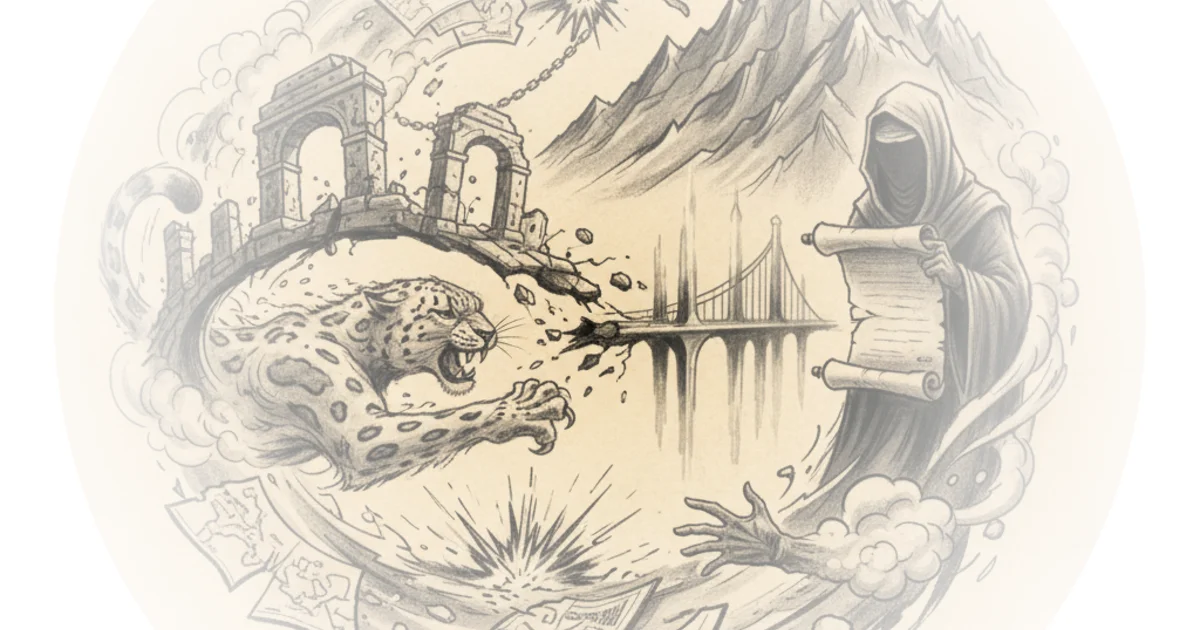
The report lays out how the Taliban government in Kabul has adopted a maximalist territorial position. Senior officials have publicly claimed Afghan territory extends to the Attock Bridge deep inside Pakistan, a claim that would redraw the map of South Asia. The Afghan interior ministry has stated plainly that the Durand Line "was imposed by force" and that the Taliban seeks "to reclaim the usurped territories." This is not ambiguity. It is a declaration of intent.
The TTP Problem Pakistan Cannot Ignore
At the center of the current crisis sits the Tehrik-i-Taliban Pakistan, or TTP, an anti-Pakistan militant organization that operates with significant autonomy from Afghan soil. The report documents how the Afghan Taliban provides the TTP with weapons, training, and safe havens in the eastern provinces of Kunar and Nangarhar, even as official Taliban spokespeople deny involvement.
TTP leaders have appeared openly at official events in the Afghan capital.
The numbers tell a grim story. More than 2,600 Pakistani security personnel have been killed in the last four years. By August 2025, Pakistan had changed its rules of engagement and launched a massive counterterrorism operation in its northwest. The implication is clear: Islamabad reached a tipping point where it concluded that diplomacy alone would not stop cross-border attacks.
The October 2025 escalation was qualitatively different from earlier skirmishes. After TTP militants ambushed Pakistani paramilitary troops on October 9th, Pakistan responded with airstrikes targeting senior TTP leaders believed to be sheltering in Kabul. The Afghan Taliban then retaliated directly against Pakistani border posts along the Durand Line, producing what the report describes as "the most intense skirmishes reported between the two sides since the Taliban retook control of Afghanistan in 2021."
The Irredentist Trap
One of the report's sharpest analytical contributions is its exposure of the logical contradictions in the Taliban's territorial claims. If Afghanistan can claim half of Pakistan's territory on ethnic grounds, the same logic would unravel Afghanistan itself. Roughly sixty percent of Afghanistan is inhabited by non-Pashtuns, including Persian, Tajik, Uzbek, and Turkmen communities, many of whom are themselves divided from ethnic kin across other borders.
If Afghanistan can claim half of Pakistan's territory on ethnic grounds, it inevitably raises questions about its own legitimacy since roughly 60% of Afghanistan is inhabited by non-Pashtuns.
This is the irredentist trap in its purest form. Ethno-nationalist claims, once made, cannot be contained. The Taliban envisions a Greater Afghanistan stretching to the Indus River and south to the sea, encompassing all Pashtun territories and the sparsely populated Balochistan province. The strategic logic is seductive: unite the Pashtun people into a dominant majority, gain access to the ocean, and escape landlocked isolation. But the report rightly notes that Pakistani Pashtuns show little interest in joining a state that ranks below Pakistan in every measurable metric of human development. As the analysis observes:
Pakistan has plenty of social and economic problems. But it's miles ahead of Afghanistan in all metrics.
There is a counterargument worth considering here. The Taliban's territorial rhetoric may be less about genuine territorial ambition and more about domestic legitimacy. Irredentist claims serve an internal political function: they rally nationalist sentiment, provide ideological coherence for a movement that must hold together fractious elements, and distract from the catastrophic governance failures that have left Afghanistan in economic collapse. The question is whether rhetoric intended for domestic consumption can be controlled once it produces real military escalation. The evidence from October suggests it cannot.
A Regional Chessboard with Too Many Players
The report sketches a geopolitical landscape of dizzying complexity. Qatar and Turkey brokered a ceasefire on October 19th, but it was already fraying within days. Saudi Arabia's mutual defense pact with Pakistan could draw Riyadh into the conflict. China, with enormous economic interests in Pakistani stability, has previously mediated between the two sides. The United States, with Trump expressing interest in Bagram Air Base, could re-enter Afghan affairs. And India, facing rare earth shortages due to Chinese export controls, sees opportunity in Afghanistan's mineral wealth.
The most provocative thread in this analysis concerns India. The Taliban's reimagined map of Afghanistan pointedly leaves the disputed Kashmir region entirely in India's hands. The Taliban's foreign minister visited India precisely as border clashes with Pakistan were escalating. Whether this represents coincidence or strategic alignment remains unclear, but the implication is striking: the Taliban may be positioning itself as a partner to India in a two-front pressure campaign against Pakistan.
India joining forces with the Taliban is not exactly a good look, and Pakistan could counteract by strengthening ties with Bangladesh or backing the revival of the Northern Alliance.
This observation deserves emphasis. Any India-Taliban alignment would be ideologically incoherent and historically bizarre, but geopolitics has never demanded ideological consistency. The risk is that such maneuvering produces not stability but a new fragile balance where layers of deterrence are stacked precariously on top of one another.
The Refugee Crisis No One Discusses
Buried in the report's opening is a fact that deserves far more attention: since 2025, between two and 3.4 million Afghan refugees have been deported from Iran and Pakistan. The United Nations has warned that this mass return is compounding instability in a country already crippled by economic collapse, food shortages, and weak governance. A government that cannot feed its people or provide basic services is simultaneously pursuing territorial expansion against a nuclear-armed neighbor. The disconnect between ambition and capacity is staggering, and it is the Afghan population that will bear the consequences.
Bottom Line
The Afghanistan-Pakistan conflict is not a border dispute that diplomacy can neatly resolve. It is the collision of an irredentist ideology with geopolitical reality, amplified by militant proxies that neither side fully controls. The Taliban's internal factionalism means it cannot credibly commit to restraining the TTP even if it wanted to, and Pakistan's patience has demonstrably run out. The ceasefire brokered in October is a pause, not a resolution. Afghanistan has not seen a single year of peace since 1978, and the current trajectory offers no reason to believe that streak will end. The Durand Line, drawn in twenty minutes by a colonial officer who never imagined it would still matter 132 years later, continues to exact its price in blood.