Most economic analysis treats inflation as a spreadsheet error—a mismatch of interest rates and money supply. Nate Hagens argues it is actually a biophysical reality check, a signal that our financial claims are colliding with the planet's hard limits. This perspective shifts the conversation from "how do we fix the numbers?" to "what happens when the energy required to sustain our complexity exceeds our capacity to extract it?"
The Biophysical Lens on Money
Hagens begins by dismantling the standard textbook definition of money. While economics teaches that money is a unit of account and a store of value, Hagens insists we must see it as "a claim on energy" and "an externalization of ecosystem costs." This reframing is crucial because it forces us to acknowledge that every dollar spent is essentially hiring an invisible energy worker. As Hagens writes, "When spent, every dollar hires an invisible energy worker that leaves a biophysical footprint." This is a powerful heuristic for busy readers: it connects abstract inflation directly to the physical world of mining, drilling, and logistics.
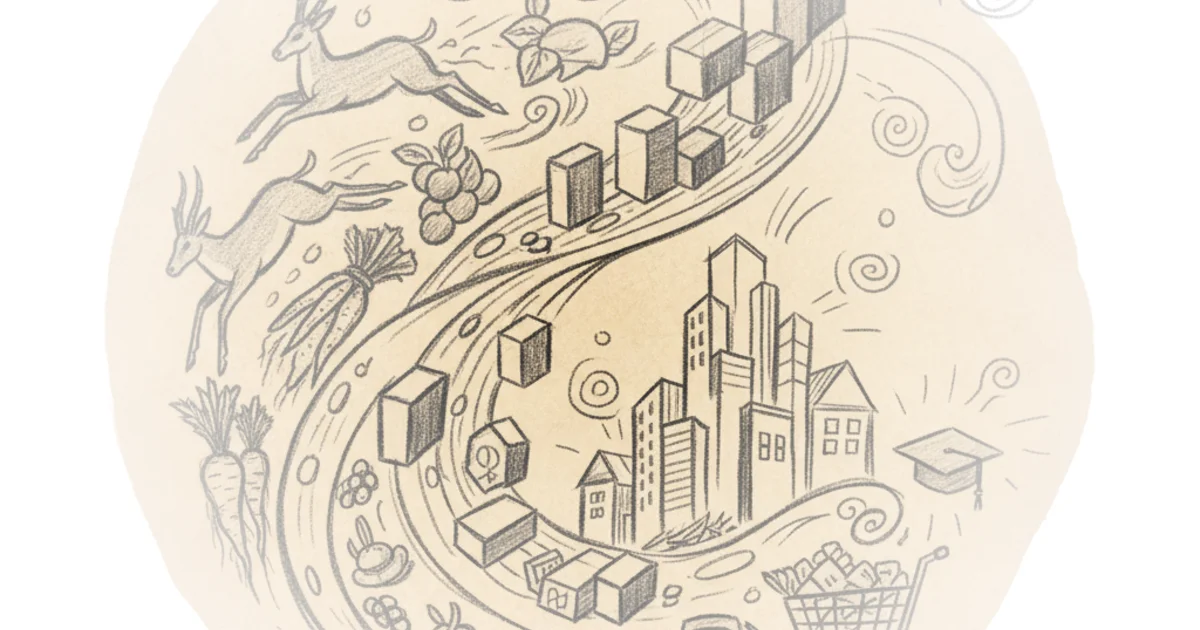
He argues that the modern economy has grown by printing money faster than we can extract resources, creating a dangerous disconnect. "Money acts as a current in the ocean of energy, materials, technology, leverage, ecosystems, and social contracts," he notes. The danger lies in the assumption that this current can flow forever without hitting a dam. Critics might argue that technology can decouple economic growth from resource use, but Hagens counters that we are currently fighting a losing battle against diminishing returns.
The Physics of Depletion
The article's most striking evidence comes from the history of copper mining in Butte, Montana. Hagens points out that in the 1800s, miners extracted ore that was 40% copper. By 1920, that figure had dropped to 4%, and today, it is down to 0.4%. "We have to grind up 10 times more ore to get a kilogram of copper," he explains. This is not just a statistic; it is the definition of inflation in a biophysical sense. As high-grade resources vanish, we must expend exponentially more energy to get the same output.
This dynamic mirrors the Jevons paradox, where efficiency gains often lead to increased consumption rather than conservation, further straining the system. Hagens writes, "When it costs more to obtain and process the raw resources, the prices of the end product inevitably goes up." The implication is stark: inflation is not a monetary glitch but a physical necessity. We are paying the bill for a century of easy energy, and the check is coming due.
Money is a social contract that relies on trust and shared values – a contract that will be increasingly stressed as a Great Simplification scenario approaches.
The Double-Edged Sword of Technology
Hagens offers a nuanced take on technology, challenging the assumption that innovation always lowers prices. While he admits that technology is usually deflationary—citing how televisions have become cheaper and more capable—he warns that this trend hits a wall when it collides with resource limits. "Technology tends to make replicable things cheaper until it collides with resource limits or shifts costs to energy-hungry infrastructure," he argues.
He uses Artificial Intelligence as a prime example of this friction. The massive data centers required for AI inference demand vast amounts of electricity, land, and cooling. If the grid cannot keep up, or if the energy required to build the infrastructure becomes too expensive, the deflationary promise of AI turns inflationary. This is a vital distinction for investors and policymakers who assume digital growth is cost-free. The physical world still demands a toll.
Affordability and the K-Shaped Reality
Beyond energy and resources, Hagens turns to the human element: affordability. He distinguishes between median and average income, noting that the "K-shaped economy" means large segments of the population are running out of financial dry powder. When people cannot afford basic goods, demand collapses, leading to deflationary pressure. "If a third to the half of the population can't afford basic things, the financial system itself would collapse," he warns.
This section highlights a critical vulnerability in the current system. Inequality is not just a social justice issue; it is an economic stability risk. As leverage unwinds and credit tightens, the "market price" becomes a meeting point that buyers can no longer reach. Hagens suggests that broad lack of affordability is deflationary, a force that could eventually crash asset prices and disrupt the flow of goods.
The Ecology of Complexity
Perhaps the most overlooked driver of prices is ecology. Hagens argues that nature is no longer an economic footnote but a central variable. Droughts, heat waves, and extreme weather events disrupt supply chains and strain energy grids. "Declining ecological stability in the 21st century will have an inflationary effect on prices," he states. The loss of free ecosystem services, like pollination and pest control, forces us to substitute them with expensive energy and chemicals.
This connects to the broader theme of complexity. As our global network of supply chains grows, the number of connections increases exponentially, requiring more energy to maintain. "What follows the increasing complexification of the last century is a simplification," Hagens predicts. The system is becoming too fragile to sustain its current level of interdependence. When a single node fails—a port closure, a refinery shutdown, a grid failure—the ripple effects are immediate and costly.
The Currency Crisis
Finally, Hagens addresses the container that holds all prices: the currency itself. He notes that currencies are human stories backed by trust, and historically, they last about 30 years. With the US dollar system now 80 years past Bretton Woods and 50 years past the gold standard, the assumptions of infinite energy and geopolitical stability are wobbly. "If those pillars wobble, trust in currency becomes something we took for granted," he writes.
He warns of a future where governments, unable to bail out failing systems, face a "too big to save" scenario. This could trigger hyperinflation, followed by a sharp deflationary reset. The transition would be painful, marking the end of an era where money could be printed without consequence. As Hagens puts it, "Eventually, instead of a 'too big to fail' situation like in 2009, we'll have a 'too big to save' situation."
Bottom Line
Hagens's strongest argument is the reframing of inflation as a biophysical constraint rather than a monetary error; it forces a reckoning with the energy reality underpinning our economy. Its biggest vulnerability is the lack of a concrete policy roadmap, leaving readers with a diagnosis of the crisis but no clear prescription for the transition. The reader should watch for how energy prices and supply chain fragility continue to drive inflation, signaling that the era of cheap complexity is ending.