Dave Amos confronts a haunting question facing modern urbanism: can a $2.3 billion transit cathedral function as a mere bus depot without becoming a monument to wasted potential? In a rare deep dive into the Salesforce Transit Center, Amos moves beyond the usual cost-benefit analysis to explore the eerie silence of a building designed for a future that has been delayed by decades. This is not just a review of architecture; it is an investigation into the risks of betting on infrastructure before the demand exists.
The Architecture of Anticipation
Amos begins by establishing the sheer scale of the facility, noting that it is "440 M long but only 50 m wide," a dimension that creates a unique, almost disorienting spatial experience. He describes the building as "inserted into the city separate from the normal building grain," a choice that highlights its isolation rather than its integration. The author's tour reveals a space that is undeniably beautiful but currently underutilized. "The bus level felt almost Eerie in its emptiness," Amos writes, capturing the dissonance between the facility's grandeur and its current reality as a terminus for buses alone.
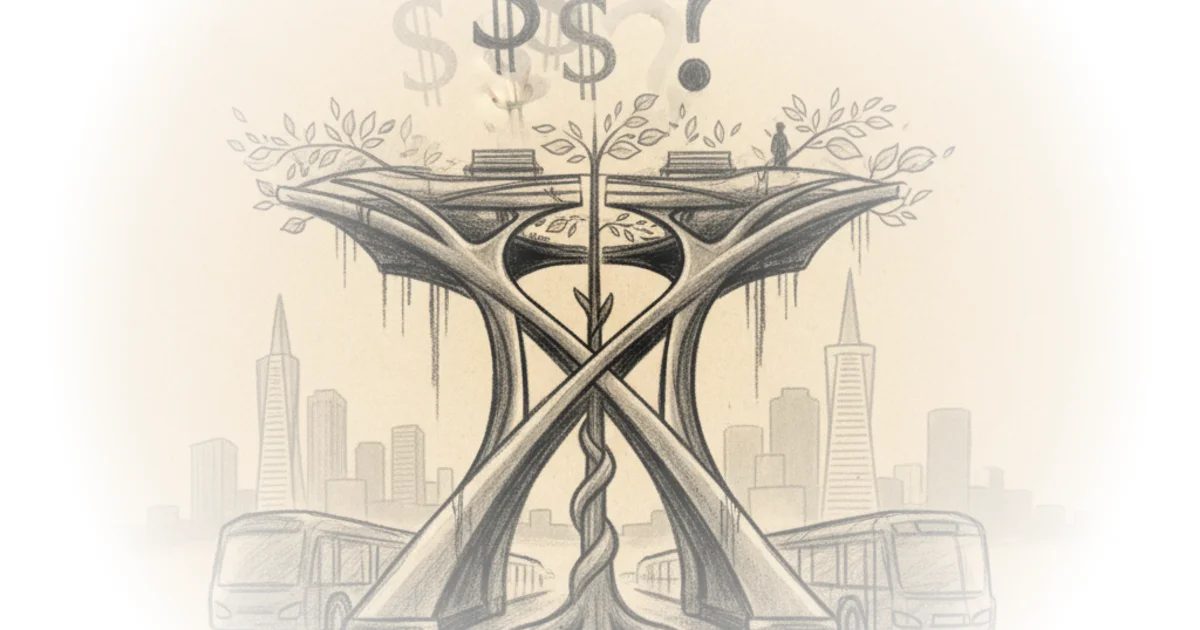
The commentary effectively uses the physical emptiness of the station to underscore the broader issue of timing in urban planning. Amos notes that while the station is "Miles better than the competition" compared to cramped terminals like Port Authority, it suffers from a lack of ridership that makes its pristine condition feel unsettling. He observes that "most of the board is used up by ads and announcements as there aren't many departures shown on the bottom half of the board," a visual metaphor for a system waiting for a train that hasn't arrived.
"It pretty much feels like a train station without any trains because that's literally what it is and if it never gets trains it will be a pretty massive disappointment especially in terms of money spent on this building."
Critics might argue that judging a transit hub by its immediate post-completion usage ignores the long lead times of regional rail projects. However, Amos's point stands: the financial and psychological weight of such a massive investment creates an expectation of immediate utility that the current administration and planning bodies have yet to meet.
The Naming Rights Dilemma
A significant portion of the analysis focuses on the commercialization of public space. Amos expresses a distinct discomfort with the naming rights deal, where the Joint Powers Authority sold the name to Salesforce for $110 million over 25 years. "I have a bit of a problem of selling naming rights to places like train stations," he argues, questioning the precedent of branding "Grand public buildings." He posits a rhetorical question that strikes at the heart of civic identity: "Can you imagine if Grand Central Station had a named sponsor or major public libraries?"
This framing is powerful because it elevates the debate from a simple transaction to a matter of civic dignity. By refusing to use the corporate name repeatedly, Amos forces the reader to consider the building on its own merits, separate from its corporate benefactor. The argument suggests that while corporate sponsorship may be the only way to fund such projects in the current fiscal climate, it comes at the cost of the station's perceived public ownership.
The Waiting Game: High-Speed Rail and Beyond
The core of the piece shifts to the future, where the station's fate hinges on the California High-Speed Rail project and the Link 21 initiative. Amos describes the underground "train box" as "roughly built out" and ready for platforms that won't be used until 2032, assuming the $6.7 billion extension from Fourth Street is completed on schedule. He remains cautiously optimistic, stating, "I think being a terminal station and what will be one of the best High-Speed Rail networks in the United States low bar I know could Elevate the station and make it feel almost like a bustling airport."
However, the analysis also exposes the fragmentation of regional transit planning. Amos points out that despite the station's proximity to BART and the Central Subway, there are "no direct transfers" to the transit center. The proposed second Trans Bay tube presents a complex dilemma: it could relieve congestion or connect the East Bay to Sacramento, but "currently there are only plans to build one tunnel." He notes the technical incompatibility between BART's wide gauge and standard commuter rail, forcing a choice between two transformative projects.
"The obvious answer here is to build two tunnels both would be hugely transformational for San Francisco and the entire Bay Area of course that's expensive so we'll see what happens."
This highlights a critical vulnerability in the region's planning: the inability to fund the full vision of connectivity. While Amos champions the boldness of the original design, the reality is that the station may remain a regional hub for buses and limited commuter rail for decades, rather than the intercity powerhouse it was envisioned to be.
Bottom Line
Amos's most compelling contribution is his refusal to dismiss the Transit Center as a failure simply because it is quiet; instead, he frames its silence as a symptom of a broken timeline between infrastructure delivery and regional integration. The argument's greatest strength is its human-scale observation of an empty hall, but its biggest vulnerability lies in the assumption that the political will to build the necessary rail connections will materialize by 2032. Readers should watch not just the construction progress, but the shifting political dynamics of the Bay Area's transit agencies, as the station's ultimate value depends entirely on the tunnels that may never be built.