This piece does something rare in contemporary discourse: it treats poverty not as a personal failure or a simple lack of income, but as a structural trap where a single misstep triggers an irreversible cascade of institutional penalties. While much of the global conversation fixates on the American "kill line," Sinification argues that China is quietly constructing its own version, one where the safety nets of the past are fraying just as the economic ground beneath the vulnerable shifts.
The Paradox of Control
The article's most provocative claim is that the very mechanisms designed to maintain social order can inadvertently cement destitution. Sinification reports, "systematic social control measures produce unintended consequences that trap individuals in persistent poverty." This reframing is crucial. It suggests that the problem isn't just a lack of money, but a "low fault tolerance" where minor financial shocks are amplified by rigid systems into life-altering crises.
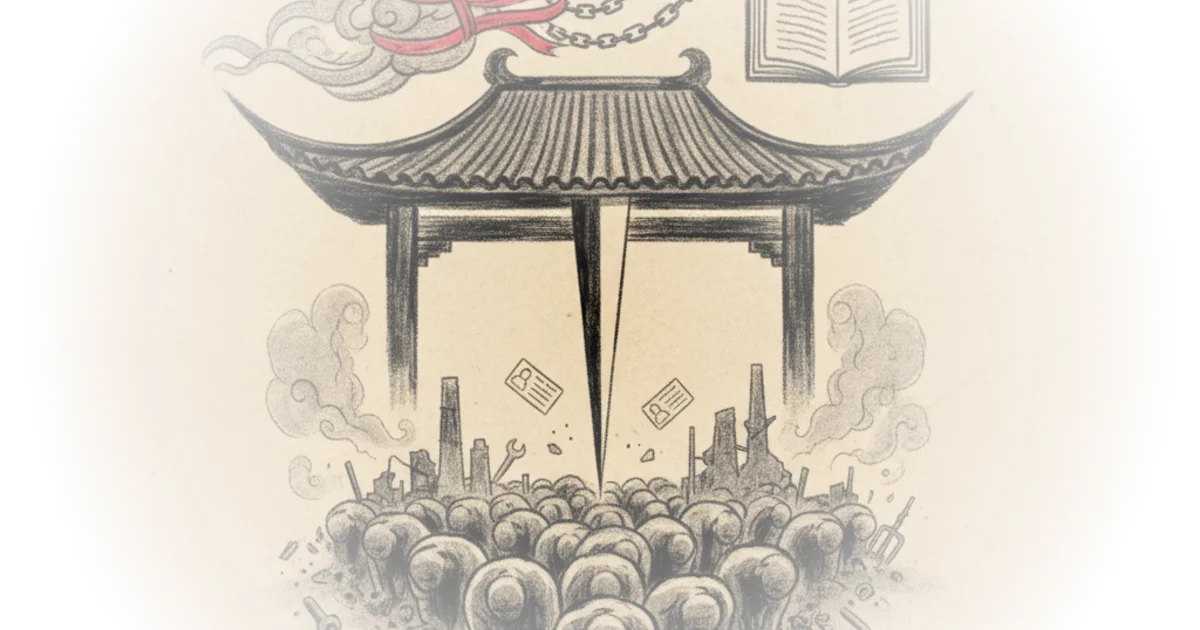
The piece draws a sharp contrast between the American and Chinese experiences. In the US, the "kill line" is often discussed through the lens of racial disparity and the ALICE demographic (Asset Limited, Income Constrained, and Employed). Sinification notes that in China, "poverty is not racially-based," but the outcome is similarly dire for those who lose their footing. The editors highlight a grim statistic: the number of urban recipients of the dibao (minimum livelihood guarantee) has plummeted from 23.5 million in 2009 to just 6.25 million in 2024. The system has shifted from supporting the merely poor to only the "totally needy, such as disabled people and elderly without other support." This contraction leaves a vast middle tier of the vulnerable with no buffer.
"Illness, unemployment, or unexpected expenses can push individuals below a critical threshold, triggering a chain of institutional consequences—damaged credit, eviction, unemployment—that make recovery almost impossible."
This observation lands with particular weight when considering the historical context of the hukou (household registration) system. For decades, the hukou and collective land ownership acted as a shock absorber, ensuring that rural migrants had a fallback. However, the article argues that rapid urbanization is eroding this safety valve. Landless farmers are often "undercompensated when land is requisitioned" and moved into high-rise housing where they are "left at a loss," with the countryside no longer serving as a viable "last-resort fallback."
The Erosion of the Fallback
The commentary also tackles the legacy of the massive state-owned enterprise (SOE) layoffs of the 1990s and early 2000s, a period that created the "new urban poor." Sinification pushes back against the idea that this crisis is in the past, noting that "up to sixty million workers were laid off" and their descendants remain trapped in unstable service work. The piece argues that the children of these workers face a future where they "are unlikely to be able to afford senior high school," creating a cycle of exclusion that education policy alone cannot fix.
Critics might note that the article's focus on structural rigidity underplays the resilience of informal economies and the role of family networks in China, which often step in where state support fails. However, the editors counter that these informal supports are increasingly strained by the same economic slowdowns affecting the formal sector.
The analysis of the second generation of urban residents is particularly nuanced. While their parents may have secured pensions, their children face a labor market that "cannot absorb even all those who graduated from good high schools and colleges." This creates a paradox where educational attainment no longer guarantees stability. As the piece observes, "Even during the earlier, free years of schooling, poor families are at a disadvantage, because they cannot afford the tutors that have become a necessity in China's highly competitive education system."
New Governance, Old Risks
In response to these deepening fissures, the administration is exploring restorative policies. The article highlights three specific initiatives: the revival of the "Fengqiao experience" for dispute mediation, the sealing of public security violation records, and personal credit rehabilitation. These measures aim to provide a "buffer zone" for those on the brink. Sinification reports that the goal is to "loosen structural constraints and to provide individuals who have temporarily fallen into hardship with a buffer zone and an opportunity for a fresh start."
Yet, the editors express deep skepticism about whether these measures can succeed in the current climate. They warn that "prevailing views in favour of harsh punishment risk undermining these efforts." There is a palpable tension between the state's desire for social stability and a public discourse that often demands "severe punishment" for minor infractions. The piece argues that "the perceived inconsistency of policies could damage government credibility, weakening policy authority and enforceability."
"Good intentions require solid social consensus: broader public discussion and precise policy communication can clear the cognitive barriers to these necessary governance reforms."
This is the crux of the argument. Without a shift in public sentiment and a genuine commitment to implementation, these new policies may remain theoretical. The article suggests that the "kill line" is not just a financial threshold but a governance failure where the system punishes the vulnerable for being vulnerable.
Bottom Line
The strongest part of this analysis is its refusal to treat poverty as an isolated economic event, instead exposing how institutional rigidity transforms a bad day into a permanent condition. Its biggest vulnerability lies in the uncertainty of whether the state can successfully pivot from a culture of punishment to one of rehabilitation without significant political cost. Readers should watch closely to see if the credit rehabilitation and record-sealing policies are implemented with the breadth required to actually alter the trajectory of China's urban poor, or if they remain symbolic gestures in a tightening system.