Rafael Holmberg delivers a jarring diagnosis of our current moment: the obsession with individual psychology is not a path to understanding, but a sophisticated mechanism designed to protect the global economic system from scrutiny. In an era where headlines fixate on the personality disorders of leaders and the 'madness' of isolated actors, Holmberg argues we are missing the forest for the trees, using the human mind as a scapegoat to avoid confronting the structural rot of late-stage capitalism.
The Fossilized Future
Holmberg begins by tracing a deep cultural irony, drawing on the work of Jean Baudrillard to describe a society that is simultaneously obsessed with history and actively erasing it. "The irony of the postmodern age, for Baudrillard, is its obsession with cultural heritage at the same time as it invents increasingly advanced ways of destroying any remnants of culture," Holmberg writes. He suggests that our modern fascination with ancient mysteries—lost cities, alien visitors, or tectonic shifts—is not genuine curiosity, but a form of denial. We are so terrified of the future that we retreat into a reconstructed past, turning history into a commodity that can be consumed without challenging our present reality.
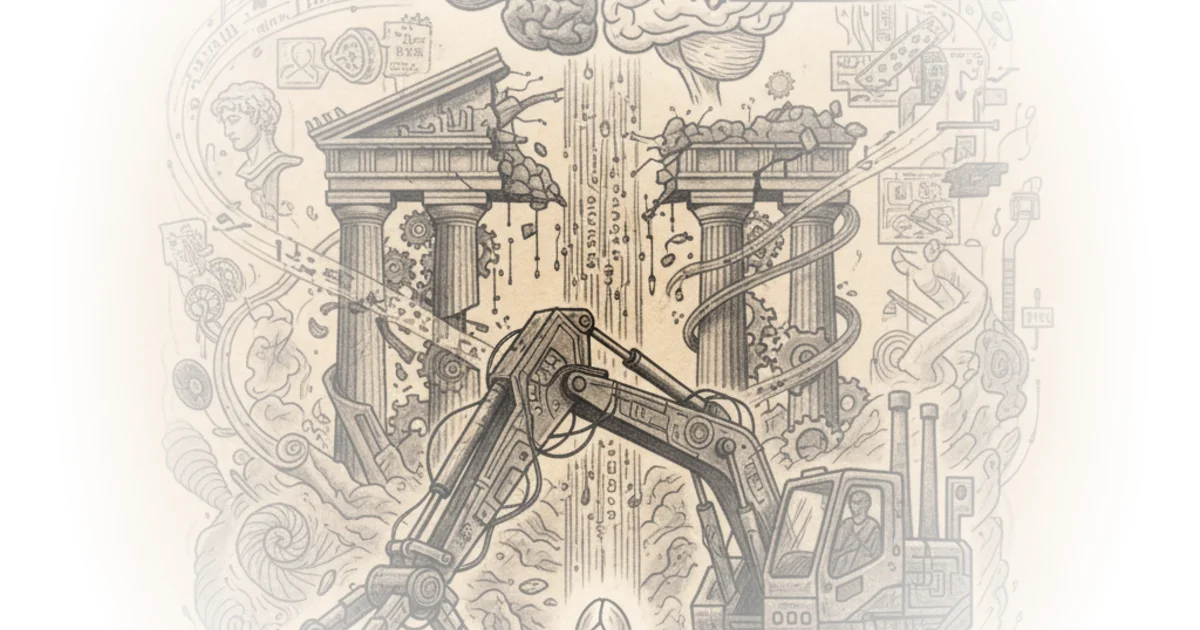
This fixation, which Holmberg terms the "fetish for fossils," serves a specific function: it allows us to disavow the possibility of a true catastrophe. "Behind the fossil we find not only the cancellation of the future, but the destruction of the past," he argues. By treating the end of things as a pre-configured plot point or a manageable event, we neutralize the threat. The author posits that even the apparent collapse of global interdependence, often attributed to recent tariff policies and protectionist shifts, is merely a recalibration rather than a true rupture. "Trump does not denounce global capitalism, he simply wants it to work more in his favour," Holmberg notes, reframing the political drama as a mere adjustment within the same exploitative system. This is a sharp, necessary correction to the narrative that any single administration can fundamentally alter the trajectory of global capital.
Critics might argue that this view reduces all political agency to a predetermined script, potentially absolving specific actors of the unique damage they cause. However, Holmberg's point is not that individuals lack impact, but that the system is robust enough to absorb and repurpose even its most aggressive critics.
Whatever we mean by the end, then, it is figured only whilst being simultaneously mis-figured.
The Cinema of Distraction
To illustrate how we digest the unthinkable, Holmberg turns to an unlikely source: the Transformers film franchise. He finds a profound metaphor in the way these movies present alien civilizations that are simultaneously incomprehensible and entirely familiar. The alien robots, who could represent a total external limit to human understanding, are instead rendered as cars, planes, and helicopters—forms of human industry. "The limit of humanity can only be framed as a mode or expression of humanity itself," Holmberg observes. The films suggest that even the destruction of human civilization is just a prelude to a "proper" civilization, effectively sanitizing the concept of an end.
This cinematic sleight of hand mirrors our political reality. We see a threat, but we immediately reframe it as something internal, something we can manage. The narrative that the end of the world is just a plot twist in a larger story allows us to sleep at night. Holmberg writes, "In the very moment that a limit is recognised, we displace it and fixate on something adjacent to this limit, something that conceals this limit." This is a powerful way to describe how we process existential dread, turning potential disasters into digestible entertainment or manageable policy adjustments.
The Psychology of Denial
The core of Holmberg's argument lands hardest when he applies this logic to our modern obsession with psychology. He contends that the field has become the ultimate "fetish-object," a distraction that allows us to blame individuals rather than systems. "Psychology does not simply investigate individual human behaviour within a greater social setting. It fixates on the individual so that it doesn't have to confront the social," he writes. By pathologizing leaders or criminals, we create a false binary: a healthy, functional society disrupted by a few "deranged" minds.
Holmberg dismantles the common comparison between the 2008 financial crisis and recent economic instability. While the former is often seen as an impersonal systemic failure, the latter is frequently blamed on the personal instability of specific figures. "Trump's psychology is as much a factor of a generalised financial system as the 2008 crash," Holmberg asserts. "The fact that a single man can cause so much economic instability speaks less about the man himself, than the fact that the system as a whole was not stable in the first place." This is a crucial insight. Blaming the individual's mental state is a convenient way to preserve the illusion that the economic machinery itself is sound.
We would prefer to think mankind as flawed rather than think the system in which he operates as flawed.
The author extends this critique to the popular consumption of true crime and serial killer documentaries. These stories, he argues, are not about justice; they are about maintaining the fiction of a functional social body. "The serial killer is required as the 'internal outsider' producing the illusion of an otherwise functional population," Holmberg explains. By isolating violence in the minds of a few "monsters," we protect the idea that the rest of society is innocent and the system is working as intended.
A counterargument worth considering is that psychology does offer genuine tools for healing and understanding individual trauma, and dismissing it entirely as an ideological tool risks ignoring real human suffering. Holmberg acknowledges this tension but insists that the systemic application of psychology is the problem, not the science itself. The issue is how it is used to deflect from the economic conditions that generate that suffering in the first place.
The Political Nature of Madness
Holmberg concludes by invoking the work of Gilles Deleuze and Mark Fisher to reframe mental illness not as a biochemical glitch, but as a political category. The proliferation of diagnoses like ADHD, depression, and anxiety, he suggests, is a direct result of the "faulty cognitive feedback systems" of late capitalism. "Psychology, it is claimed, explains human behaviour, and since psychology does not ask any economic questions, we conclude that economics can be disregarded," he writes. This separation is, in his view, the ultimate convenience for aggressive economic practices. By framing people as faulty objects of study, the system avoids asking why it is producing so many broken people.
The piece ends with a call to action that is as radical as it is necessary: "In order to really make sense of people in the 21st century, psychology should be dethroned, and exposed for the ideological function that it really provides for the status quo." This is a bold challenge to the reader to stop looking for the villain in the mirror and start looking at the structure of the room.
Bottom Line
Holmberg's argument is a masterful deconstruction of how we use individual psychology to shield ourselves from the terrifying reality of a failing global system. Its greatest strength lies in connecting disparate phenomena—from ancient history to blockbuster movies to mental health trends—into a single, coherent critique of capitalist denial. The biggest vulnerability is its tendency to view all psychological inquiry through a purely ideological lens, which may overlook the genuine, non-political struggles of individuals. However, as a corrective to the prevailing narrative that blames personalities for systemic collapse, this piece is essential reading for anyone trying to see the world clearly.