Razib Khan challenges a modern cultural ritual by asking a radical question: what if the people we call "indigenous" are actually the most recent arrivals in a long line of population replacements? By applying the lens of ancient DNA to the history of Greenland, he reveals that the ancestors of today's Inuit did not simply coexist with earlier Europeans or Paleo-Eskimos; they completely supplanted them. This is not just a history lesson; it is a genomic reality check that forces us to reconsider the very definition of "native" in an era obsessed with land acknowledgments.
The Myth of the Eternal Native
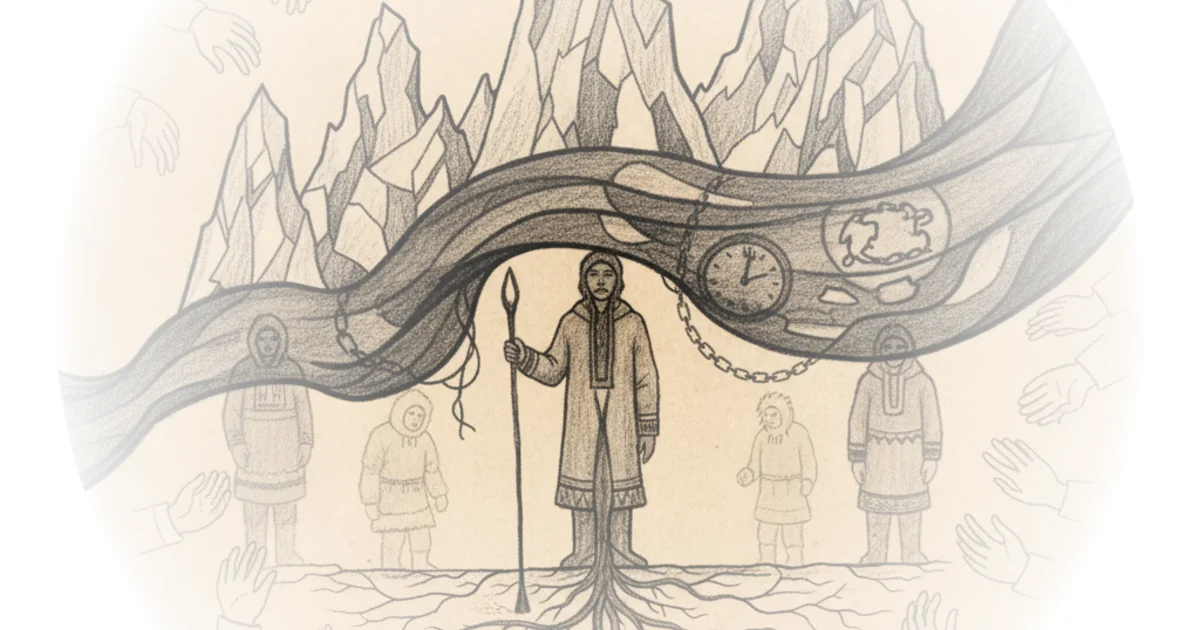
Khan opens by critiquing the somber ceremonies common in left-leaning American circles, where officials acknowledge the "inherent sovereignty of indigenous people" who resided in a locale "since time immemorial." He argues that this self-seriousness flourishes in North America precisely because the continent has "as few layers of human churn and conquest" as any place on Earth. The core of his argument is that modern genomics has shattered the idea of static populations. He writes, "What if a people whose genetic close kin we are accustomed to regarding as marginal or indigenous... are the usurpers?" This framing is provocative because it inverts the standard narrative of victimhood and displacement, suggesting instead that human history is defined by a relentless cycle of replacement driven by superior toolkits rather than racial destiny.
What if those vanished early inhabitants are Europeans? And what if when the dust settles, we see that the commonality of these johnny-come-latelies who out-compete long-time inhabitants and master a new locale, is not race, continent of origin or bellicosity, but simply an upgraded toolkit that runs circles around that of the locals'?
The strength of this section lies in its refusal to moralize the replacement. Khan presents the data coldly: the ancestors of modern Greenlanders arrived last and are the last ones standing. Critics might argue that equating biological replacement with modern political claims to land ignores the cultural continuity that defines indigenous identity, regardless of genetic turnover. However, Khan's point is that the biological "native" status is far more fluid than our current political discourse admits.
The Greenhouse and the Glacier
To illustrate this, Khan turns to Greenland, a place where the climate itself has dictated the rhythm of human survival. He details the arrival of the Norse in 982 AD, led by Erik the Red, who established settlements during the Medieval Climate Optimum, a period of warmer temperatures that began in 950 AD. This timing was fortuitous, allowing the Norse to survive where earlier Paleo-Eskimo cultures had failed. Yet, Khan notes that the Norse were not the first; humans had occupied Greenland since at least 2500 BC. The Saqqaq culture, part of the "small tools tradition," had migrated from Siberia 5,000 years ago, only to vanish without leaving a genetic legacy.
As Khan puts it, "The Norse were actually newcomers in a land haunted by the remains of earlier peoples who had not been extirpated by fellow humans, but repulsed by the harshness of the unforgiving terrain itself." This distinction is crucial. The first wave of humans was wiped out by the environment, not by the second wave. But the third wave, the Thule culture (ancestors of the modern Inuit), arrived with a different strategy. They were whale hunters who flourished in colder temperatures after 1400, eventually dominating the polar world.
In 1408, Thorsteinn Ólafsson and Sigríður Björnsdóttir, were joined as man and wife at Hvalsey Church... Their nuptials mark the last written record of Europeans in Greenland before the modern era.
The story of the Hvalsey Church wedding serves as a poignant bookend to the Norse experiment. While the couple returned to Iceland, the community they left behind slowly faded, their genetic signature erased by the incoming Thule people. Khan emphasizes that the Thule did not just coexist with the Dorset people (the successors to the Saqqaq); they replaced them entirely. The Dorset, described in Norse sagas as "Skræling," were a "shadowy menace" but ultimately left no descendants in modern Greenland.
The Genomic Revolution
The piece's most compelling evidence comes from the field of paleogenomics, which Khan describes as having "anticipated a later key pattern gleaned from ancient DNA again and again: modern humans tend to replace each other with incredible regularity." He highlights the 2010 sequencing of a Saqqaq individual, the first ancient human genome ever fully sequenced. The results were startling: the Saqqaq person was not ancestral to modern Greenlanders. Instead, his closest genetic matches were found among the Chukchi and Koryak minorities in northeastern Siberia.
Khan writes, "The Saqqaq, and their Dorset descendants are both genetically entirely unconnected to the Amerindians of North America to their south, and, surprisingly also to the Thule culture that would eventually supersede them." This genetic discontinuity is the smoking gun. It proves that the "indigenous" label is not a permanent biological state but a snapshot of the most recent successful migration. The Saqqaq people left their artifacts but not their genes. The same pattern occurred south of the Arctic, where the Beringian wave nearly erased earlier genetic signatures 15,000 years ago.
By and large the earlier peoples left their artifacts, not their genes.
This finding complicates the narrative of continuous heritage. Khan notes that while the Clovis culture was once thought to be the single pulse of settlement, new evidence shows multiple waves, yet the pattern of replacement remains consistent. The Inuit, who speak Eskaleut languages distinct from the Na-Dene languages of the interior, represent a distinct expansion that swept across the Arctic, leaving the Dorset and Norse in the dust. The fact that the Yupik people expanded into Asia as well, with thousands of Siberian Yupik living in Russia, underscores the circumpolar nature of this migration. Khan argues that the "fully circumpolar world whose extent we are only just beginning to fathom" is a reality of human movement, not a static map of ancient rights.
Bottom Line
Razib Khan's argument is a powerful corrective to the romanticized view of indigenous continuity, using the hard evidence of DNA to show that "native" is often just a synonym for "most recent successful invader." The piece's greatest strength is its refusal to let sentiment override data, forcing readers to confront the brutal efficiency of human population dynamics. Its vulnerability, however, lies in potentially reducing complex cultural identities to mere genetic turnover, risking the erasure of the cultural resilience that defines modern indigenous communities despite these historical shifts.
What if a people whose genetic close kin we are accustomed to regarding as marginal or indigenous... are the usurpers? What if they arrive last and are the last men standing?