This piece from Sinification cuts through the noise of daily headlines to offer a chillingly clear-eyed forecast: the world is not moving toward multipolarity, but hardening into a rigid, US-China bipolarity that will define the next decade. What makes this analysis urgent is its refusal to treat the current fragmentation as a temporary glitch; instead, it frames the "counter-globalisation order" as a deliberate, escalating phase that will peak before a potential moral reckoning in 2035. For busy leaders trying to navigate supply chains and digital standards, the argument that cyberspace has superseded physical territory as the primary geopolitical arena is not just theory—it is the new operating system for global risk.
The Anatomy of a New Bipolarity
The editors at Sinification anchor their forecast in the work of Yan Xuetong, a scholar who straddles the line between nationalist conviction and empirical realism. The piece argues that by 2035, the global economy will bifurcate not by ideology, but by function: "The US will maintain an overall lead, dominating cyberspace, services and international influence, whilst China will dominate the physical economy, manufacturing and military scale." This is a stark departure from the "multipolar" narratives often favored by middle powers hoping to play both sides.
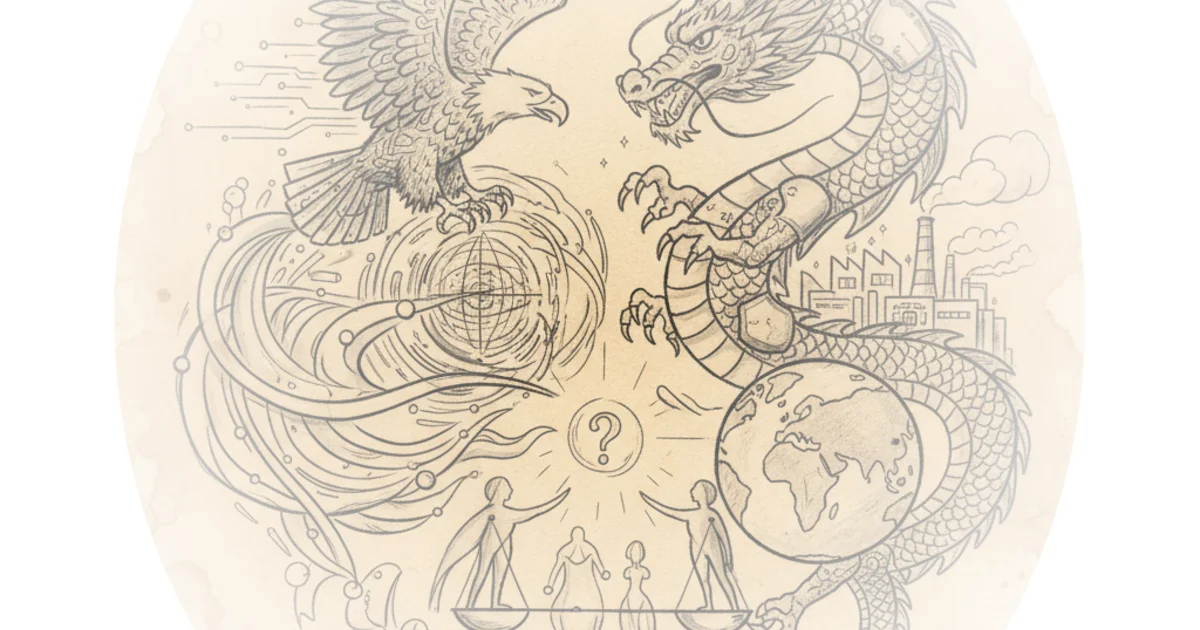
The analysis suggests that the current era of populism and protectionism is not an aberration but a structural feature of the coming decade. Sinification reports that "fuelled by populism, trade protectionism and the normalisation of 'might makes right', the current 'counter-globalisation order' will reach its peak during the second Trump administration." While the article avoids focusing on the personality of the executive, it correctly identifies the institutional dynamics: a shift toward "club-style" coordination where states retreat from universal rules into exclusive, security-first blocs.
"Cyberspace will supersede physical territory as the primary geopolitical arena, stratifying the globe into three tiers: intelligent technology standard-setters (the US and China), innovators and AI application economies."
This stratification mirrors the logic of the Club of Rome's earlier warnings about resource constraints, but here the constraint is digital sovereignty. The piece notes that the mutual estrangement of US and Chinese research sectors will create "two distinct global digital standards and market spheres." This is a critical insight for any organization relying on cross-border data flows; the "internet of things" is becoming the "internet of things" and the "internet of things," with no bridge in between.
Critics might argue that this binary view underestimates the resilience of the European Union or the rise of India as a true third pole. However, the article counters this by predicting that middle powers will reject ideological camps in favor of "issue-based alignment," a pragmatic hedging that ultimately reinforces the superpower duopoly rather than breaking it.
The Paradox of Moral Realism
The most intellectually rigorous part of the commentary is its dissection of Yan Xuetong's "moral realism." The piece highlights a fascinating tension: Yan is a self-identifying nationalist who nonetheless believes that a hegemon's longevity depends on adhering to rules. "From the philosopher Xunzi, he derives the broadly applicable idea that when a hegemon largely abides by the rules it sets for the international system (the 'humane way'), its system will be more resilient than one in which it habitually breaks those rules."
This framework forces a difficult question: if the US is seen as breaking its own rules through populism, and China is seen as contesting the liberal order through state capitalism, who holds the moral high ground? Sinification notes that Yan identifies "domestic populist trends" as a major obstacle to China's rise, including the protectionist impulse to shield "national industries" and the desire to defend national culture against "foreign invasion."
"The research of American scholars is mainly concerned with the means of stabilising hegemony—in fact, many Chinese scholars also conduct research on hegemony from this point of view. I lead my PhD students in researching how hegemony declines, and how it is replaced."
This quote captures the scholar's unique position: he is not trying to overthrow the system in the name of chaos, but to understand the mechanics of its replacement. Yet, the piece points out a blind spot. Yan classifies behaviors like "using sovereignty to negate human rights" and "invoking 'economic security' to justify protectionism" as populist, yet these are precisely the tools China has used to contest the liberal order. The article suggests that Yan's "moral realist" prescription is a "tricky intellectual balancing act" that often relies on tacitly liberal assumptions while trying to avoid the label of liberalism.
The editors observe that Yan's recent work has shifted from a confident blueprint for China's rise to a strategy of "waiting out its disorder." He warns against falling into a "leadership trap," where a nation takes on global responsibilities before it has the material strength or international trust to sustain them. This is a sobering admission that the "rise" is not a straight line, but a precarious climb fraught with internal entropy.
"Rather than outlining a clear moral purpose for China on the world stage, his new book portrays international tensions as a struggle between the liberal defenders of the established order and the populist detractors who would tear it down."
This reframing is significant. It suggests that the next decade will not be a battle of civilizations, but a battle of system maintenance versus system decay. The "entropy" of the current order, driven by a lack of active leadership, may create the vacuum that eventually demands a new international order grounded in "basic moral principles."
The Digital Frontier and the Cost of Fragmentation
The piece makes a grim prediction about the nature of future conflict. "The growing lethality of intelligent weapons, combined with nuclear deterrence, will constrain major powers to cyber operations." This implies a future where the most devastating battles are fought not with tanks, but with code, and where the "lower immediate lethality" of cyberattacks paradoxically leads to a higher frequency of conflict.
Sinification argues that China must transition its diplomatic focus to this digital realm, encouraging enterprises to "go out" via a "produce locally, consume locally" model to bypass protectionism. This is a strategic pivot that acknowledges the reality of a fractured global market. The article notes that the US is increasingly mimicking Chinese industrial policy, leading to a pattern of "homogenised development" where both superpowers adopt similar tools of statecraft, even as they compete.
"AI-driven excess production and entrenched protectionism will fracture global markets, pushing states towards 'club-style' coordination and cause a long-term shift away from the dollar towards gold and other currencies."
This potential shift away from the dollar is perhaps the most financially disruptive prediction in the piece. It suggests that the financial architecture of the last century is already cracking under the weight of geopolitical distrust. The reference to "digital sovereignty" here is not just about data privacy; it is about the very currency of international trade.
Critics might note that a shift away from the dollar is a slow-moving train, and the network effects of the US financial system are deeply entrenched. However, the piece's argument that "middle powers" will increasingly hedge their bets suggests that the erosion of trust is already underway, driven by the normalization of "might makes right."
Bottom Line
The strongest element of this analysis is its rejection of the comforting narrative that the world will naturally drift toward a stable multipolarity; instead, it presents a future of hardened, functional bipolarity where the US and China dominate distinct spheres of influence. Its biggest vulnerability lies in the ambiguity of Yan Xuetong's "moral realism," which struggles to reconcile China's illiberal domestic practices with the universal moral principles required to lead a new global order. Readers should watch for the "issue-based alignment" of middle powers like India and the EU, as their ability to navigate between these two ecosystems will determine whether the "counter-globalisation order" peaks and collapses or calcifies into a permanent new normal.