Tim Mak uncovers a silent, submerged catastrophe waiting to happen: the very waters where Kyiv residents seek escape harbor a radioactive time bomb, destabilized not by nature, but by the calculus of modern warfare. While the world watches the front lines, Mak directs our gaze to the Kyiv Reservoir, arguing that the war's most enduring threat may not be the next missile strike, but the potential reactivation of Chornobyl's legacy through the destruction of a single dam.
The Sediment That Never Left
Mak's narrative begins not with a geopolitical analysis, but with the intimate, quiet life of Yana Antoniuk, a local accountant who treats the Kyiv Sea as her substitute for the lost Black Sea coast. This human anchor is crucial; it grounds the abstract horror of radiation in the daily reality of a population trying to find normalcy. Mak writes, "The Kyiv Reservoir is part of the Dnipro River cascade, a water source for millions of people, and an ecosystem that stretches to the Black Sea across several countries." By establishing the reservoir as a lifeline rather than just a scenic backdrop, he immediately raises the stakes of any potential disruption.
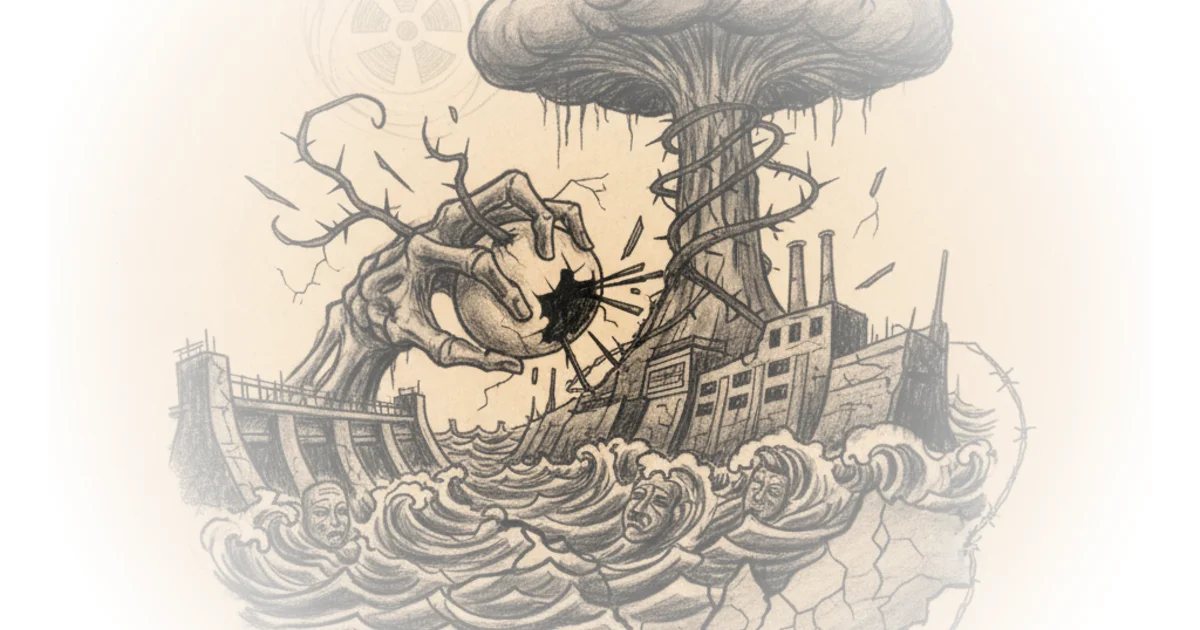
The core of Mak's argument rests on a terrifying geological fact: the radioactive dust from the 1986 Chornobyl disaster did not vanish; it settled. As Mak explains, "What settled over the water fell into rivers and ended up in the Dnipro River cascade. The Pripyat River, which flows through the exclusion zone, carried the contamination directly into the Kyiv Reservoir. There, the particles settled to the bottom and remained there." This is not merely historical trivia; it is a dormant hazard. The author effectively reframes the reservoir's bottom as a containment vessel that is currently holding back a toxic history.
Official sources say there is no cause for concern as long as the sediment remains at the bottom. The main thing is to not disturb it. But the war poses a particular threat to the stability of radioactive sediments.
Mak's framing is sharp here. He contrasts the official reassurance of stability with the violent reality of the conflict. The argument holds significant weight because it relies on the physics of the situation rather than speculation. If the Vyshhorod Hydroelectric Power Plant dam, which holds back this reservoir, were to collapse, the containment strategy fails. Mak notes that in 2024, Russian forces already struck this specific dam, proving the vulnerability is not theoretical.
The Precedent of Kakhovka and the Risk of Dredging
To illustrate the magnitude of the threat, Mak draws a chilling parallel to the destruction of the Kakhovka Dam in 2023. He details how that catastrophe released 83,000 tons of heavy metals, but he makes a critical distinction that elevates the current risk: the Kakhovka reservoir did not contain Chornobyl-level sediment, whereas the Kyiv Reservoir does. "The stronger and faster the current, the more contaminated silt it can transport hundreds of kilometers in a short time," Mak writes, invoking the mechanism that spread cesium and strontium to the Black Sea in 1986.
This section is particularly effective because it anticipates the counterargument that the risk is manageable. Mak points out that even peaceful, non-military interventions have been deemed too dangerous. He references an independent study by the French organization ACRO, which found that "28 million people downstream, who depend on the Dnipro for water and food, could face increased radiation risks if dredging continued." This historical precedent of halting dredging to protect public health underscores that the international community already recognizes the fragility of these sediments. War, however, introduces a "far more violent kind of disturbance" that no safety protocol can mitigate.
Critics might argue that the probability of a total dam collapse remains low compared to other battlefield risks, and that focusing on this possibility could induce unnecessary panic among a population already suffering from war fatigue. However, Mak counters this by highlighting the catastrophic irreversibility of the event. Once the sediment is stirred, the contamination enters the food chain and the water supply in a way that cannot be undone.
The Human Cost of Invisible Radiation
Mak shifts the focus from the physics of the dam to the biology of the human body, a move that personalizes the long-term consequences. He introduces Professor Timothy Mousseau, a leading expert on Chornobyl's biological effects, to explain the insidious nature of the threat. Mousseau warns that if the dam were destroyed, it would "dramatically increase the water flow from the Chornobyl region, stir up the sediments, and have the possibility of moving these radioactive sediments closer to Kyiv."
The author does not shy away from the grim medical reality. Mak paraphrases the expert consensus on how cesium and strontium behave once ingested: cesium distributes in muscles, while strontium lodges in bones and teeth, emitting radiation from within for years. "Ultimately, they will end up in humans, causing a slow accumulation of radiation exposure," Mak writes. This is a profound shift from the immediate violence of explosions to the slow, silent violence of cancer and genetic damage.
"People make use of the river to irrigate agricultural fields, for drinking water, and to recharge aquifers. The potential for increased radioactivity in agricultural products — the wheat and other crops — is a concern."
This quote encapsulates the breadth of the disaster. It is not just about water; it is about the soil, the crops, the livestock, and the children who are most vulnerable. Mak notes that children face higher risks because their cells divide more rapidly, and pregnant women face risks to the fetus. By weaving these biological facts into the narrative of a mother like Yana, who buys iodine supplements "just in case," Mak creates a powerful emotional resonance. Yana's resignation—"I usually don't even leave Kyiv; I go to the beaches here. But if I do manage to get away, the Kyiv Sea is truly the best place"—highlights the tragic lack of alternatives for civilians.
The Data Gap and the Future
The piece concludes with a sobering admission of uncertainty. Despite the clear dangers, Mak notes that "We have insufficient information. It has not been sufficiently studied." This lack of data is not a gap in knowledge but a gap in safety. Mousseau's warning, "Unfortunately, we got used to risks. But you can never know too much and relax," serves as a final plea for vigilance.
Mak's coverage is distinguished by its refusal to treat the war as a series of isolated military events. Instead, he presents it as a systemic threat to the environment and public health that will outlast the current conflict. The argument is strengthened by the juxtaposition of Yana's desire for peace with the lethal reality beneath her feet. While the article focuses on the Russian threat to the dam, the broader implication is that the conflict has turned the entire Dnipro ecosystem into a potential weapon.
Bottom Line
Tim Mak's most compelling contribution is his ability to translate complex radiological risks into a narrative of immediate human vulnerability, proving that the war's most dangerous legacy may be the water we drink and the food we eat. The piece's greatest strength is its reliance on the Kakhovka precedent and the biological reality of sediment transport, though it rightly acknowledges that the lack of real-time data leaves the exact scale of the potential disaster unknown. Readers must watch for the stability of the Vyshhorod dam, as its integrity is now the single most critical factor in preventing a secondary Chornobyl catastrophe.