In a geopolitical landscape saturated with alarmist rhetoric, Burning Archive delivers a startling counter-narrative: the dominant Western fear of an inevitable Russian invasion is not a strategic assessment, but a historical distortion. While intelligence chiefs warn of an "interlocking web of security challenges," this piece argues that the "spectre" haunting NATO is a self-fulfilling prophecy rooted in imperial anxiety rather than Russian reality. For leaders and analysts tired of the endless cycle of escalation, this analysis offers a necessary, if uncomfortable, pause to examine the actual history of Russian statecraft versus the fever dreams of the West.
The Architecture of Fear
Burning Archive begins by dissecting the recent rhetoric of Blaise Metreweli, Britain's newly appointed spy chief, whose December 2025 speech framed Russia as a "spider at the centre of an interlocking web of security challenges." The author argues that this language is not merely descriptive but constitutive of a specific doctrine. "Her artfully articulated fears were more than lurid propaganda. They were the chiselled certainties of the NATO doctrine of permanent attrition war," Burning Archive writes. This framing is crucial because it shifts the debate from whether Russia will attack to why the West is so invested in believing they will.
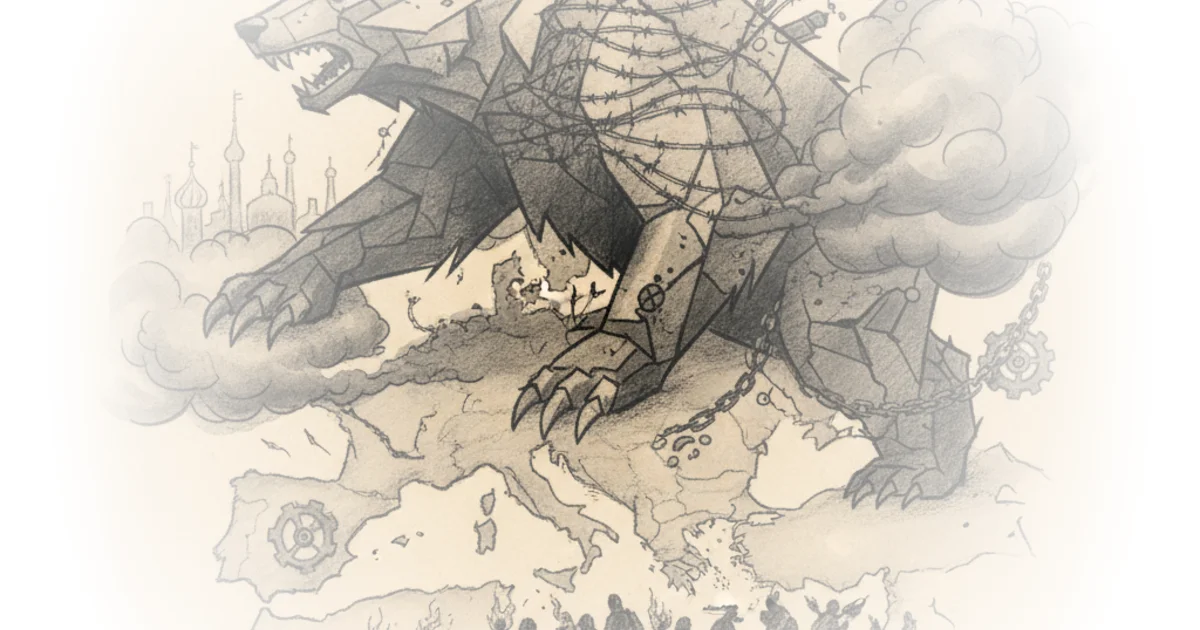
The commentary suggests that the current security architecture is built on the export of chaos, a concept Metreweli explicitly endorsed. "The export of chaos is a feature not a bug in this Russian approach to international engagement," the spy chief claimed. Burning Archive turns this assertion on its head, noting that the projection of "permanent grey zone war" onto Moscow serves to justify limitless Western military spending and internal repression. The piece highlights how this narrative has already begun to silence dissent, pointing to the sanctions against Swiss Colonel Jacques Baud for simply documenting that the war in Ukraine was not an unprovoked invasion. "He must be punished. He undermined the fear campaign of the Russia Anxiety," the author observes, noting that the West is punishing those who challenge the central historical assumption that Russia is inherently bent on dominance.
The invader obsession pays no heed to practical realities. It is as much a fevered projection as the British invention of the 'Great Game' of the nineteenth century.
Critics might argue that dismissing the "grey zone" tactics as mere projection ignores the tangible hybrid warfare Russia has employed. However, Burning Archive contends that the Western response often exaggerates these threats into existential crises, a pattern reminiscent of the 19th-century British obsession with a Russian invasion of India—a threat that never materialized because the logistical reality of marching troops over the Himalayas made it impossible.
The Historical Record vs. The Spectre
The core of the argument rests on a rigorous re-examination of history, specifically challenging the "Black Legend" that portrays Russia as a perpetual aggressor. Citing Mark B. Smith's The Russia Anxiety, Burning Archive notes that "Russian invasions and foreign occupation have been the exception rather than the rule and can't be explained as an historical tendency." This is a bold claim in an era where history is often weaponized to justify current policy. The author points out that while Russia has acted as a great power, it has been "risk-averse, defensive, prickly, fearful," often driven to war by the very encirclement the West claims to fear.
To illustrate this, the piece turns to the figure of Alexandra Kollontai, a Soviet diplomat in the 1930s whose career defies the Western caricature of the "monstrous" Russian. Burning Archive describes her as a "technocrat, revolutionary and old-style intelligent" who combined "Bolshevism tempered by warmth, revolutionism alongside humanity." Her diplomatic efforts in Sweden reveal a Russia desperately seeking security alliances against Hitler, only to be rebuffed by a Western elite more interested in weakening the USSR. Kollontai's reports from the time echo modern frustrations, noting how the French and British press preyed on neutral nations, urging them to fight "to the last Swede" for imperial glory. "As the Ukraine peace talks founder, as I expected, we hear the same sentiment - 'to the last Ukrainian' - from the agents of the American empire in Europe," Burning Archive writes, drawing a direct line from the diplomatic failures of the 1930s to the current stalemate.
The historical analysis extends to the Napoleonic Wars, a period often misunderstood in Anglophone history. Burning Archive reminds readers that it was France, not Russia, that was the "aggressive, expansionist and revisionist" state in 1812. "Napoleon's France - surely an 'aggressive, expansionist and revisionist' state - and its empire across Europe invaded Russia in 1812, not the other way around," the author states. The piece leans heavily on Dominic Lieven's Russia Against Napoleon to argue that the Russian army was seen as a liberator in 1813-14, bringing an end to constant war and restoring European stability. "The basic point was that Alexander was convinced that Russian and European Security depended on each other. That is still true today," Burning Archive concludes, suggesting that the current estrangement is a deviation from a centuries-old norm of interdependence.
The Cost of the Narrative
The human cost of this "Russia Anxiety" is not abstract; it is measured in the lives lost in Ukraine and the erosion of democratic norms in Europe. By framing the conflict as an inevitable clash of civilizations, the West has made diplomatic off-ramps impossible. Burning Archive argues that the "spectre" rationalizes internal repression and enforces "deceptive narratives about war, peace and history." The piece suggests that the fear of invasion is actually a "hypomanic phase of the mood swings of the Russia Anxiety syndrome," which distorts assessments and makes Europe less secure.
Maybe it is time for British spooks and American geostrategists to abandon their fever dreams of Russian hatred and dispel their conjured spectres of Russian invaders.
A counterargument worth considering is that even if historical aggression is the exception, the current Russian leadership under Putin represents a unique and immediate threat that historical precedents cannot fully capture. However, Burning Archive maintains that the "invader obsession" blinds the West to the fact that Russia has historically sought peace when its security is respected, and that the current escalation is a failure of Western statecraft, not Russian destiny.
Bottom Line
Burning Archive's most compelling contribution is its ability to strip away the emotional fog of current events to reveal a long, consistent pattern of Western projection and Russian defensiveness. The argument's greatest vulnerability lies in its reliance on historical analogies that may not fully account for the unique volatility of the nuclear age and the specific ideological rigidity of the current Kremlin. Nevertheless, the piece serves as a vital corrective, urging readers to question whether the "permanent attrition war" is a necessary response to reality or a self-inflicted wound of the imagination.