Jordan Schneider and his guests dismantle the most persistent myth about China's industrial ascent: that it was the result of top-down, central planning. Instead, the coverage reveals a chaotic, bottom-up explosion where local officials and private entrepreneurs danced around the very state-owned giants the central government tried to protect. For listeners trying to understand the current global overcapacity crisis in electric vehicles, this piece offers a crucial correction to the narrative, showing that the world's most competitive EV industry was born not from a master blueprint, but from a "magical concoction" of regional ambition and regulatory arbitrage.
The Myth of Central Planning
The piece's most compelling argument is that China's automotive dominance emerged precisely because the central government's rigid framework failed. Schneider highlights a paradox that often goes unnoticed: "Over the last ten or twenty years, especially after 2012, you see the rise of SOEs — state-owned enterprises — in many corners of the Chinese economy. But the automotive sector, or the EV sector, is an exception." This observation is vital. While the administration has pushed for consolidation in other strategic sectors, the auto industry flourished in the cracks left by state-owned enterprises (SOEs) that were too slow or too arrogant to adapt.
Schneider frames the 1990s landscape not as a unified national strategy, but as a fragmented mess of 130 different carmakers, many of which were economically absurd on paper. "Back in the '90s... the automotive industry was super fragmented. As far as I remember, every province had its own carmaker except Tibet." The central government tried to impose order with the "three bigs and three smalls" policy, aiming for a minimum scale of 150,000 cars a year to achieve efficiency. But as Schneider notes, "That wasn't the only list... many of those carmakers pulled various strings to get onto the list." This highlights a critical dynamic: the central government's rules were often just hurdles to be navigated, not commands to be obeyed.
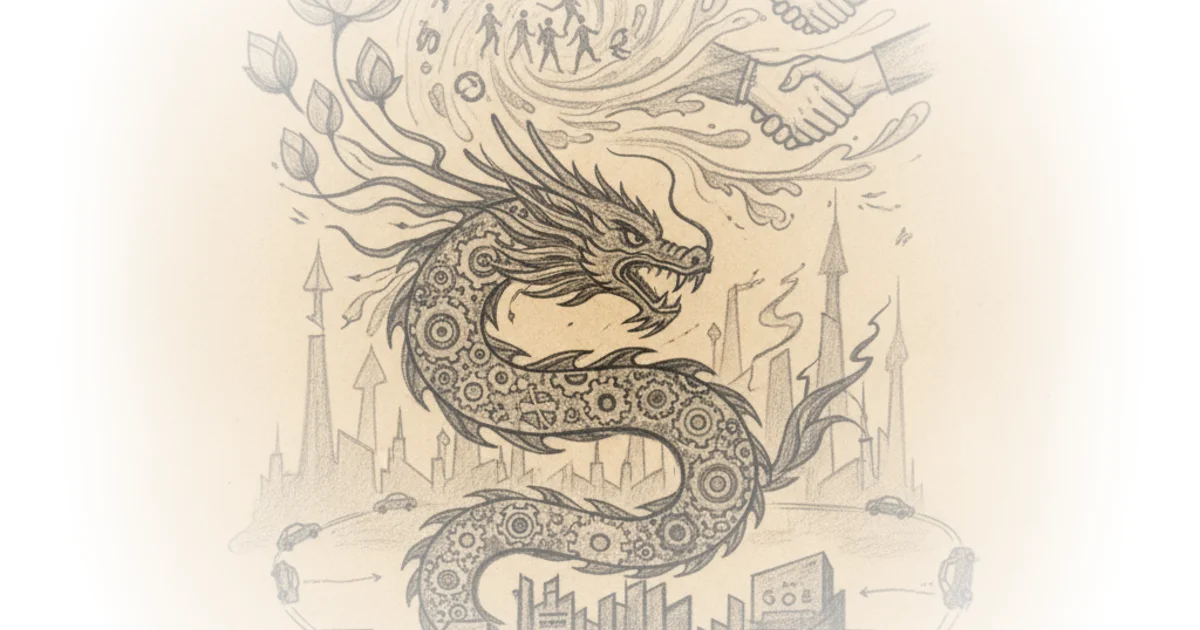
"It wasn't really central planning from Beijing. It was a magical concoction of entrepreneurs and local officials using their guanxi to dance around giant SOEs and central-government regulation."
This framing is powerful because it shifts the blame for current global trade tensions away from a monolithic "China Inc." and toward the specific, localized mechanics of how these companies actually built their scale. Critics might argue that ignoring the central government's role in providing subsidies misses half the story, but the author's point stands: without the local maneuvering, those subsidies would have gone to the inefficient SOEs that dominated the sector for decades.
The Wuhu Anomaly and the Power of Local Guanxi
The narrative deepens when Schneider and guest Fengming Lu dissect the origin story of Chery, a company that defied the odds by emerging from the city of Wuhu. The story illustrates how local officials used their networks to bypass the "eldest son" of the Chinese auto industry, FAW Group. When Wuhu officials tried to partner with FAW, the state giant's arrogance was palpable. "FAW felt it didn't need to listen to Wuhu... The managers FAW sent would smash into the conference room in the middle of Wuhu's own meetings, shouting, 'Is your party secretary here? I want to talk to him.'"
This anecdote is not just colorful; it explains the structural shift. The central government's preferred vehicle, FAW, was too bureaucratic to help a struggling city. So, Wuhu officials pivoted. They sold a cement works—a move that ironically foreshadows the rise of Anhui Conch Cement, another giant born from similar local industrial pivots—to raise capital. "They used that money — plus bank loans arranged through the provincial government — when they heard that some engine-manufacturing assembly lines were on offer in Britain." This is the essence of the argument: local governments acted as venture capitalists, taking risks that the central state would never sanction.
Schneider emphasizes that this was a deliberate dance around the rules. The local officials knew they were operating in a grey area. "They first pulled strings with one of China's largest state-owned carmakers, FAW... but it didn't end well." The failure of the top-down approach forced the bottom-up innovation. The result was a company that could produce cars for $10,000, undercutting the expensive, low-quality offerings of the state-sanctioned giants.
"The leadership of Wuhu discussed it with the leadership of Anhui, and they decided to give car-making a try... maybe the party and the government can do something in car-making."
This quote captures the improvisational nature of China's economic rise. It wasn't a grand strategy; it was a series of desperate, brilliant gambles by local leaders who saw a gap in the market and filled it with private capital and foreign technology. The argument holds up well against the standard narrative of state control, showing that the "state" in China is often a collection of competing local interests rather than a single, coherent actor.
The Downside of Success: Overcapacity and the Next Wave
The commentary doesn't shy away from the consequences of this success. The very mechanisms that allowed China to leapfrog the West have now created a global surplus. Schneider notes, "That's led to our situation in 2026 — world-beating companies that have a ton of overcapacity and are set to take over the planet." The piece connects this directly to the current trade tensions, suggesting that the same local-government playbook that built Chery and Geely is now being applied to robotics and AI.
The argument here is that the central government's inability to rein in these local champions has created a structural imbalance. The local officials, driven by the need for GDP growth and employment, continue to pump money into these industries, leading to a glut that the global market cannot absorb. "The downside of success — how China's EV boom created an overcapacity problem," is a key theme. This is not just a Chinese problem; it is a global one, driven by the specific incentives of China's decentralized political economy.
Schneider also touches on the broader implications for other industries. "We also get into the lessons this story holds for other strategic industries like robotics and AI." If the same dynamic of local government-private capital alliances is at play in these sectors, then the world should expect similar surges in capacity and similar trade frictions. The piece effectively argues that the "China model" is not a monolith but a complex, often contradictory system where local innovation frequently outpaces central control.
"The most globally impressive, successful industrial leapfrogging has taken place in an industry where the SOEs were basically stuck, doing nothing."
This is the piece's most striking insight. It reframes the narrative of Chinese industrial policy from one of state dominance to one of state failure and local adaptation. The central government's attempts to control the sector were largely bypassed, and the result was a more dynamic, competitive, and ultimately disruptive industry.
Bottom Line
Schneider's analysis is a necessary corrective to the oversimplified view of China's industrial rise, successfully arguing that local entrepreneurship and political maneuvering, not central planning, drove the EV boom. The strongest part of the argument is the detailed reconstruction of how Wuhu and Chery bypassed the state-owned giants, proving that the "state" in China is often a fragmented collection of competing interests. Its biggest vulnerability is the potential underestimation of the central government's later role in consolidating these gains, but the core thesis—that the industry was born from chaos, not order—remains compelling and essential for understanding the current global trade landscape.