Noah Smith cuts through the noise of recent cultural debates to expose a brutal economic reality: when commentators romanticize shoplifting as political rebellion, they are often blind to the fact that the pain of theft falls hardest on the very people they claim to champion. This piece is notable not for its moralizing, but for its forensic breakdown of how retail loss prevention costs are actually distributed, revealing that the "rich" are rarely the ones bleeding from the transaction.
The Illusion of the Locked Shelf
Smith begins by grounding the abstract debate in a tangible, frustrating reality that millions of consumers face daily. He contrasts the frictionless shopping of the past with the current landscape of security measures. "Seven years ago, when I wanted some toothpaste, I would walk down to my local Walgreens, grab a box of Crest off of the shelf, pay for it at the register, and walk home with it," he writes. "Today... the toothpaste is locked behind a clear plastic case."
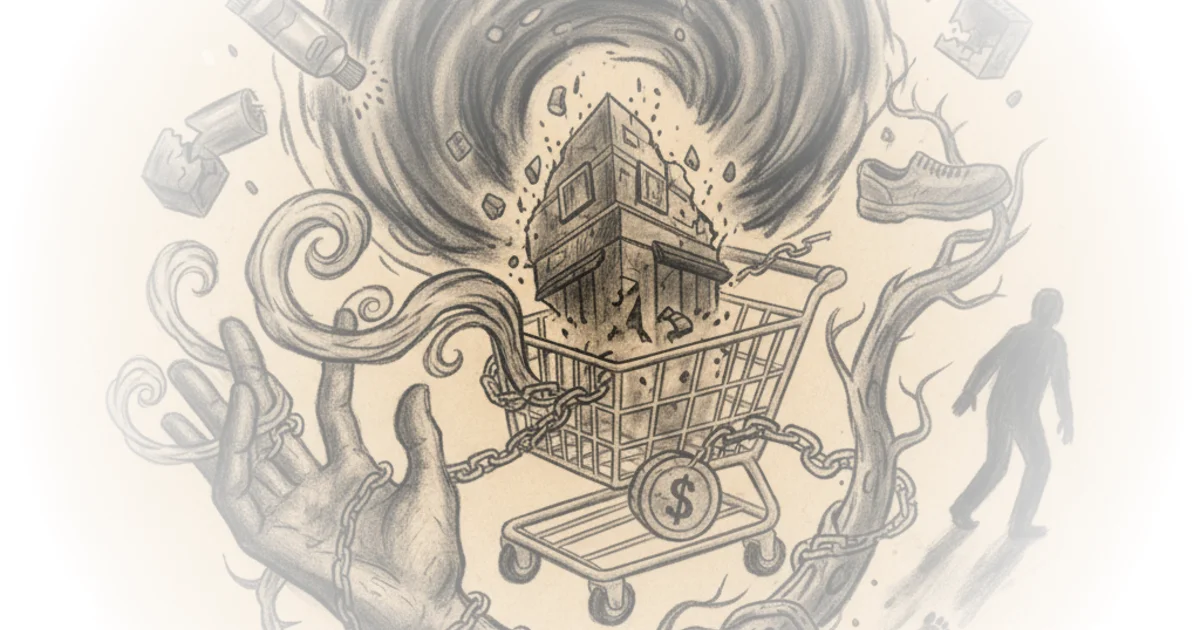
This shift is not merely an inconvenience; it is a direct economic signal. Smith argues that the proliferation of these barriers is undeniable proof that theft imposes significant costs on retailers, regardless of whether official crime statistics show a decline in specific metros. He points out that if these anti-theft measures were a waste of money, hyper-efficient chains like CVS would not invest in them. "Unless companies are just stupidly wasting their money on those cases... the existence of those cases is direct evidence that shoplifting has real costs," Smith asserts. The data backs him up: a 2024 report from Numerator found that 61% of shoppers have seen an increase in locked merchandise, and 27% would abandon a purchase rather than wait for assistance.
Every time you shoplift, in other words, you're stealing from the people who work at grocery stores and drugstores and discount stores.
The argument here is compelling because it bypasses the usual moralizing about "property rights" to focus on the actual victims of the loss. Smith notes that these costs do not vanish; they are absorbed by shareholders, executives, or passed down. However, he makes a crucial distinction about who ultimately bears the brunt. "Maybe the stores cut wages and force their employees to work longer hours. Maybe they raise their prices... Maybe they close their least profitable stores — i.e., the stores in poor areas." This reframing is vital. It suggests that the "retail apocalypse" and the rise of food deserts are not just inevitable market forces, but are exacerbated by the very theft that some on the left defend as a form of protest. Critics might argue that this ignores the desperation of the shoplifter, but Smith's point is that the systemic response to theft punishes the community more than the perpetrator.
The Hypocrisy of "Microlooting"
The piece takes a sharp turn into cultural criticism, targeting a recent New York Times roundtable where commentators Hasan Piker and Jia Tolentino defended shoplifting as a form of "microlooting" against the rich. Smith dissects their arguments, highlighting the disconnect between their rhetoric and their actual behavior. He quotes Piker's enthusiastic endorsement of chaos: "Yeah, I'm pro-piracy all the way, like, across the board... We've got to get back to cool crimes like that: bank robberies, stealing priceless artifacts, things of that nature."
Yet, Smith immediately undercuts this bravado by noting Piker's confession: "I — ironically enough — I don't personally do it. I never do it." Similarly, Tolentino admits to stealing lemons for a friend but frames it as a moral calculation. Smith argues that this represents a dangerous form of "effective altruism" where the elite decide which laws to follow based on their own situational morality. "They envision a purely situational morality, in which people decide, moment-by-moment, whether to follow the law based on a sophisticated judgement of whether following the law will make the world a better place," Smith writes.
This is where the argument hits its hardest note. Smith suggests that this approach assumes every citizen is a "superhuman homo economicus" capable of accurately calculating the social costs of every action. He points out the flaw in their logic: Piker and Tolentino assume stealing from a big-box store hurts only the billionaire CEO, while stealing from a local diner hurts the small owner. "Both of those assumptions are almost certainly wrong," Smith counters. "Stealing from an indie restaurant will hurt corporations a bit; stealing from a big-box store will hit working-class employees and customers to some extent."
If you're shoplifting because you're a bored, arrogant multimillionaire with a chip on his shoulder, you're just a rich person hurting poor people for fun.
The commentary here is scathing but precise. It challenges the notion that individual acts of theft can be a coherent political strategy. Smith notes that the externalities of theft—militarized store environments, vacant storefronts, reduced tax revenue for schools—are impossible for an individual to calculate in the moment. "That's probably why society has a social contract — a system of rules that we follow instead of calculating the results of each action from first principles," he explains. This connects to broader themes of institutional decay; just as shrinkflation quietly erodes purchasing power over decades, the cumulative effect of normalized theft degrades the infrastructure of daily life.
The Danger of Situational Ethics
Smith extends his critique beyond retail theft to the broader implications of this "situational morality." He highlights Tolentino's comment that blowing up a pipeline might be acceptable, while using a plastic cup for iced coffee is not. This reveals a disconnect between symbolic gestures and material consequences. "Tolentino is obviously thinking purely about climate change when she says this," Smith observes, noting the irony of valorizing destruction while condemning minor consumer choices.
The core of Smith's warning is that when intellectuals abandon the social contract in favor of personal moral calculus, they risk creating a world where rules are arbitrary and enforcement is chaotic. "Individual anarchism — the rejection of any social contract in favor of personal morality based on current assumptions — pretty much instantly runs into the hard limits of individual human knowledge," he writes. This is a powerful reminder that the stability of the systems we rely on—supply chains, public safety, local economies—depends on a baseline of compliance that cannot be easily hacked by individual acts of defiance.
Bottom Line
Noah Smith's strongest move is dismantling the romantic narrative of shoplifting by tracing the money to its actual destination: the wages of low-income workers and the viability of neighborhood stores. His biggest vulnerability is that he offers no easy solution to the desperation that drives theft, focusing instead on the consequences of the act itself. However, the piece serves as a necessary corrective to a discourse that often prioritizes the feelings of the commentator over the material reality of the community. The reader should watch for how retail policies evolve in response to these tensions, as the balance between security and accessibility will define the future of our physical public spaces.
If you're shoplifting because you're a bored, arrogant multimillionaire with a chip on his shoulder, you're just a rich person hurting poor people for fun.