The initial optimism following the May summit has evaporated, replaced by a stark realization: the structural contradictions between Washington and Beijing are not merely persisting; they are hardening into a new global architecture. This digest from Sinification is notable because it refuses to treat recent diplomatic gestures as a reset button, instead framing them as a fleeting "narrow strategic window" that could slam shut if China fails to engage specific US interest groups immediately. For busy observers tracking the next decade of global stability, the piece's refusal to sugarcoat the risk of accidental escalation in East Asia offers a necessary corrective to triumphalist narratives.
The Limits of Stabilization
The editors at Sinification begin by dismantling the idea that the recent summit established a "G2" co-governance model comparable to Nixon's historic visit. Jia Qingguo, cited in the piece, argues forcefully that while the meeting advanced stabilization, it "did not fundamentally alter its future trajectory." This is a crucial distinction often missed in headlines focused on handshake photos. The underlying reality remains that Washington's overarching goal of strategic competition is unchanged, meaning US government departments will likely continue rolling out policies Beijing views as confrontational.
The coverage then pivots to the dangerous ambiguity surrounding Taiwan. Zhao Minghao notes that while the administration displays new thinking by questioning old commitments like the "Six Assurances," many in Congress still operate under outdated frameworks from 1979 and 1982. The piece warns that if these officials continue to send wrong signals, they could "drag China and the United States into a war." This framing shifts the burden of risk away from abstract ideology and toward specific legislative behaviors that could trigger kinetic conflict. Critics might argue this places too much weight on congressional intransigence rather than executive policy, but the historical precedent suggests Congress often drives escalation even when the White House seeks restraint.
"The outlook remains far from optimistic: structural contradictions remain acute, cooperation will be difficult and the US domestic political atmosphere remains adverse."
The AI Battleground and the Techno-Industrial Complex
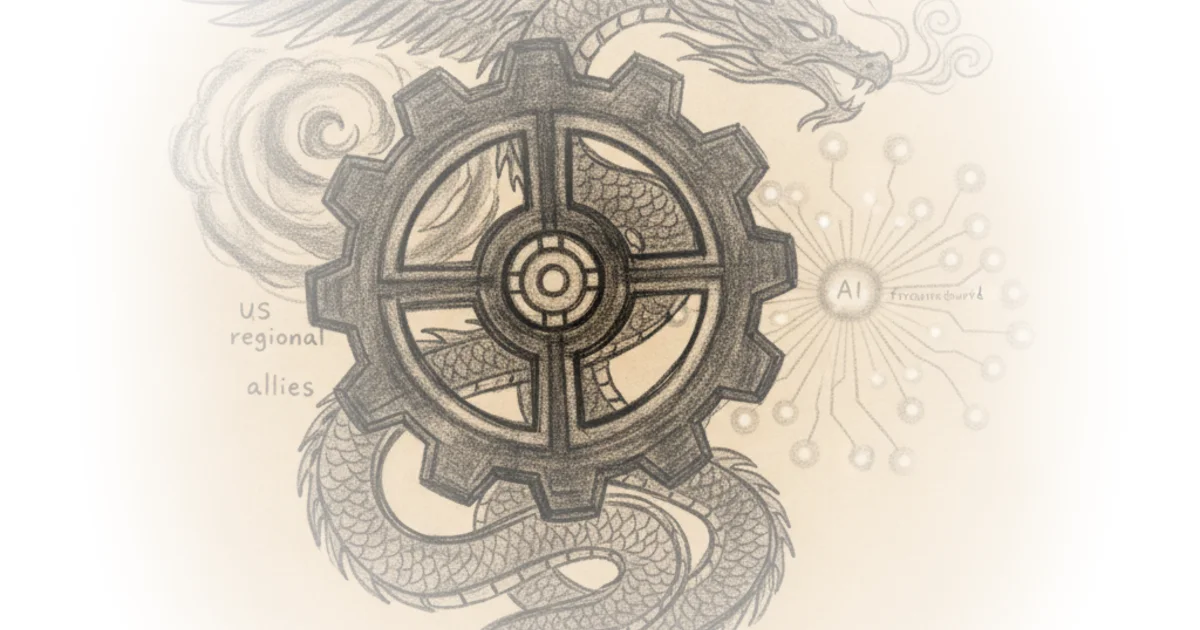
Perhaps the most urgent section of the digest concerns artificial intelligence. Huang Ping treats the newly agreed-upon intergovernmental dialogue as a "narrow strategic window" for China to secure a place in global governance or risk being shut out permanently. The argument here is sophisticated: it suggests that if standards and industrial ecosystems harden before engagement occurs, Chinese AI could be reduced to a bounded "local-area network," formidable domestically but irrelevant globally.
The piece expands this by analyzing the internal composition of American power. Di Dongsheng and Ji Xianbai describe an emerging "techno-industrial complex" where big tech, national security agencies, and venture capital have fused into a single interest bloc. They argue that America is abandoning free-market orthodoxy for state-led industrial policy to harvest "war dividends" across global conflicts while maintaining technological hegemony through "small yard, high fence" containment. This analysis reframes the trade war not as a dispute over tariffs, but as a systemic clash between two different models of innovation: one people-centered and inclusive, the other driven by individualism and self-interest.
The commentary suggests that the US is not declining but entering an "AI founding period," a cycle where technological innovation is fused with social development to rebuild hegemony. This challenges the comforting narrative of Western decline. Instead, it presents a competitor that has become more flexible and strategically attuned. The danger for Beijing is missing the chance to engage different layers of this complex—from the tech right seeking market access to MAGA hardliners focused on manufacturing jobs—before the walls go up.
A Dual-Core World Order?
On the broader stage, the digest explores competing visions of the future global order. Zhang Jian offers a triumphalist view, suggesting that the weakening US-European front allows China to become a key "connecting point" in a multipolar world where Europe and Russia reduce dependence on Washington. However, Da Wei provides a more restrained and perhaps more realistic formulation: a "dual-core multipolar order."
In this view, China and the US respect each other's security space while allowing middle powers the room to hedge selectively between them. The piece argues that this structure is essential to prevent a slide into Cold War-style blocs where supply chains are weaponized. Sinification reports that "constructive strategic stability" requires open multipolarity rather than playing diplomatic triangles against one another. This is a pragmatic approach that acknowledges the reality of two superpowers without forcing smaller nations into binary choices.
Yet, the economic friction remains acute. The editors highlight a clear fault line in China's own economic debate regarding stimulus. While some scholars advocate for infrastructure-led spending to boost growth, others like Li Xunlei warn that such counter-cyclical measures would only deepen imbalances. Liu Shijin suggests funds are better spent on rural pensions to address weak end-user demand. Huang Yiping adds a chilling note: past stimulus has often generated short-term inflation but long-term deflation, a pattern AI adoption may exacerbate further.
"China risks repeating the fate of China's internet: formidable at home, but internationally reduced to a bounded 'local-area network' if it misses the narrowing window to enter global AI rule-making."
The Talent Deficit and Institutional Rigidity
Finally, the digest turns inward, scrutinizing China's own capacity for innovation. Following high-profile academic fraud cases and a renewed emphasis on basic research, the question of "talent" is under intense scrutiny. Wang Mingyuan analyzes what these scandals reveal about deeper flaws in research institutions, while Yao Yang argues that the current education system is poorly designed to produce creative geniuses.
Zheng Yongnian extends this critique to the economy, noting that regulation and state-owned enterprises often squeeze the "oxygen out of private innovation." He points to the success of motorcycle entrepreneur Zhang Xue as a model for recognizing talent outside the mainstream system. This internal self-critique is rare in official discourse and highlights a significant vulnerability: without fixing the domestic ecosystem for creativity, external technological containment could prove fatal. The piece suggests that "talent security" is not just about preventing espionage, but about reforming the very structures that stifle the next generation of innovators.
Bottom Line
Sinification's digest offers a sobering assessment that the era of easy engagement with Washington is over, replaced by a high-stakes race to define the rules of AI and global order before they solidify against China. The strongest part of this argument is its granular breakdown of US internal dynamics, moving beyond "Trump" as a personality to analyze the structural forces of the techno-industrial complex. Its biggest vulnerability lies in assuming that middle powers will successfully hedge between two superpowers rather than being forced into alignment by economic coercion or security threats. Readers should watch closely for how the upcoming Fifteenth Five-Year Plan addresses the tension between infrastructure stimulus and the urgent need for consumption-led growth.