Adam Tooze transforms a story about low water levels in a German river into a profound meditation on the fragility of modern logistics and the stubbornness of geography. While headlines obsess over global flashpoints, Tooze argues that the true economic choke point for Europe lies not in a geopolitical conflict zone, but in a 20-centimeter shallow stretch of the Rhine near the town of Kaub. This is not merely a report on a drought; it is a diagnosis of a century of bureaucratic paralysis where the solution to a natural problem has been delayed for thirty-four years, threatening to negate an entire year of economic growth.
The Ghost of the Loreley
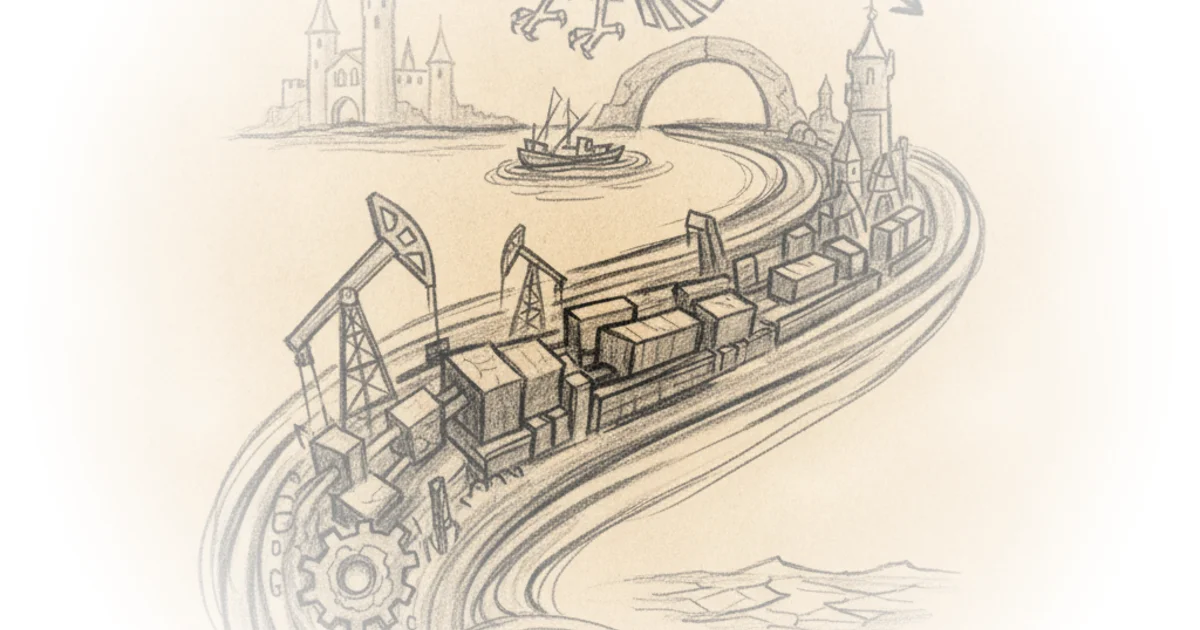
Tooze begins by reframing the current crisis through a deep historical lens, connecting the modern supply chain to the toll castles of the 14th century. He notes that the Rhine carries roughly 80 percent of Germany's inland shipping cargo, yet it is the narrow passage at Kaub, guarded by the castle of Pfalzgrafenstein since 1326, that now dictates the flow of the European economy. The author draws a striking parallel between the medieval toll collectors who forced ships to pay for passage and the modern administrative barriers preventing the removal of submerged rocks.
"The river passage is at its tightest in Hesse, north of Frankfurt around the famous rocks of the Loreley... And this narrow is marked by the picturesque castle of Burg Pfalzgrafenstein which from 1327 had the job of leveraging the rocky formation it stood on, to impose a toll on river traffic."
This historical framing is effective because it strips away the illusion of modern technological omnipotence. Tooze reminds us that despite centuries of engineering, the river remains a "second nature" that can still be held hostage by a single rock ledge. The reference to the Congress of Vienna in 1815, where European powers first agreed to free the Rhine from tolls, serves as a poignant reminder that the political will to keep waterways open is a recurring, fragile achievement. Today, that will seems to have evaporated.
The Decades of Dithering
The core of Tooze's argument targets the specific failure of the German state to act on a known problem. He cites reporting from the Financial Times to highlight that the government of Chancellor Helmut Kohl promised in 1992 to remove the submerged rocks, yet 34 years later, the bottleneck remains. The delay is not due to a lack of engineering capability but a failure of political prioritization and planning bureaucracy.
"It's just inscrutable why it takes so long to plane off six underground sections of rock," Jens Schwanen, chief executive of Germany's association of inland shipping, told the FT. "We are wasting time that we don't have."
Tooze uses this quote to underscore the absurdity of the situation: a project that could take eight months has been dragged out for over three decades. The author points out that while the Federal Waterways Engineering and Research Institute has labeled the project "highest priority," the timeline has slipped to 2033. This disconnect between official urgency and actual delivery is emblematic of a wider infrastructure crisis. Critics might argue that environmental regulations are a necessary check on hasty development, but Tooze suggests that the current debate has become a distraction from the fact that the delay itself is causing economic damage.
The Engineering Paradox
Perhaps the most sophisticated part of Tooze's commentary is his exploration of the technical debate surrounding the solution. It is not simply a matter of digging deeper; the author explains that dredging can actually worsen the problem by accelerating water flow and lowering levels downstream. The article presents a genuine "culture war" between those who want to deepen the channel and those who advocate for narrowing it to concentrate the remaining water.
"Deepening or optimizing a navigation channel can increase the usable water depth, but it does not create any additional water," Boris Lehmann, a water engineering researcher at TU Darmstadt, told the Science Media Center.
Tooze highlights the irony that while the government debates deepening, they are simultaneously spending millions to replace sediment in other parts of the river to prevent the banks from collapsing. This illustrates the fundamental misunderstanding of the river as a static resource rather than a dynamic system. The author argues that the real culprit is climate change, which has reduced snowmelt in the Alps, combined with drainage infrastructure that rushes water away too quickly. The solution, Tooze suggests, may not be a single engineering fix but a fleet renewal toward vessels with shallower drafts, a transition that has been woefully underfunded.
"The Kaub section [of the Rhine] has in effect turned into Germany's Strait of Hormuz," ING's global head of macro Carsten Brzeski told the FT, adding that German policymakers for too long took natural infrastructure like waterways and rivers "for granted."
This comparison to a military flashpoint is powerful, yet Tooze is careful to note that the disruption here is self-inflicted through neglect rather than external aggression. The stakes are high: a large disruption on the scale of the 2018 drought could be enough to "negate any growth in the German economy this year." The author's choice to weave in the specific detail of the tanker Stolt Ludwigshafen, which can only carry half its cargo even with a one-meter water level, makes the abstract concept of "logistical friction" viscerally real.
Bottom Line
Adam Tooze's analysis succeeds by exposing the gap between the complexity of the Rhine's hydrology and the simplicity of the political response. The strongest part of the argument is the historical continuity of the Kaub bottleneck, proving that geography is a constant while political will is fleeting. However, the piece leaves the reader with a lingering vulnerability: the proposed solutions, from shallow-draft vessels to channel narrowing, require a level of long-term planning and capital investment that the current political cycle seems incapable of sustaining. The reader should watch not just the water levels, but the next budget cycle, to see if Germany finally treats its rivers as the critical infrastructure they are, or continues to let the rocks win.
"We are wasting time that we don't have."
The ultimate verdict is that the Rhine crisis is a symptom of a deeper malaise: a failure to maintain the "second nature" of our infrastructure against the rising tide of climate change. Until the political will matches the engineering reality, the rocks at Kaub will remain the most dangerous place in Europe.