Self-Improvement Through Superhero Television
TV Philosophy, a Substack publication dedicated to extracting life lessons from popular television, uses the sixth season of The CW's The Flash to examine determination in the face of seemingly inevitable catastrophe. The article is the latest entry in a running series that has previously covered beginnings, hard work, goal-setting, and the temptation to skip steps. Season 6 provides the author's framework for arguing that determination is qualitatively different from effort -- that confronting mortality demands something beyond simply working harder.
The argument centers on three characters whose arcs converge around a single theme: what happens when the thing you are determined to overcome might genuinely be unbeatable.
Barry Allen and the Weight of Sacrifice
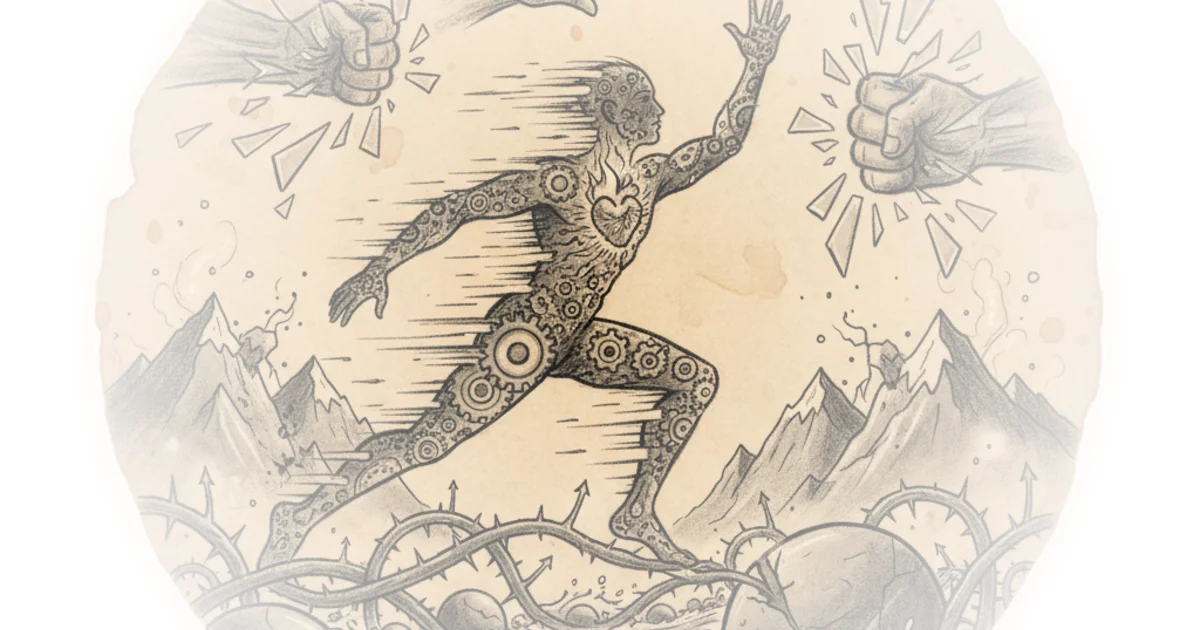
Barry Allen enters season 6 carrying two burdens. His daughter from the future sacrificed herself for him, and he now faces the prophecy that he must die during the Crisis on Infinite Earths to save the multiverse. The article frames this as a philosophical pivot point. Barry's friends and family are determined to save him. Barry himself is trying to accept his fate. That tension -- between fighting the inevitable and making peace with it -- drives the season's emotional core.
"Barry, no person is immune to fear and doubt. No matter how brave, that's what makes you human Barry. But the courage to move forward? Even in the face of overwhelming odds? That's what makes you a hero. That's what makes you The Flash."
The article uses this exchange to argue that determination is not the absence of fear but the decision to act despite it. Fair enough as motivational philosophy goes, though the argument would benefit from acknowledging that Barry's situation is categorically different from most real-world challenges. The show gives him literal superpowers, a team of genius allies, and narrative armor. Mapping that onto an ordinary person's struggle with illness or career setbacks requires more bridging than the article provides.
Ramsey Rosso and the Refusal to Die
The season's first villain, Ramsey Rosso, serves as determination's dark mirror. A doctor whose mother died of cancer, Rosso becomes obsessed with conquering death itself. His origin story is delivered in a monologue that the article quotes at length.
"My name is Ramsey Rosso, and my mother Dr Rachel Rosso was everything to me. When I was seven, I skidded out pretty badly on a bike she bought me for my birthday. Imagine a scared kid with two scraped knees and a bloody nose. Well mum found me, she picked me right up, she brushed me off and told me to get back on my bike... and ride."
Rosso's mother taught him that pain should never prevent forward motion. The article positions this as admirable in isolation but catastrophic when taken to its logical extreme. Rosso's determination to survive at any cost transforms him into the very thing he feared -- a monster who robs others of their agency in order to preserve his own existence.
"This isn't anger. This is the pain beneath my anger. It takes courage to fight death."
"Maybe it takes more to accept it."
That exchange captures the season's central philosophical tension cleanly. The article treats Barry's acceptance and Rosso's refusal as two poles of the same spectrum, though it stops short of fully exploring the uncomfortable middle ground where most people actually live -- neither heroically accepting death nor villainously defying it, but simply muddling through.
Eva McCulloch and Life After Crisis
The season's second antagonist, Eva McCulloch, represents a third variation on determination. Where Barry accepts and Rosso fights, Eva survived. She endured imprisonment in the Mirror Dimension through a catastrophe and emerged with a singular focus: reclaiming the life that was taken from her. The article argues that post-crisis survival brings its own form of paralysis.
"I've been in overdrive ever since we learned that you were going to die in Crisis. I've spent the last month trying to live every day like it was my last. Hell bent on trying to make the most of the limited time I thought we had left together. But, Crisis is over now and you didn't die. And I think I just... I forgot to..."
The trailing sentence -- completed by the word "slow down" -- speaks to a real psychological phenomenon. People who orient their entire identity around surviving a crisis often struggle to find purpose once the crisis passes. The article handles this thread more convincingly than the others, perhaps because it maps more naturally onto ordinary human experience than superpowered sacrifice does.
Borrowed Time and Elemental Forces
The article's broader thesis is that determination fractures identity. The more options and pressures a person faces, the more they feel pulled apart -- "like elemental forces beyond even what an ordinary person might understand." Season 6 literalizes this through its multiverse mechanics and mirror duplicates, characters split into versions of themselves that make different choices.
"The truth is we're all living on borrowed time."
"Sometimes the truth is the hardest lie to see through, and when you can't put your faith in the truth, all you have left is yourself."
The strongest insight here is that determination without direction can be as destructive as apathy. Rosso is maximally determined and it ruins him. Eva is maximally determined and it isolates her. Barry's arc suggests that the healthiest form of determination involves accepting constraints -- you cannot save everyone, but you can save someone.
"You can't always save everyone, but you can always save someone."
That line functions as the article's quiet thesis statement, even if the author does not explicitly frame it that way.
Bottom Line
TV Philosophy's reading of The Flash Season 6 works best as a catalog of how different characters embody determination under extreme pressure. The three-villain structure gives the article a natural framework: acceptance, resistance, and survival as distinct responses to catastrophe. The direct quotes are well-chosen and do much of the argumentative heavy lifting.
Where the piece falters is in its connective tissue. The transitions between self-help philosophy and plot summary can feel thin, and the article occasionally states its themes rather than developing them. The claim that determination is categorically different from effort or goal-setting -- the essay's core proposition -- is asserted more than demonstrated. Still, as an entry in a longer series, it functions effectively as a chapter in an ongoing argument about personal growth, and the choice to use a superhero show facing literal apocalypse as the vehicle for discussing determination has a certain logical elegance to it.