Perun cuts through the cacophony of conflicting claims to expose a singular, terrifying reality: in this high-stakes air and missile war, the fog of war is not just obscuring the truth, it is being weaponized by artificial intelligence and cheap propaganda. While official narratives clash over casualty counts and carrier strikes, the author argues that the true metric of this conflict isn't who strikes first, but who runs out of ammunition first. This is not a standard military analysis; it is a forensic dissection of how modern information warfare is designed to break our ability to distinguish between a hypersonic strike and a recycled video from a year ago.
The Fog of Manufactured Reality
The piece opens with a stark observation about the dissonance between the two sides' narratives. Perun notes that "almost as soon as American and Israeli forces launched their attacks on Iran in the closing days of February, the fog of war descended and the propaganda and announcements from both sides seem to be describing almost parallel universes." This framing is crucial because it immediately disarms the reader's reliance on headline news. The author points out that while the Iranian narrative claims massive US casualties and successful carrier strikes, the American side is projecting an image of total dominance, with the executive branch reportedly rating the operation a "12 to 15 out of 10."
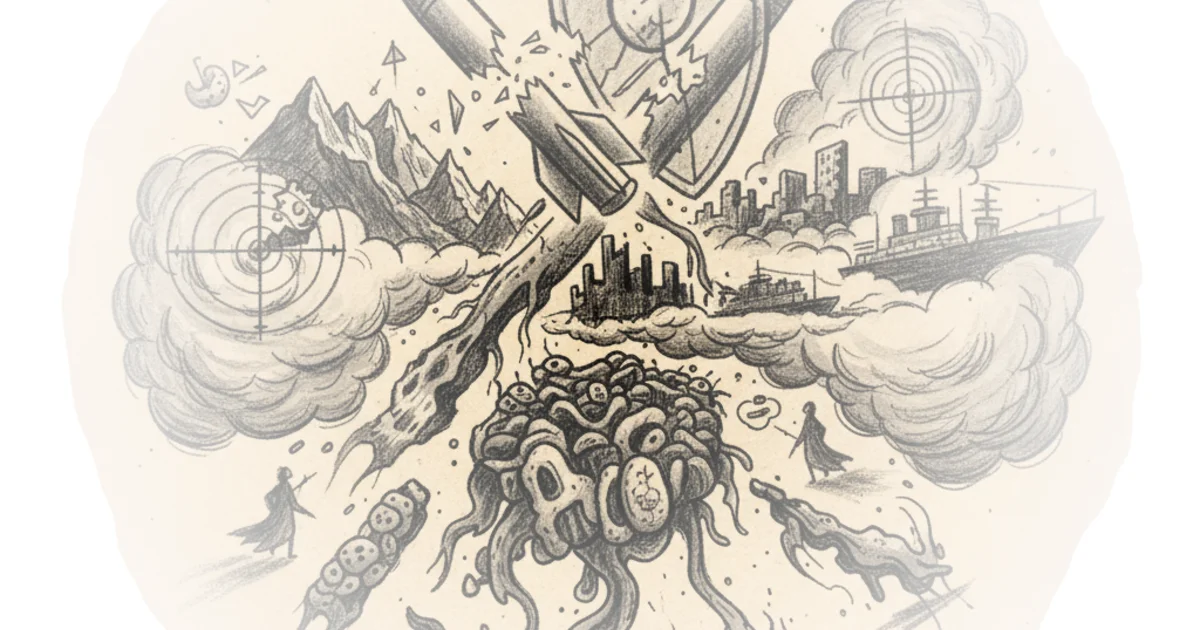
However, Perun argues that these grandiose claims are less about military reality and more about the new economics of cognitive warfare. The author writes, "One of the issues now, though, is that a lot of the tools you'd associate with information and cognitive warfare... are now much cheaper and more democratized than ever." This is the article's most significant insight: the barrier to entry for creating convincing disinformation has collapsed. We no longer need state-level propaganda machines; we need a smartphone and a generative AI tool. The author warns that this democratization means "you don't need an expensive globe spanning propaganda arm in order to run an online bot farm."
Critics might argue that focusing on AI fakes distracts from the very real kinetic destruction occurring on the ground, but Perun makes a compelling case that the fake is the weapon. By flooding the zone with low-quality, AI-generated content, bad actors can drown out verified reporting. The author illustrates this with a specific example of a video claiming to show a hypersonic missile barrage, which was actually a recycled clip from weeks prior. Perun writes, "My point is AI fakes are out there in enormous numbers. And so, if something looks a bit odd, whether it says something you want to be true or not, take the second to check it wherever possible."
The technology is still getting better, but there are still for the moment a few things you can look for. The videos will tend to be short in duration... and then there's the often present, for lack of a better term, AI feel where things might look mostly right but just a little bit off.
The Mechanics of Deception
The commentary shifts to a technical breakdown of how these deceptions work, moving beyond simple fabrication to more subtle forms of manipulation. Perun highlights the danger of "deceptive captioning," where a genuine video is paired with a false narrative. The author describes a viral clip of a missile hitting a ship, which was actually a missile that "landed in the open water presumably to the relief of civilians in the area but the great chagrin of any nearby fish." This distinction is vital; the visual evidence is real, but the context is entirely manufactured. This technique bypasses standard fact-checking tools because the image itself is not AI-generated.
Furthermore, the author exposes the issue of content recycling, noting that footage from the "12-day war back in 2025" is being repurposed to suggest ongoing attacks. This connects to a broader historical pattern of using past conflicts to stoke current fears, a tactic that also appeared in coverage of Operation Praying Mantis, where historical naval engagements were often conflated with contemporary threats to confuse the public. Perun writes, "That's despite the fact that this was one of the Iranian Navy's most advanced warships... It's worth noting that according to the Indian Ministry of Defense, the Milan 2026 exercises that Iranian vessel returning from included a live fire component." The author uses this to demonstrate that even seemingly specific details can be misleading when stripped of their original timeline.
The piece also tackles the issue of AI hallucinations in verification. Perun points out a disturbing trend where people use AI tools to verify AI fakes. "The issue with the hey rock is this real phenomenon, though, is that generative AI wasn't built to be an intelligence analysis tool, and it is entirely capable of saying things are real when they're not," the author writes. This creates a feedback loop of misinformation where the tools meant to clarify reality actually deepen the confusion. The author's advice is blunt: "Treat them as two separate pieces of information and also remember that even genuine video can be altered by, for example, overlaying different audio."
The Real War: Munitions and Endurance
Once the information fog is cleared, Perun pivots to the hard metrics of the conflict: munitions stockpiles and sustainability. The author suggests that the initial claims of overwhelming success or total devastation are secondary to the logistical reality. "Everyone apparently was running out of weapons with potentially enormous implications for how this was all going to play out," Perun writes. This shifts the focus from the dramatic headlines to the grinding attrition of modern warfare.
The author argues that the Iranian strategy of holding back advanced weapons is a deliberate choice, not a sign of weakness. As Perun puts it, the reason the missile campaign hasn't caused more damage is not due to shortages, but because "We have no intention of deploying all our advanced weapons and equipment from the outset." This reframes the conflict from a simple exchange of fire to a calculated game of resource management. The author notes that the question isn't whether the war will end in days, but whether the inventories of the various actors can sustain a prolonged campaign.
This analysis draws a parallel to the dynamics seen in Russia's 2026 war, where the initial surge of firepower was quickly followed by a critical need to replenish stocks. Perun writes, "It's also one that's raised a huge number of questions. Why now? What will happen with the naval war in the Straits of Hormuz?" The author implies that the answer to these questions lies not in the political rhetoric of the White House, but in the physical limits of missile production and defense interceptor availability. The core of the argument is that the side that misjudges its own logistical ceiling will be the first to lose strategic initiative.
The truth is this is an incredibly complex conflict, one whose consequences are already reverberating around the world. It's also one that's raised a huge number of questions. Why now? What will happen with the naval war in the Straits of Hormuz?
Bottom Line
Perun's strongest contribution is the rigorous dismantling of the information ecosystem that surrounds this conflict, proving that the most dangerous weapon in the 2026 theater is not a hypersonic missile, but a convincing lie. The article's greatest vulnerability is its necessary reliance on limited open-source data, which means the true scale of the munition shortages remains speculative. Readers should watch for the next shift in the narrative: not when the first major strike occurs, but when the first side admits to a critical depletion of its defensive interceptors. The fog of war is thick, but the author has provided the only reliable compass we have: skepticism of everything, and a focus on the logistics of endurance over the theater of headlines.