Cyril Hédoin challenges a deeply ingrained assumption in modern political thought: that self-governance is the exclusive domain of the democratic state. In an era where political discourse often oscillates between blind faith in markets and desperate appeals to state power, Hédoin offers a startlingly different map, arguing that the true path to autonomy lies in the messy, shifting grey area between the two. This is not a dry theoretical exercise; it is a timely intervention suggesting that our current polarization stems from a failure to recognize that the boundaries of public and private are not fixed, but fluid.
The Illusion of Pure Democracy
Hédoin begins by dismantling the romantic notion that democracy automatically equals self-governance. He points out that while the ideal is universally praised, its realization is often a façade. "Self-governance is never fully realized," he writes, noting that in less-than-ideal societies, the pursuit of this ideal can sometimes be counterproductive. The author argues that even leaders who actively undermine citizen autonomy frequently cloak their actions in the rhetoric of "We the people."
This distinction is crucial. Hédoin suggests that the mere existence of voting booths does not guarantee that individuals are in control of their destiny. He draws on Alexis de Tocqueville to illustrate that the democratic form of life carries its own risks, such as political indifference and a retreat into private spheres. "The very success of populists who falsely appeal to self-governance is proof that modern democracy has failed to realize this ideal," Hédoin asserts. This is a sharp critique of the current political climate, where the machinery of democracy often feels disconnected from the actual agency of the citizenry.
Critics might argue that dismissing the democratic state as insufficient risks undermining the only mechanism we have for collective action against powerful private interests. However, Hédoin's point is not to discard democracy, but to refine our understanding of where it actually functions.
The ideal of self-governance is best expressed by the U.S. Constitution's first three words, "We the people." These words state that the ultimate justification of government is to serve its citizens.
Markets as a Form of Autonomy
Perhaps the most provocative section of the essay is Hédoin's defense of market relations as a genuine expression of self-governance. This runs counter to the standard liberal narrative that views markets as inherently coercive or amoral. Hédoin argues that market prices are not just economic signals but tools of information and coordination that allow individuals to pursue their goals without undermining others' freedom.
"Market relations are the expression of self-governance," he writes, explaining that they result from individuals' freedom to pursue their goals without limitations other than their capacity to offer value. He posits that in an ideal market, negative freedom (freedom from interference) actually enhances positive freedom (the ability to achieve one's values). This reframing forces the reader to reconsider the role of the private sector not as an enemy of the public good, but as a vital engine of individual autonomy.
In a market economy, individuals can freely pursue their interests and achieve their goals without undermining others' freedom. Quite the contrary, in the ideal case, their (negative) freedom to make choices without interference enhances others' (positive) freedom to achieve their own personal values and ideals.
Yet, Hédoin is no blind libertarian. He readily admits that market freedom is insufficient on its own. He notes that a person's ability to govern themselves in the market is heavily dependent on factors they cannot control, such as birth, education, and brute luck. "Unskilled and unlucky individuals will struggle to achieve self-governance through market relations alone," he concedes. This nuance prevents the argument from collapsing into a simple defense of the status quo.
The Blurred Lines and the Case for Polycentricity
The core of Hédoin's argument rests on the idea that the distinction between the public and the private is not a fixed line but a moving frontier. He uses the example of music to illustrate this: what was once a private good has shifted into a public or club good depending on technology and consumption habits. "The private and the public are two ideal types—two ways to understand the relationship between what people want and value and what society is collectively doing," he explains. Neither extreme works in isolation.
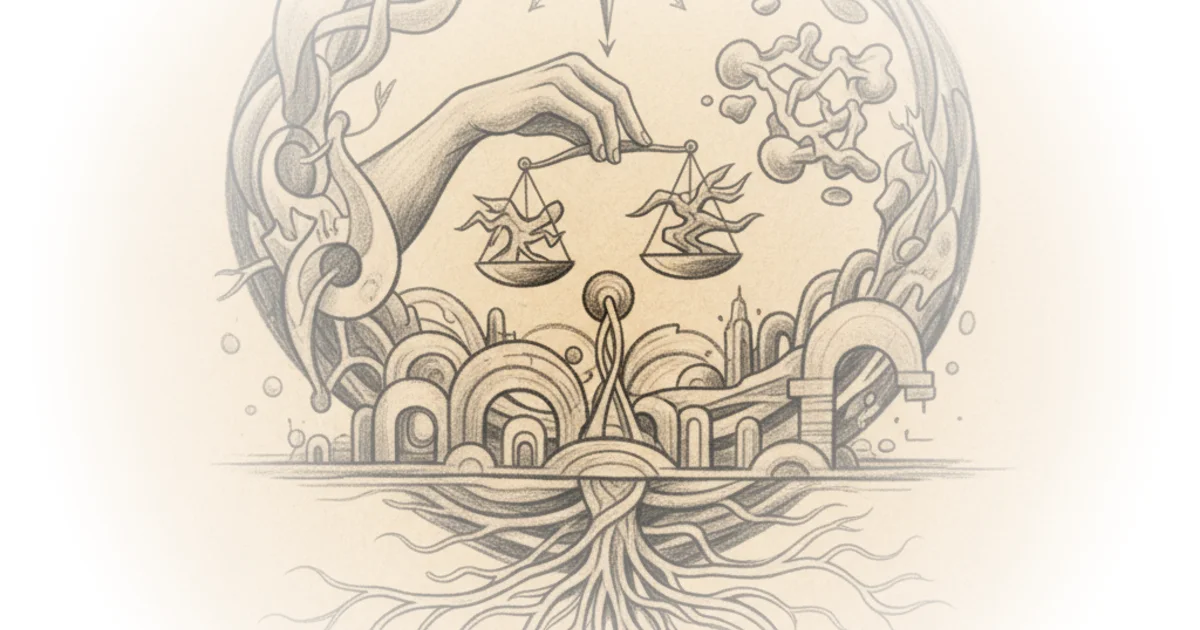
Because the lines are constantly shifting, Hédoin argues that we need a system capable of constant adjustment. This leads him to champion "polycentricity"—a system of multiple, overlapping centers of decision-making rather than a single, monolithic authority. He suggests that self-governance is not a static state to be achieved, but a dynamic process. "Polycentricity is the social organization that naturally responds to this observation," he writes, citing the work of scholars like Vincent Ostrom and Michael Polanyi.
The justification of polycentric democracy is to provide the constitutional and social framework for favoring social, economic, and political experiments in search of the best way to align individual with social preferences in different sets of circumstances.
This is where the essay offers its most practical policy insight. Hédoin contends that federalism and local experimentation are superior to top-down mandates because they allow for the necessary testing of institutional arrangements. A monocentric state, he implies, is too rigid to adapt to the complex, evolving nature of human preferences and technological change. Critics might note that polycentric systems can lead to fragmentation or a "race to the bottom" in regulations, but Hédoin's focus on minimizing external costs suggests a framework designed to mitigate such risks through competition and feedback loops.
Bottom Line
Cyril Hédoin's strongest contribution is his refusal to accept the false dichotomy between state coercion and market anarchy, offering instead a sophisticated framework of polycentric democracy that treats self-governance as an ongoing experiment rather than a finished product. The argument's greatest vulnerability lies in its reliance on the assumption that institutions will naturally evolve toward efficiency; it offers less guidance on how to handle entrenched power structures that resist such adaptation. For the busy reader, the takeaway is clear: if you value autonomy, you must support flexible, multi-layered governance structures that can adapt to a world where the public and private spheres are increasingly indistinguishable.