Most analyses of foreign policy failure focus on the leader's ego or the specific intelligence gap. Jordan Schneider, in his deep dive into Tyler Jost's new book Bureaucracies at War, argues something far more structural and terrifying: that the very success of a leader can systematically dismantle the information systems they need to survive. This isn't just history; it is a warning about how institutional silos and the "hot hand" phenomenon can turn a superpower's greatest asset—its confidence—into its fatal flaw.
The Psychology of the "Hot Hand"
Schneider frames the conversation by asking why leaders with vast expert bureaucracies at their fingertips make devastating decisions. He points to a psychological trap where past victories breed a dangerous overconfidence. "Most leaders experience a series of successes and luck over the decades it takes them to reach power, which can build psychological confidence in their own instincts," Schneider writes. This is the core of the "hot hand" fallacy applied to geopolitics: the belief that because a gamble worked once, it will work again.
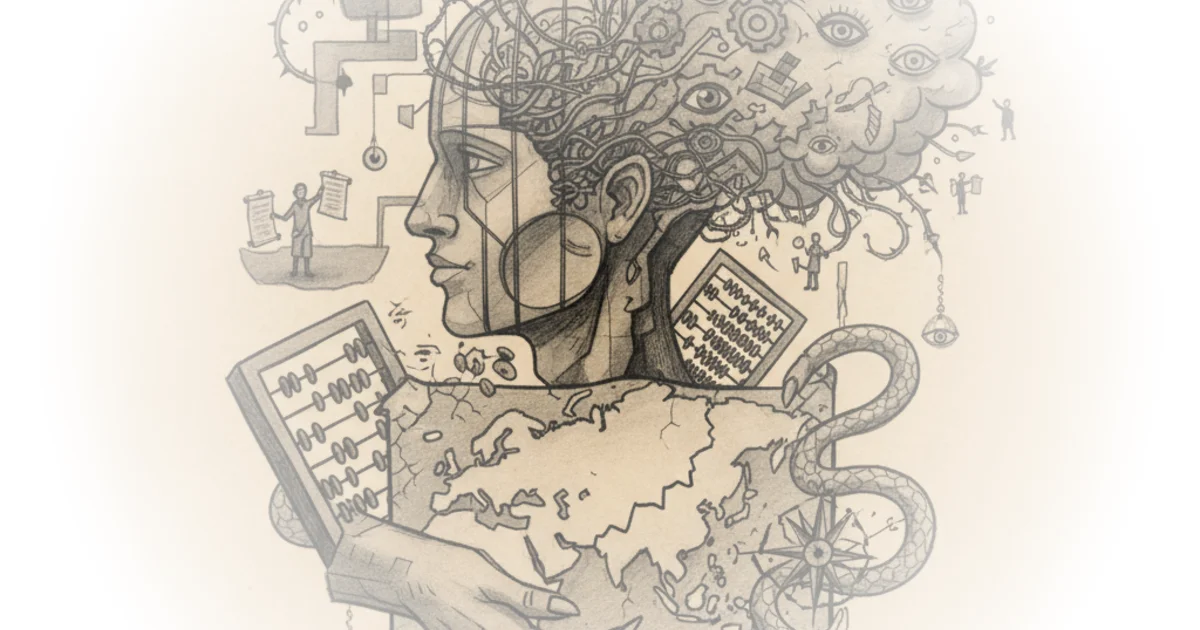
The author draws a sharp parallel between historical figures and modern governance, noting that "if you had a 5% chance of things going your way according to the data, then that's still a 5% chance. But if you keep making that bet over and over again, eventually it will catch up with you." This temporal analysis is crucial. It shifts the blame from a single bad day to a systemic erosion of judgment over time. Critics might argue that this psychological framework ignores the unique constraints of nuclear deterrence, where the stakes are binary and the margin for error is non-existent, but the pattern of isolation remains a compelling lens.
If you keep making that bet over and over again, eventually it will catch up with you.
The Erosion of the Integrated State
The piece moves from theory to the specific mechanics of the Chinese state under Mao Zedong. Schneider highlights a critical turning point: the shift from an "integrated" system to a siloed one. In the early years, the Foreign Ministry held high status because its leaders, like Zhou Enlai and Chen Yi, were revolutionary veterans with direct access to the top. "From the late 1940s to the early 1960s, Chinese leaders' ability to get the information they needed from the state system was pretty good," Schneider notes. This integration allowed for a rare moment of clarity in 1962.
When Chiang Kai-shek's "Project National Glory" threatened to invade the mainland, the system worked. The Foreign Ministry, acting on intuition that the US would not support a rogue invasion, successfully used the Warsaw channel to verify US intentions. Schneider emphasizes the impact of this data flow: "Wang says in his memoir — and I think this is proven by Mao's subsequent actions — that the information coming through the Foreign Ministry channel had a big impact on Mao's thinking." This historical reference to Wang Bingnan and the 1962 crisis serves as a stark counter-example to what happens later. It proves that when the bureaucracy speaks, and the leader listens, disaster can be averted.
The Cost of Isolation
However, the narrative takes a dark turn as the Great Leap Forward's failures erode trust in the very experts who could have prevented them. By 1969, during the Sino-Soviet border disputes, the integrated system had fractured. Mao, convinced the Soviets were planning an attack, bypassed the nuanced diplomatic channels and opted for a "demonstration of military force." Schneider explains that "Mao was wrong on two fronts. First, the Soviets would not back off. Second, he misjudged the severity with which the Soviets were contemplating military action prior to China initiating conflict in March of '69."
The human cost of this miscalculation cannot be overstated. The escalation led to skirmishes that nearly triggered a nuclear exchange, a scenario where the difference between a border skirmish and global thermonuclear war was a single leader's isolation from his own intelligence apparatus. The administration's decision to escalate, based on a gut feeling rather than bureaucratic consensus, brought the world to the brink. As Schneider observes, the pattern is tragic: "leaders gradually isolating themselves from their own information gathering systems with catastrophic consequences."
Leaders gradually isolating themselves from their own information gathering systems with catastrophic consequences.
Bottom Line
Schneider's commentary on Jost's work succeeds in reframing foreign policy failure not as a lack of information, but as a failure of the mechanism to deliver it to the leader. The strongest part of this argument is the historical evidence showing how the same system that prevented war in 1962 nearly caused it in 1969 simply because the leader stopped listening. The biggest vulnerability is the assumption that modern leaders can always be identified as being in a "pre-isolation" or "post-isolation" phase, a distinction that may be harder to spot in real-time. The reader should watch for how current institutional silos in any major power are being reinforced, not just by external threats, but by the internal psychology of those at the top.