Chris Chappell cuts through the fog of official statistics to deliver a stark assessment: China's economic "master plan" for 2030 is already faltering under the weight of its own structural contradictions. While mainstream analysis often focuses on geopolitical posturing, Chappell argues that the recent "Two Sessions" political meeting revealed a regime desperate to manage a crumbling domestic reality rather than project strength. The piece is notable for its refusal to accept Beijing's narrative of "high-quality growth" at face value, instead dissecting the specific mechanisms—debt, demographic collapse, and state intervention—that threaten to derail the country's future.
The Illusion of Data and the ABCDs
Chappell opens by dismantling the reliability of China's economic reporting, a point that is often glossed over in favor of headline GDP numbers. He notes that the leadership recently approved a 15th five-year plan, a blueprint for 2026 to 2030, yet the growth targets set within it are the lowest on record since 1991. "For years, the CCP has reported that China has consistently hit its GDP growth targets, which if true, should mean that they have no problem keeping the higher growth targets of the past years," Chappell writes. This observation is critical because it highlights the disconnect between the regime's need for legitimacy and the economic reality on the ground.
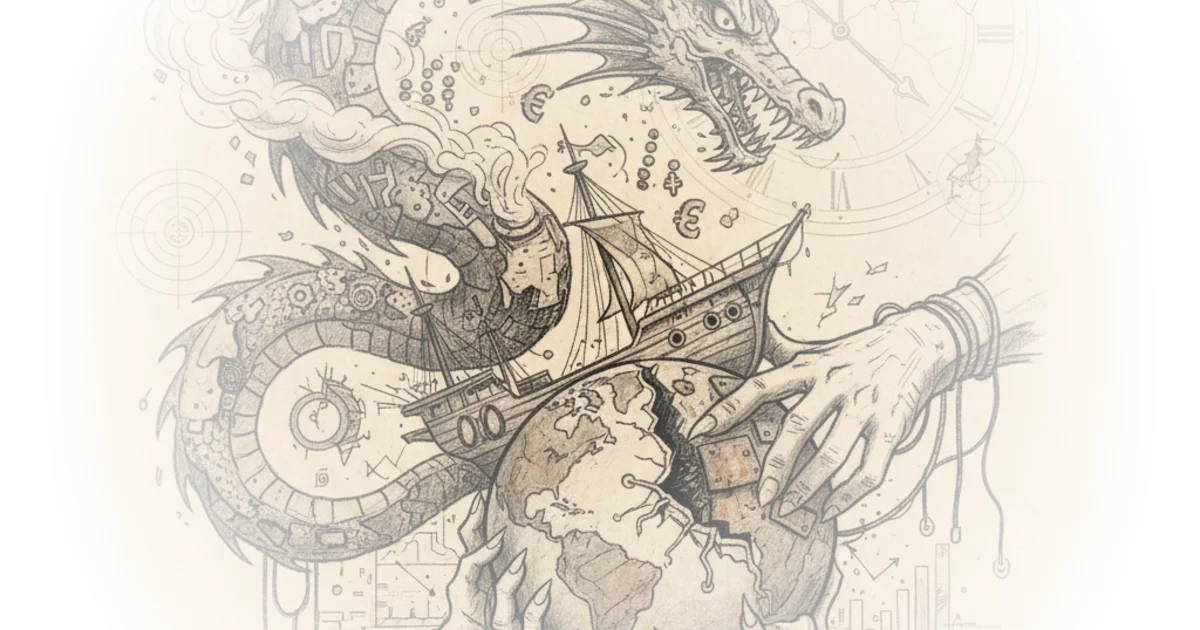
The author introduces a framework he calls the "ABCDS" to describe the current crisis: All-time high debt, Birth rate decline, Consumer confidence crisis, and Deflation. He adds a cynical twist, noting, "And also dummies in charge. So, I guess the ABC double D's." While the humor is sharp, the underlying data regarding the demographic shift is sobering. The 15th five-year plan aims to double per capita GDP by 2035, a goal that seems increasingly impossible given the rapidly aging society. Chappell argues that the leadership knows this, which is why they are lowering expectations while simultaneously engaging in massive fiscal stimulus.
"The fact that China has lowering its official GDP goals to around four and a half to 5% goes to show that not even tweaking the numbers is enough to hide how bad things have gotten."
This reframing of lower growth targets as "structural optimization" is a classic example of what Chappell calls "word salad." He suggests that the regime is attempting to pivot from a numbers-first mindset to a quality-first one, but the execution relies on the same old tools. Critics might note that the government's focus on "new quality productive forces"—a term emphasizing state-led development in AI, quantum computing, and semiconductors—is a genuine strategic shift rather than just a rebranding exercise. However, Chappell counters that this approach ignores the fundamental issue: the economy has been running on debt and real estate investment for decades, and that bubble has burst.
The Debt Spiral and the Bureaucratic Trap
The commentary then shifts to the financial mechanics of the crisis, specifically how local governments are funding their operations. Historically, these governments relied on land sales, but with the real estate market collapsed, they are resorting to desperate measures. Chappell points out that the central government is now bailing out localities, issuing over 15 trillion yuan in central budget expenditures and 4.4 trillion yuan in special purpose bonds. "It's like they saw they were eating themselves and thought, I know, let's start eating faster," he quips.
This section effectively illustrates the systemic flaw in China's fiscal federalism. The central government collects most of the revenue but forces local governments to bear the burden of expenditure. When localities can't pay, the center steps in, but as Chappell observes, "This changes absolutely nothing in the long term." The solution proposed by the administration—more debt to service old debt—risks a death spiral where revenue is consumed entirely by interest payments.
"One way to solve this problem is to develop a stronger domestic consumer economy. And the CCP knows that... But China is still refusing to do anything that will fundamentally make itself a real consumer economy, despite what Chinese staterun media would have you believe."
The author's analysis here is particularly strong: the regime is unwilling to empower consumers because doing so would dilute state control. Instead, they are pushing for "involution," a cut-throat competition that leads to overproduction in sectors like solar panels and electric vehicles. This creates a paradox where cheap Chinese labor is undercut by the very state policies designed to protect it. While some might argue that state subsidies are necessary to nurture infant industries, Chappell rightly questions the sustainability of propping up "zombie enterprises" that are essentially dead but still kicking.
Security Over Prosperity
Perhaps the most alarming aspect of the 15th five-year plan, according to Chappell, is the continued prioritization of military spending over economic stability. Despite the economic turmoil, defense spending is set to rise by 7%. "China's planning on boosting defense spending by 7% this year... It is still a 7% increase in spending, which means China is still very much set on preparing for something like, oh, I don't know, starting a world war," he writes.
This allocation of resources suggests that the leadership views external threats as more immediate than internal economic collapse. The push for grain and energy self-sufficiency further underscores a "siege mentality" that could lead to aggressive geopolitical posturing. Chappell connects this to the broader narrative of the "Two Sessions," noting that the meeting was preceded by purges, which he argues creates a culture of fear where officials are incentivized to hide bad news rather than solve problems.
"Concentrate power at the top, spend money like it's going out of style, act like a jerk on the world stage, and beef up the military to deal with the inevitable backlash."
The author's conclusion is that the Chinese Communist Party is trapped in a cycle of its own making. They are trying to solve a structural crisis with the same top-down, command-and-control methods that caused it. While the administration may hope to leverage "new quality productive forces" to escape the middle-income trap, the lack of genuine market reforms and the suppression of consumer power make this outcome unlikely.
"China makes mistakes like any other country, and it only wins if we allow it to win."
Bottom Line
Chappell's strongest asset is his ability to strip away the jargon of "structural optimization" to reveal the raw mechanics of a debt-fueled stagnation. The argument is most compelling when it connects the dots between the 15th five-year plan's unrealistic targets and the regime's refusal to empower domestic consumers. The biggest vulnerability in the piece is its reliance on the assumption that the leadership is entirely irrational; there is a possibility that the "security-first" approach is a calculated gamble that the economy can be stabilized through coercion if external pressures are managed. Readers should watch for the next quarter's local government debt data, as that will be the true test of whether the central government's bailouts are working or merely delaying the inevitable.