In an era where digital noise often drowns out genuine connection, Maria Popova resurrects a radical truth from the late science fiction visionary Ursula K. Le Guin: that speaking and listening are not separate acts, but a single, shared event. This piece is not merely a tribute to a beloved author; it is a corrective to our mechanical understanding of how humans actually relate, arguing that true communication requires a biological and spiritual synchronization that algorithms cannot replicate.
The Failure of the Mechanical Model
Popova begins by dismantling the dominant framework we use to understand conversation. She notes that Le Guin rejects the "source–message–channel–receiver" model, a concept formalized by Shannon and Weaver in 1948, which treats communication like a package delivery system. Instead, Le Guin insists that "our ruling concept of communication is a mechanical model," where Box A sends a unit of information through a tube to Box B. Popova highlights how this view reduces human interaction to data transfer, ignoring the complex, living context in which words actually exist.
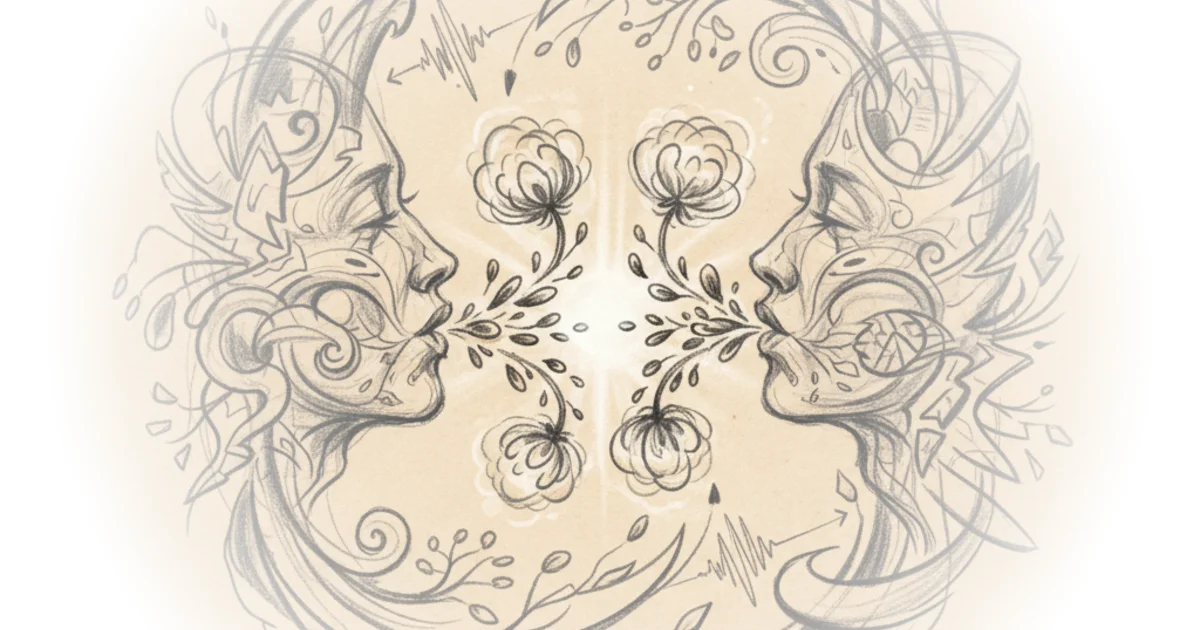
The argument here is potent because it exposes the flaw in our current tech-driven interactions. We treat our devices as perfect conduits, assuming that if the signal is clear, the meaning is preserved. But as Popova paraphrases Le Guin, "The message not only involves, it is, a relationship between speaker and hearer." The medium is not just a tube; it is a culture, a society, and a shared history. This reframing is essential for anyone trying to navigate a world increasingly mediated by screens, reminding us that the "tube" cannot carry the weight of human intent on its own.
"Words are events, they do things, change things. They transform both speaker and hearer; they feed energy back and forth and amplify it."
The Biology of Mutual Entrainment
Moving beyond the mechanical, Popova guides the reader into Le Guin's most striking biological analogy: the mating of amoebas. Le Guin uses this image to illustrate "intersubjectivity," a concept deeply rooted in the work of philosophers like Hannah Arendt, who argued that human existence presupposes a spectator. Popova writes that for Le Guin, "My private model for intersubjectivity, or communication by speech, or conversation, is amoebas having sex."
This is a bold, visceral choice. Le Guin explains that unlike human heterosexual reproduction, which she argues is often hierarchical and one-directional, amoebas "literally give each other inner bits of their bodies" through a channel made of their outer bodies. Popova emphasizes that this is a "continuous interchange between two consciousnesses," not a mechanical alternation of roles. The commentary here lands with force because it shifts the metric of success from "information accuracy" to "mutual transformation."
Critics might argue that Le Guin's dismissal of human sexual dynamics as "more like a lecture" oversimplifies the complexity of human intimacy, which can be deeply reciprocal. However, the point stands that in the realm of speech, the ideal is a total melding of perspectives, where the speaker and listener are equally responsible for the outcome. Popova captures this by noting that "Listening is not a reaction, it is a connection."
"Talking and listening are ultimately the same thing."
The Physics of Voice and Community
The piece deepens by introducing the physics of "entrainment"—the phenomenon where oscillating objects, like clock pendulums, eventually swing in unison. Popova explains how Le Guin applies this to human biology: "All living beings are oscillators. We vibrate." When we speak, we are not just transmitting data; we are physically syncing our rhythms with another person.
This section is particularly effective because it grounds abstract emotional concepts in hard science. Le Guin argues that "Successful human relationship involves entrainment — getting in sync. If it doesn't, the relationship is either uncomfortable or disastrous." Popova extends this to the power of sound itself, distinguishing between "scenery" (the static visual of a mountain) and "event" (the sound of it exploding). "Sound signifies event," she writes, quoting Le Guin. "A noise means something is happening."
This distinction is vital. In a visual culture obsessed with static images and curated feeds, Le Guin reminds us that speech is dynamic action. "The voice creates a sphere around it, which includes all its hearers: an intimate sphere or area, limited in both space and time." The commentary suggests that this physical limitation is actually a strength, creating a temporary, sacred community that digital broadcasts often fail to replicate.
"When you speak a word to a listener, the speaking is an act. And it is a mutual act: the listener's listening enables the speaker's speaking."
The Magic of the Living Word
Finally, Popova connects these biological and physical insights to the realm of art and storytelling. She argues that great writers are those who can trigger this entrainment, offering "the irreproducible moment, the brief, fragile community of story told among people gathered together in one place." The act of reading or listening to a story is not passive consumption; it is a "communion we long for in the silence of our inner solitude."
Popova's framing of Le Guin's work as a remedy for modern isolation is compelling. The argument is that we seek out these "living responses" because they fulfill a fundamental human need for synchronization. As Popova puts it, "The living tongue that tells the word, the living ear that hears it, bind and bond us." This elevates the act of conversation from a utility to a form of magic, where the very act of speaking changes the speaker and the listener.
Bottom Line
Popova's curation of Le Guin's "Telling Is Listening" offers a necessary antidote to the sterile, transactional view of communication that dominates our digital age. Its greatest strength lies in grounding the mystical act of conversation in biological and physical reality, proving that our connection is as much about rhythm and vibration as it is about words. The piece's only vulnerability is its idealism; it assumes a willingness to be vulnerable that many in our polarized world may find difficult to summon, yet the vision of mutual phase-locking remains a powerful goal for any society seeking to heal.