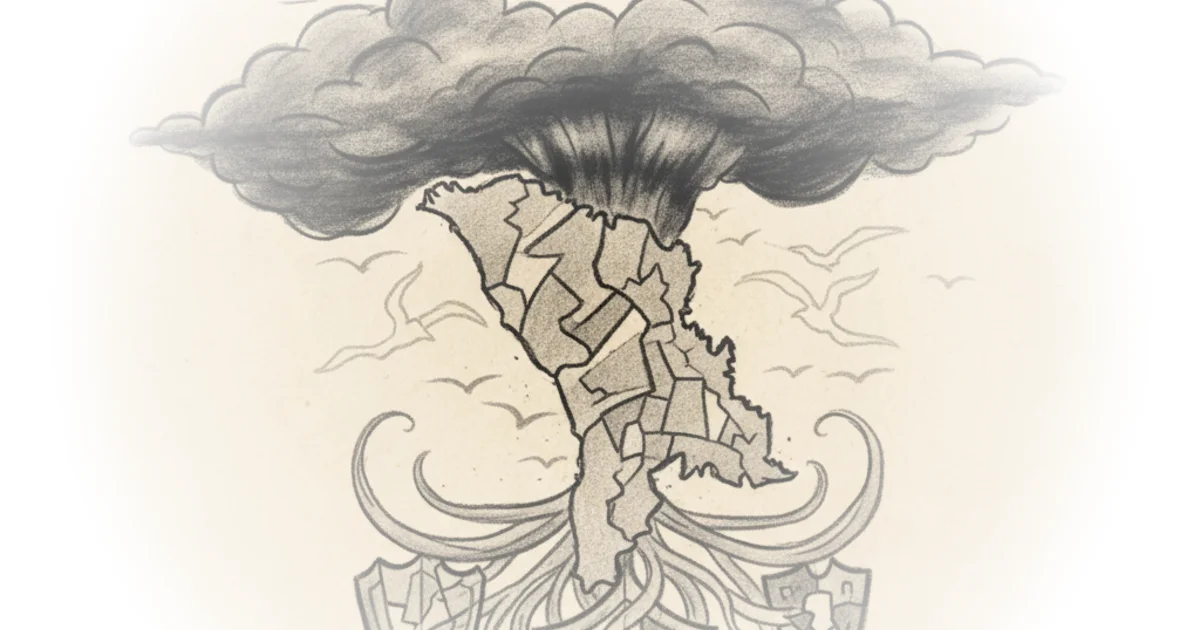
David Smith delivers a sobering reality check: while the world fixates on the immediate explosions in the Middle East, the true danger for Moldova lies in the "long tail" of economic strangulation that follows. The piece is notable not for predicting the next missile strike, but for exposing how a nation with no strategic oil reserves is suddenly forced to play catch-up in a global market where the rules have just changed. Smith argues that the closure of the Strait of Hormuz has triggered a crisis that dwarfs the oil shocks of the 1970s, turning Moldova's energy insecurity from a theoretical risk into an immediate panic.
The Geopolitical Domino Effect
Smith's analysis begins by dismantling the assumption that Moldova is insulated from Middle Eastern conflicts. He writes, "The closure of the Strait of Hormuz has led to skyrocketing oil prices," setting the stage for a cascade of failures in global energy security. The author highlights a disturbing trend where the administration in Washington has begun "temporarily" dropping sanctions against Russian energy, effectively allowing Moscow to replenish its war chest while peace talks in Ukraine freeze. This reframing is crucial; it shifts the narrative from a simple proxy war to a complex economic realignment where the executive branch's policy shifts inadvertently empower adversaries.
The piece draws a sharp contrast between the resources available to Gulf states and those left for Ukraine. Smith notes, "Incredibly, the United States and Gulf nations expended more Patriot Missile interceptors in 3 days than have been used by Ukraine since 2022." This statistic is devastating in its simplicity. It underscores a strategic vulnerability: the U.S. had long argued it needed to limit Patriot sales to Ukraine to maintain a deterrent against China, a logic that now seems precarious as stocks deplete in the Middle East. As Smith puts it, "Now, with US stocks rapidly depleting and Arab Gulf states running dangerously low on interceptors, they have turned to Ukrainian experts to help them with a more cost effective drone and missile defense." This irony—that Ukraine is being asked to teach others how to defend against the very threats it faces while its own supplies dwindle—adds a layer of tragic urgency to the coverage.
"The longer the war lasts the harder it will be to restart this production. With analysis saying that this is already the largest oil shock in history (with the potential to dwarf 1973 and 1979) it is clear that the crisis could have a long tail."
Critics might argue that the Pentagon's assertion of being "not concerned" about Russian aid to Iran is a diplomatic stance rather than a reflection of operational reality. However, Smith's focus on the material consequences—the depletion of missile stocks and the rise in oil prices—grounds the argument in tangible risks that transcend diplomatic posturing.
Moldova's Energy Precipice
The commentary then pivots to the domestic front, where the abstract global crisis becomes a concrete threat to Chisinau's stability. Smith observes that while there are no immediate shortages, "worries have set off panic-buying that is causing lines and emptying gas stations." The author exposes a critical gap in national preparedness: the EU requires 90 days of reserves, yet Moldova's commercial stocks cover only 21 to 30 days. This disparity is the core of the vulnerability.
The government's response, a 60-day State of Alert and a proposed law to mandate 90-day reserves split between the state and private companies, is presented as a necessary but belated scramble. Smith writes, "The proposal states that 60% of the reserves would need to be kept in-country," a detail that highlights the logistical nightmare of securing fuel in a landlocked nation dependent on imports. The situation is even more dire in Transnistria, where the gas supply was cut immediately, forcing the MGRES power plant to switch to coal. This mirrors the historical reliance on Soviet-era infrastructure that has plagued the region, much like the strategic petroleum reserves in India that were only fully realized after decades of vulnerability.
Smith notes that the crisis is accelerating the renewable transition, with renewables covering 24.5% of electricity consumption in 2025. "The country ended the year with 980 MW of installed capacity, up from 77 MW in 2020," he writes, suggesting that the very instability threatening the country is also forcing a modernization that could eventually insulate it from such shocks.
Domestic Fractures and Institutional Trust
Beyond energy, Smith turns a critical eye toward Moldova's internal political dynamics, where the pressure of external threats is exacerbating internal fractures. The piece details the controversy surrounding the nomination of Herman von Hebel to the Prosecutor's Evaluation Commission. Smith captures the tension when he notes that the ruling party "abruptly voted to change the law on vetting to reduce the required threshold to a simple majority," a move that drew widespread condemnation from civil society.
The author quotes President Maia Sandu defending the move: "In this Parliament, there are not 61 deputies who support justice reform. There are not." This justification, while politically expedient for the majority, is framed by Smith as a dangerous precedent. The Legal Resources Center's Ilie Chirtoacă is quoted calling it "an absolutely regrettable decision, because it is not justified, it was not consulted and I think it will serve as a rather bad signal for the European Commission."
"This is not reform, it is the reflex of a majority that prefers to change the rules of the game rather than play by them."
The commentary also addresses the tragic death of Ludmila Vartic, the wife of a PAS party official. Smith navigates this sensitive topic with care, noting that while the National Coalition "Life Without Violence" labeled it "femicide," the police found no prior reports of domestic violence. The author writes, "At the core there is a tragic death, and an accusation by a well respected coalition of NGOs without accompanying evidence or clear sourcing." This balanced approach highlights the difficulty of navigating public outrage and due process in a high-pressure political environment.
Finally, Smith touches on the "Alliance of Sovereign Nations" gathering in Washington, where Moldovan MP Vasile Costiuc aligned with far-right figures. The event, organized by MAGA-aligned groups, featured speakers opposing globalism. Smith's inclusion of this detail serves as a reminder that Moldova's political landscape is increasingly influenced by transnational ideological currents, complicating its path toward European integration.
Bottom Line
Smith's strongest argument lies in his ability to connect the dots between a distant war in the Middle East and the empty gas pumps in Chisinau, proving that no nation is an island in a globalized energy crisis. The piece's greatest vulnerability is its reliance on the assumption that the proposed energy reserve laws will be implemented effectively before the next shock hits. Readers should watch closely to see if the government can bridge the gap between emergency declarations and long-term infrastructure investment.