Robert Yaman makes a counterintuitive claim that will unsettle many environmentalists: the path to better treatment for farm animals isn't less growth, but more. He argues that industrialization, often vilified for its cruelty, actually created the economic surplus necessary for us to care about animal welfare in the first place.
The Wealth Paradox
Yaman begins by dismantling the romantic notion of the pre-industrial farm. He notes that "in historical terms, the way we raise farm animals today is strikingly new," pointing out that the industrial shift only began after World War II. This transformation, while controversial, delivered a massive economic windfall. He writes, "a century ago, the average American household spent 40% of their income on food. Today, that figure is just 10%."
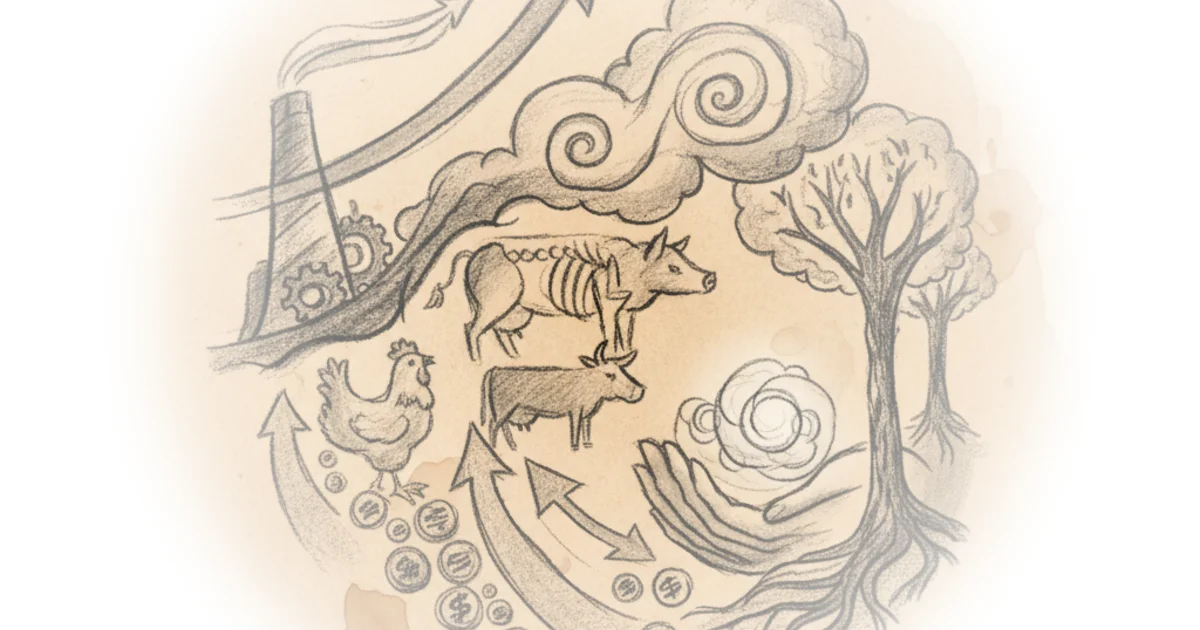
This data point is the foundation of his entire thesis. Yaman argues that when people are struggling to feed themselves, animal welfare is a luxury they cannot afford to prioritize. "Animal welfare may be difficult to prioritize when food is scarce and you're worried you might not have enough of it," he observes. Once basic needs are met, however, the national conscience shifts. He cites the overwhelming public support for the 1958 Humane Methods of Slaughter Act, noting that President Eisenhower remarked, "If I went by mail, I'd think no one was interested in anything but humane slaughter."
The author's framing here is effective because it reframes industrialization not as the enemy of ethics, but as the prerequisite for it. Critics might argue that this ignores the immediate suffering caused by the industrial model itself, suggesting that we shouldn't have to wait for wealth to fix cruelty. Yet, Yaman's historical evidence suggests that without the efficiency gains of the mid-20th century, the market for higher-welfare products—like the cage-free eggs that now make up over 40% of production—would never have emerged.
Wealth represents the ability to sculpt the world into what we want it to be. An agricultural system that is both abundant and in line with our values is something we clearly want, but we don't currently have.
Engel's Law and the Future of Care
Yaman leans heavily on "Engel's Law," the economic principle stating that as income rises, the percentage of income spent on food falls, even as the absolute amount spent increases. He uses this to explain why we see a bifurcation in the market today. In wealthy urban centers, animal welfare isn't a niche; it's the baseline. "Visit a Whole Foods in San Francisco or New York, and you'll find that animal welfare isn't just a premium option - it's built into their business model," he writes.
This observation highlights a crucial dynamic: prosperity allows for the segmentation of the market, where consumers can pay a premium for ethical production. Yaman suggests that as societies get richer, the cost of welfare improvements becomes trivial. "For challenges that represent true trade-offs with efficiency, like giving animals more space, we'll need to be rich enough as a society that the cost becomes trivial," he argues.
He extends this logic to the developing world, suggesting they can "leapfrog" the worst of our historical mistakes. "A new hatchery in Vietnam, for instance, can implement in-ovo sexing or other Hatchery of the Future technologies from the start rather than having to make a costly transition away from conventional methods later." This is a compelling vision of global progress, though it assumes that technology will always be cheaper than the labor it replaces, a premise that isn't guaranteed in every economic context.
The Case for Radical Growth
Perhaps the most provocative part of Yaman's commentary is his rejection of the "degrowth" movement. He contends that slowing the economy would lock us into a state where we must choose between feeding people and treating animals well. "The overall trend we therefore see over the last 100 years is that as the wealth of Americans grew due to economic gains from industrialization, they spent a smaller percentage of their income on food. However, they also spent more on food in absolute terms," he summarizes.
Looking forward, he ties this economic optimism to the potential of artificial intelligence. He envisions a future where AI allows for "top-notch individualized care to millions of individual animals at a time," a feat impossible under current constraints. "As we look toward a future of potentially unprecedented wealth from advances in AI, we have an opportunity to take this even further: to build an agricultural system that truly reflects how we believe animals should be treated," Yaman writes.
This is where the argument faces its steepest climb. While the economic theory holds, the political reality of distributing that wealth remains a massive hurdle. Just because a society can afford better welfare doesn't mean the market or the government will automatically deliver it. Yaman acknowledges that "government support could play a crucial role" for challenges where market forces fail, but he places the ultimate burden on the existence of surplus wealth itself.
Bottom Line
Yaman's strongest contribution is the historical reminder that ethical consumption is a luxury good, and that poverty is often the true barrier to animal welfare, not just industrialization. His biggest vulnerability is the assumption that economic growth will naturally translate into ethical progress without aggressive policy intervention. The reader should watch for whether the coming AI boom actually lowers the cost of humane farming or simply concentrates wealth further, leaving the moral choices to the few rather than the many.