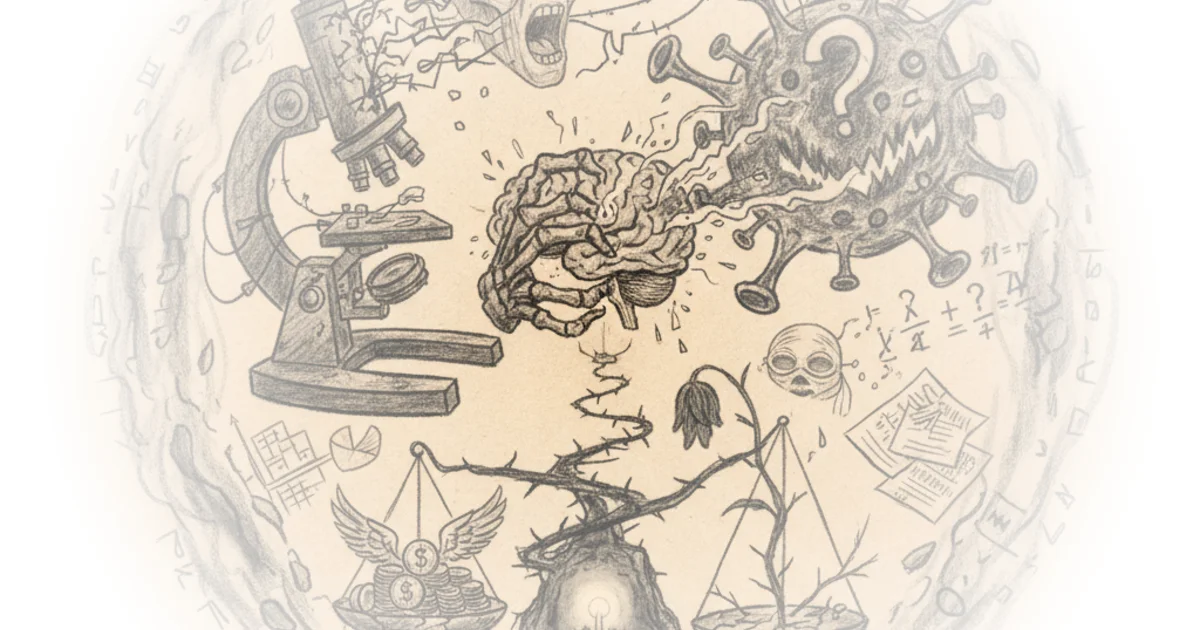
Rohin Francis delivers a searing indictment not of politicians who ignore science, but of the scientists who actively dismantled it during the pandemic. While public discourse often blames government inaction or media hype, Francis argues that the most damaging confusion came from within the scientific community itself, turning a crisis of uncertainty into a catastrophe of misinformation.
The Death of Nuance
Francis opens by challenging the pervasive political refrain that decisions were simply "following the science." He argues this phrase implies a false certainty that never existed. "The statement pisses me off because it implies that science is like deep thought a big computer that spits out solutions," Francis writes. This framing is crucial because it shifts the blame from a lack of data to a failure in communication. The core of his argument is that science is inherently messy, yet the public was sold a narrative of absolute clarity that collapsed under the weight of reality.
The author pinpoints the moment this breakdown occurred: the initial, global panic over ibuprofen. "I knew at that moment that covert was going to pervert science like never before," Francis recalls, noting how a single theoretical line and a few anecdotes were elevated to global policy without rigorous proof. This illustrates a systemic failure where the scientific community, terrified of the unknown, defaulted to caution that quickly metastasized into dogma. Critics might argue that in a novel pandemic, extreme caution is the only ethical path, but Francis contends that the lack of transparency about the uncertainty of that caution is what destroyed public trust.
Science was murdered not by a conspiracy, but by a thousand small compromises where certainty was demanded where none existed.
The Statistical Mirage
The commentary then dissects how flawed statistics were weaponized to create false narratives, from the claim that smoking offered protection to the dangerous suggestion that blood pressure medication should be stopped. Francis explains the concept of "collider bias" to show how a large British study erroneously suggested smokers were less likely to suffer severe outcomes. "You might end up with stats that suggest smoking is beneficial due to erroneous correction and or missing information," he explains. This is a vital lesson for any reader trying to navigate health news: correlation is not causation, and adjusting for the wrong variables can invert reality.
Francis also tears into a study linking acid reflux medication to higher infection rates, highlighting a sample population that was demographically impossible. "Six percent were covered positive which is higher than the proportion out of all people tested," he notes, pointing out that the study's participants were overwhelmingly wealthy, young, and smokers. The fact that this study, driven by financial incentives for survey completion, was never retracted despite being "torn to pieces" by the community, underscores a rot in the publication process. The author's frustration is palpable as he describes how pre-print servers, intended for rapid peer feedback, became a wild west where "millions of eyeballs are on them ready to believe whatever they see."
The Erosion of Authority
Perhaps the most damaging section focuses on how high-profile scientists, including former heroes of the field, fell into the very traps they had previously warned against. Francis discusses the Santa Clara study by John Ioannidis, which claimed infection rates were far higher than reported, effectively downplaying the virus's lethality. "Yanidis did the rounds on fox news and the like," Francis writes, noting how a pre-print without peer review became the primary evidence for politicians arguing against lockdowns. This highlights a dangerous dynamic where institutional prestige can shield flawed methodology from immediate scrutiny.
The piece also addresses the confusion around masks, arguing that the demand for randomized controlled trials for a low-risk intervention was a strategic error. "The people who demand randomized controlled trials are wrong," Francis asserts, arguing that the scientific community failed to communicate that masks were a precautionary measure to protect others, not just the wearer. He suggests that if leaders had admitted uncertainty early on while advocating for caution, the issue might not have become a partisan wedge. "We're all aware of the utterly confusing messaging on masks initially," he writes, noting that the CDC and surgeon general actively discouraged masks, a decision that "never made any sense" given the subsequent reality.
The public aren't dumb; they saw through the contradiction that masks didn't work for the public but were needed for healthcare workers, and trust evaporated.
Bottom Line
Francis's most compelling contribution is his refusal to let scientists off the hook for the pandemic's misinformation crisis, arguing that the failure was one of hubris and poor communication rather than just bad luck. The piece's greatest vulnerability is its broad brush, which occasionally risks conflating honest scientific debate with outright negligence, yet its core diagnosis—that the demand for false certainty killed trust—remains a powerful warning for future public health crises. Readers should watch for how institutions handle uncertainty in the next global emergency, as the lessons of 2020 suggest that admitting "we don't know" is far more effective than pretending to have all the answers.