Then & Now delivers a rare feat: making Immanuel Kant's dense, 18th-century epistemology feel like a urgent, practical toolkit for navigating modern chaos. Rather than getting lost in the technical weeds of the Critique of Pure Reason, the piece reframes Kant's entire project as the solution to a fundamental human problem—how we construct a coherent reality from a flood of sensory noise. This is not just a history lesson; it is a guide to the mental operating system that allows us to function at all.
From Chaos to Cosmos
The piece opens with a bold assertion about the stakes of Kant's work. Then & Now writes, "He saw that people had been pushed around by religious sellers, by powerful leaders, and by arrogant metaphysicians and he wanted to prove and show how we could think for ourselves." This framing immediately elevates Kant from a dry academic figure to a liberator of the human mind. The argument is that Kant offered a way to strip away "misconceptions, false opinion, all this fuzz, all this confusion, all this complexity" to find "pure reason" within us.
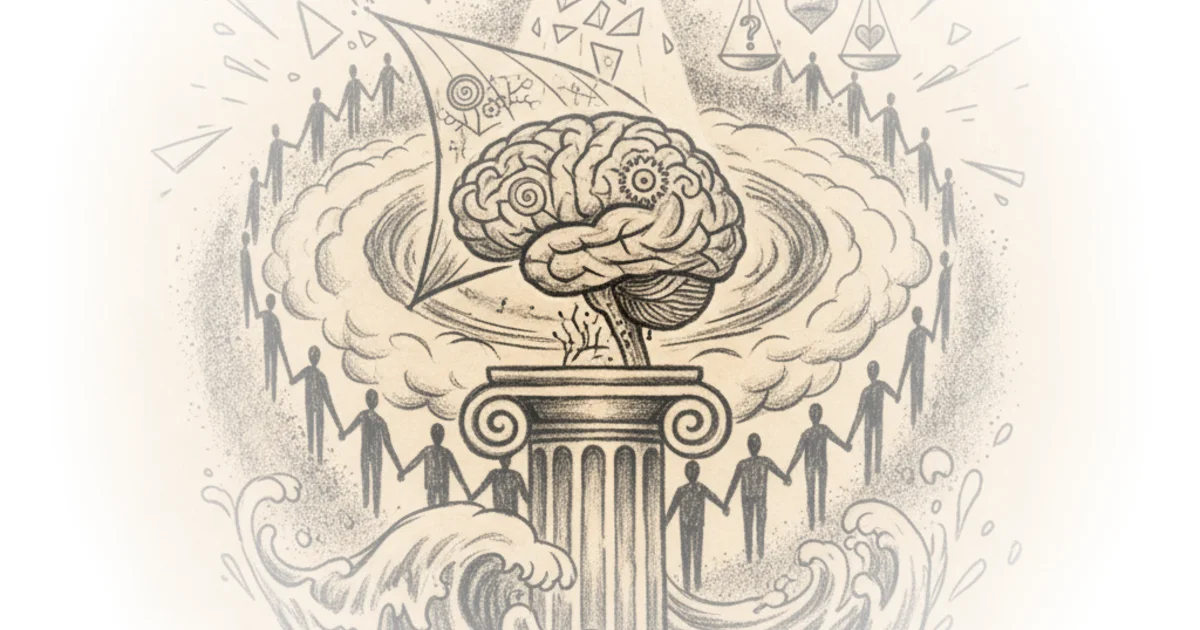
The coverage effectively simplifies Kant's response to the Scottish philosopher David Hume. Hume had argued that we cannot know anything with certainty because all knowledge comes from sensory experience, which is fallible. Then & Now explains that this skepticism "deeply disturbed Kant" because it threatened the emerging scientific method. If we cannot trust that the sun will rise tomorrow simply because it has always done so, then science has no secure foundation. Then & Now notes, "It awoke him from his dogmatic slumber," a famous phrase Kant used to describe his own intellectual awakening. The piece argues that Kant's solution was to realize that we are not passive receivers of data; we are active constructors of reality.
"How do we in here constitute a cosmos out of chaos?"
This central question drives the narrative. Then & Now paraphrases the philosopher Immanuel Velasquez, suggesting that Kant asks how we create meaning from the "billions of artists' paintbrush strokes" that hit our senses every second. The commentary here is sharp: it visualizes the overwhelming nature of raw data. "Half a billion photons hit the retina every single second," the text notes, yet we manage to form a "comprehensible picture." The piece argues that without an internal organizing system, our experience would be nothing more than "content without form."
The Architecture of Thought
The most distinctive part of this coverage is its rejection of standard philosophical introductions. Then & Now explicitly avoids the typical "a priori" examples like "bachelors are unmarried men," calling that route "confusing." Instead, it focuses on the mechanism of conceptualization. The author writes, "Conceptualizing is what we do in every moment; it's the foundation of thought itself." This is a crucial pivot. It shifts the reader's focus from abstract definitions to the active process of thinking.
The piece explains that Kant proposed a synthesis between empiricists (who say knowledge comes from outside) and rationalists (who say it comes from inside). Then & Now quotes Kant's famous dictum: "Thoughts without content are empty; intuitions without concepts are blind." This quote lands with significant weight because it clarifies that neither raw data nor pure logic is sufficient on its own. We need both the input from the senses and the internal "operating system" to process it.
The commentary then tackles the concept of "a priori" knowledge—truths that exist independently of experience. Then & Now describes this as the "elixir" or "holy grail" of pure thought. The argument is that space and time are not things we learn from the world; they are the lenses through which we see the world. "Space is not an empirical concept that has been drawn from outer experiences," the piece quotes, explaining that we must already have a framework of space to even perceive an object as being "over there." This is a profound claim: our perception of reality is pre-structured by our own minds.
Critics might note that this idealist perspective can feel counter-intuitive to modern readers steeped in materialism. It suggests that the structure of the universe is, in a sense, a projection of the human mind. However, Then & Now mitigates this by grounding it in the practical necessity of having a "compass" for right and wrong, just as we have one for physical navigation. The piece writes, "The starry heavens above me and the moral law within me" are the two things that fill the mind with reverence. This dual focus on the physical and the ethical gives the argument a humanistic depth that pure epistemology often lacks.
"Reason is a goal-oriented activity whose goal lies in itself rather than in anything other than itself."
This insight reframes rationality not as a tool for achieving external ends, but as an end in itself. Then & Now uses the metaphor of a beaker or measuring jug: the mind takes the crude data of the outside world and shapes it according to its own rules. This is a powerful image for busy readers who often feel overwhelmed by the sheer volume of information they must process. It suggests that the ability to focus and categorize is an innate power, not a learned skill.
The Practical Payoff
The coverage concludes by returning to the idea of integrity and trustworthiness. Then & Now writes, "The most important value that you can bring to the table is your integrity, is your trustworthiness." This connects the abstract machinery of Kant's philosophy back to the reader's daily life. If we are the ones who constitute our reality, then we are also responsible for the moral laws we follow. The piece suggests that understanding this "inner compass" allows us to navigate the "unbounded magnitude" of the world with confidence.
The argument is effective because it avoids the trap of making Kant seem irrelevant. Instead, it presents his work as the foundation of modern scientific and moral reasoning. The piece asserts that Kant wanted to make humanity a "truly scientific species" by discovering the "laws that governed human thought." This is a high bar, but the commentary supports it by showing how Kant's ideas underpin our very ability to make sense of schedules, relationships, and physical laws.
Bottom Line
Then & Now succeeds in demystifying one of philosophy's most difficult subjects by focusing on the human experience of chaos versus order. The strongest part of the argument is the reframing of space and time as internal tools rather than external facts, a concept that fundamentally changes how one views perception. The piece's biggest vulnerability is the risk of oversimplifying Kant's complex proofs, but this is a necessary trade-off for accessibility. For the busy reader, the takeaway is clear: we are not passive victims of our environment; we are the architects of our own understanding.