Cory Doctorow delivers a stinging correction to the tech industry's collective amnesia, arguing that the current explosion of artificial intelligence isn't a triumph of pure genius, but a lucky accident of timing. He posits that the sector is built on a specific historical window where hardware trends and data availability aligned perfectly, creating a false sense of inevitability that blinds investors to the technology's fundamental flaws.
The Illusion of Meritocracy
Doctorow begins by dismantling the myth of the self-made tech titan. He recounts his own entry into the field, noting, "I often tell young people who want to get into tech, 'Well, if you don't have the foresight and work ethic to be born in 1971, I can't really help you.'" This framing is crucial because it shifts the conversation from individual hustle to structural advantage. He describes a generation that benefited from a unique convergence of cheap education, accessible computing power, and a labor market that rewarded curiosity over credentials. "I got to go to university, too, at a time when education was cheap enough that I could drop out of four schools before figuring out that it wasn't for me, and still be debt-free," he writes. This personal anecdote isn't just nostalgia; it's a data point proving that life outcomes are often determined by "world-historic forces" rather than just personal grit.
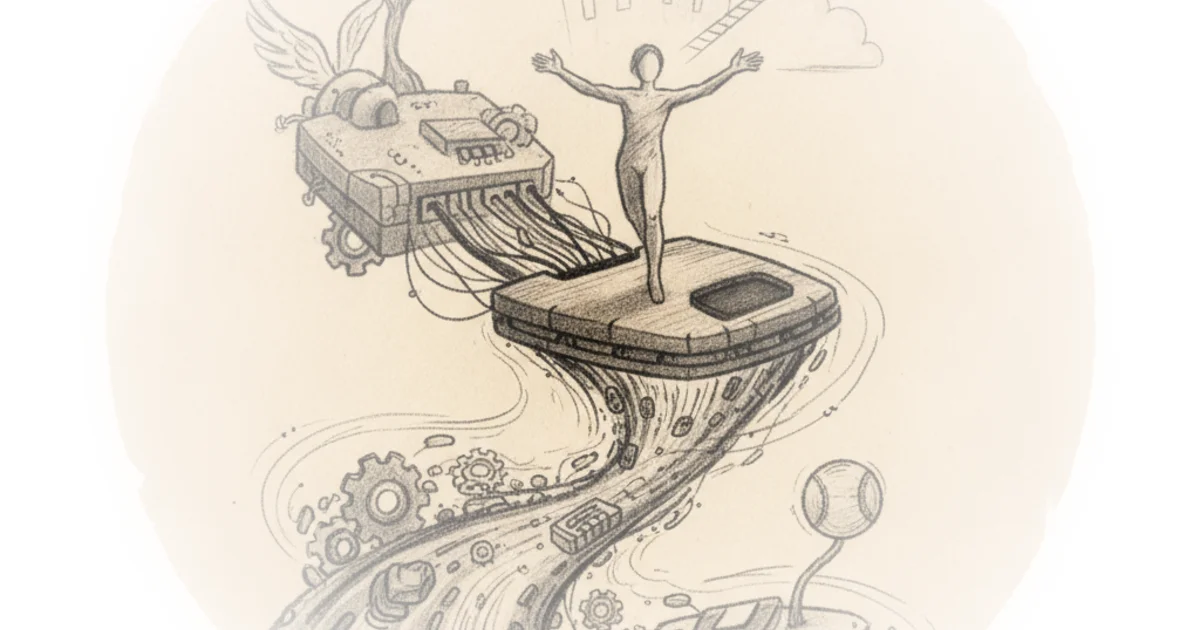
The argument gains depth when Doctorow connects this to the physical limits of computing. He explains that for decades, the industry rode the wave of Moore's Law, where computers simply got faster every year without needing architectural changes. "When Moore's Law tapped out... computing changed with it," he observes, marking the shift to parallel computing as the true engine of the current era. This historical pivot is often overlooked in favor of narratives about software brilliance. The rise of Graphics Processing Units (GPUs) created a specific environment where tasks that could be broken down into parallel chunks thrived. "This is the era of performance gaming, VR and AR, cryptocurrency, and, of course, AI," Doctorow notes. The implication is clear: AI didn't win because it was the best tool for the job; it won because the hardware landscape suddenly favored its specific architecture.
Historical contingency produced the AI bubble, and it is producing the conditions for that bubble to pop.
The Trap of Theory-Free Inference
Doctorow then turns his critique toward the methodology driving the current AI boom: "theory-free inference." He describes this as a brute-force approach where systems learn by consuming massive datasets rather than understanding causal relationships. "Deep learning swapped the painstaking work of describing reality in software for a brute-force approach: throw lots more training data at the system and then throw lots more (parallel) computing power at that data," he explains. This is a powerful critique of the industry's reliance on scale over understanding. He argues that while this method works for predicting the next word in a sentence, it fails catastrophically when faced with novel situations that require genuine reasoning.
He illustrates this limitation with a stark example involving chess. "As Gary Marcus describes in a recent Organized Money interview, an LLM can recite the rules of chess, but it can't play chess because — lacking a theory of how chess works — it will just emit statistically likely chess moves," Doctorow writes. This comparison highlights a dangerous gap between performance and competence. The industry has convinced itself that correlation is a sufficient substitute for causation, a stance Doctorow calls "grossly wasteful, inefficient and unreliable" for many real-world applications. Critics might note that theory-free inference has achieved remarkable results in fields like protein folding and language translation, suggesting that the "understanding" gap is narrowing. However, Doctorow's point remains that relying solely on statistical probability is a fragile foundation for critical infrastructure.
The Danger of Doubling Down
The final section of the commentary addresses the economic and societal risks of ignoring these limitations. Doctorow warns that the massive capital inflow into AI is based on the belief that the current model can solve everything. "The AI companies have proved that there are many domains and applications where we can swap scale for understanding. But... they cannot be dissuaded from their conviction that theory-free inference and scale can do everything," he argues. This hubris, he suggests, is reminiscent of the housing bubble, where boomers mistook a rising market for financial genius. "By the same token, continuing to give trillions to AI companies because they experienced early success with theory-free inference at scale tells us nothing about how to solve the vast range of problems that theory-free inference at scale sucks at," he concludes.
The piece serves as a necessary reality check for a sector intoxicated by its own momentum. Doctorow's framing of AI as "born on technology's third base" effectively strips away the mystique, revealing a system that is highly dependent on specific, non-replicable conditions. He urges a shift in focus from scaling up current models to developing systems that actually understand the world. "Doubling down on AI to overcome its increasingly obvious limitations is like doubling down on building post-war suburbs to fix today's housing market," he writes, a metaphor that perfectly captures the futility of applying old solutions to new structural problems.
Bottom Line
Doctorow's strongest argument is the reframing of AI's success as a product of historical accident rather than inevitable progress, a perspective that challenges the industry's core investment thesis. The piece's biggest vulnerability is its potential dismissal of the rapid, albeit narrow, capabilities of current models, but its warning against conflating statistical correlation with causal understanding remains a vital critique for policymakers and investors to heed.