Most observers assume China's renewable energy surge signals the imminent end of its coal era. Asianometry dismantles this assumption with a stark reality check: the absolute volume of coal burning is still rising, driven by physics, economics, and deep-seated inertia that no amount of solar panel installation can easily override.
The Coal Paradox
Asianometry begins by contextualizing China's energy hunger, noting that the nation has been the world's single largest energy consumer since 2011, with demand growing at an average of 4% annually since 1980. The author argues that while headlines focus on green transitions, the underlying infrastructure remains stubbornly fossil-fuel dependent. "China has the largest installation of renewable energy in the world," Asianometry writes, "but there is still a problem." This framing is crucial because it separates the narrative of capacity from the reality of reliability. The piece effectively highlights that while newly installed capacity is now 70% renewable, the sheer scale of growth means coal generation has actually increased by 41% in absolute terms between 2010 and 2019.
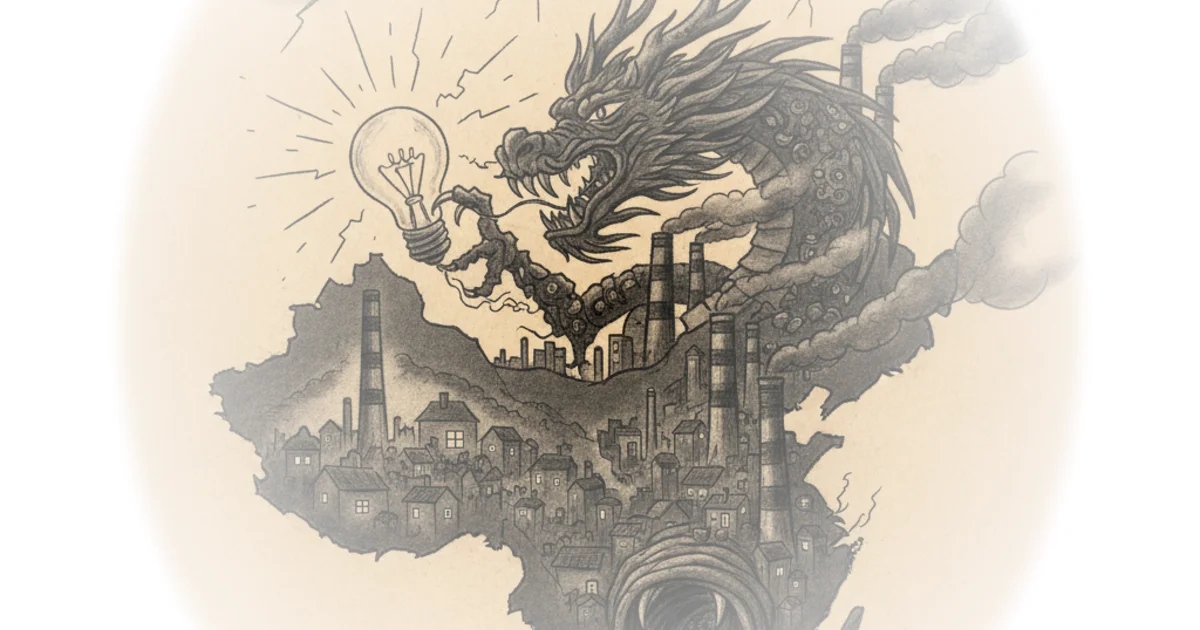
The author identifies four structural barriers preventing a faster exit from coal. First, technical competency gaps mean China's energy efficiency lags developed nations by roughly 10%. Second, the intermittency of wind and solar requires expensive battery storage and massive transmission upgrades. "Renewable energy is not as reliable as coal," Asianometry explains, pointing out that rivers run low and the sun sets, creating gaps that coal fills without hesitation. Third, the geography of resources is a logistical nightmare; nearly 70% of domestic coal comes from the remote north and west, while consumption centers are in the south and east. This necessitates a "billion dollar super grid" of high voltage direct current cables, adding significant cost to the final kilowatt.
The economics of coal power are quite good. Estimates from 2015 find that internal rates of return for a 600 megawatt coal fired power plant are far above financial benchmarks, reaching nearly 18% in Guangdong.
This economic argument is the piece's most compelling insight. It suggests that without a radical shift in pricing mechanisms or subsidies, market forces will naturally favor coal. Asianometry notes that the internal rate of return for coal plants can hit 18%, a figure that is difficult for investors to ignore. Critics might note that this analysis relies heavily on historical cost data and may underestimate the speed at which renewable storage costs are dropping globally. However, the author's point about the "marginal break even cost" of renewables being disadvantaged by transmission and storage expenses remains a formidable hurdle.
The Inertia of Industry
Beyond the physics and economics, the commentary digs into the bureaucratic and political inertia that locks the system in place. Energy providers in China are deeply local, with decades of experience and entrenched incentives that favor the status quo. "Government and economic inertia" is cited as the fourth and most significant reason for the continued reliance on coal. The central government struggles with a lack of transparency around generation costs, obscured by subsidies and bad data, leading to a cycle of over and under capacity in mining.
The supply chain dynamics further complicate the picture. Domestic coal is becoming more expensive due to stricter safety regulations and mine consolidation, while imported coal from places like Australia and Indonesia offers higher quality at lower prices. This created a precarious situation in the autumn of 2021, where a trade dispute with Australia, combined with a global manufacturing rebound, led to a coal shortage. "As coal prices rose, utilities, their cost dependent on the cost of their major input, fell into the red," Asianometry writes. This financial squeeze forced utilities to reduce utilization hours, triggering the very blackouts the system was designed to prevent.
The entire world relies on a single country to produce pretty much everything for them, China. And China in turn relies on million years old dead plant rocks to power this magnificent industrial machine.
This juxtaposition of global dependency and fragile domestic energy security is the piece's emotional core. The author argues that the manufacturing sector is extremely sensitive to outages, with historical data suggesting that blackouts can cost billions in lost output. The situation is exacerbated by climate change itself; rising temperatures are driving an exponential increase in cooling demand. In Guangdong, energy consumption for air conditioning has risen tenfold since 2000. "For every 1° C increase in the temperature, the annual electricity usage rises by nearly 10%," the text notes, with peak consumption rising even more sharply.
The Path Forward
The commentary concludes by assessing the difficulty of the transition. With the average Chinese coal-fired plant only 12 years old, moving away from coal risks stranding billions in assets that have not yet depreciated. "Getting the country's energy industry to change that is going to be as hard as getting the United States to wean off oil," Asianometry asserts. This comparison to the US oil industry effectively illustrates the magnitude of the political and economic challenge. The solution requires unprecedented central government involvement, including the creation of nationwide wholesale markets and better coordination between provinces.
Critics might argue that the author underestimates the political will of the central government to enforce green mandates over local economic interests, given the high stakes of climate policy. Yet, the piece maintains a sober tone, suggesting that while progress is being made, the timeline for a coal-free grid is far longer than the headlines suggest.
Bottom Line
Asianometry's strongest contribution is its refusal to conflate renewable capacity with renewable reliability, exposing the economic and logistical realities that keep coal dominant. The argument's biggest vulnerability lies in its reliance on current cost structures, which may shift rapidly with technological breakthroughs in battery storage. Readers should watch for how the administration navigates the tension between stranding young coal assets and preventing the kind of supply shocks that cripple the global manufacturing chain. The transition is not just an environmental imperative but a complex economic puzzle that the world is watching unfold.