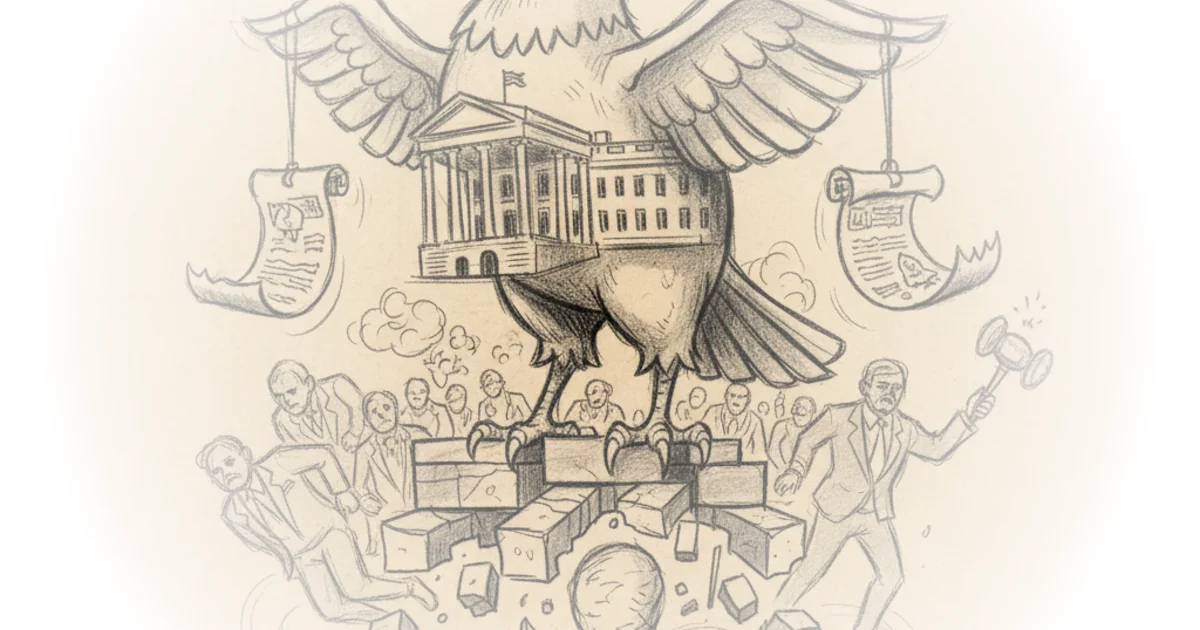
Laura Rozen's latest analysis for Diplomatic delivers a stark, data-driven verdict: the executive branch is no longer operating with unchecked authority, but is instead confronting a rapid erosion of power driven by economic reality and institutional pushback. While the narrative often focuses on political theater, Rozen pivots to the hard metrics of consumer sentiment and the tangible consequences of policy failure, arguing that the administration has effectively become a lame duck before its term is even halfway through.
The Illusion of Control
Rozen begins by dismantling the administration's recent attempts to spin the narrative around the longest government shutdown in U.S. history. She notes that as the leader signed legislation to reopen the government, he "threw out a claim about the price of a Thanksgiving meal at Walmart supposedly costing 25% less this year than last year." Rozen immediately contextualizes this as a disconnect from reality, pointing out that the administration's own data does not support the claim and that such "gimmicky" assertions only highlight a growing gap between the White House and the daily financial struggles of Americans.
The author argues that this disconnect is not merely rhetorical but structural. She writes, "The gimmicky claim only showed how out of touch [the administration] is with the experience of most Americans who actually go to the grocery store on a regular basis and face not only rising food costs, but higher housing, energy, health care, and other costs." This observation is crucial because it shifts the blame from abstract political maneuvering to concrete economic pain. The administration's suggestion that Americans should simply stop paying insurance companies and pay for care directly is dismissed by Rozen as a "half-baked thought" that offers no concrete pathway for the 22 million people relying on federal tax credits.
The fundamental problem for [the administration] is that he promised prices would fall, but voters are getting the opposite.
Critics might argue that economic cycles are complex and that blaming a single administration for inflation ignores global supply chain issues. However, Rozen's reliance on polling data suggests that voters are making a direct causal link between policy and their wallets, regardless of external factors.
The Epstein Shadow and Institutional Friction
The piece takes a darker turn as Rozen examines the administration's reaction to the release of new emails regarding Jeffrey Epstein. She describes a White House that is "suddenly on defense, not shaping the narrative, but reacting to it." The author highlights a specific moment of vulnerability: when reporters attempted to question the President about the emails, "the White House cut off the livestream feed." This act of censorship, Rozen suggests, is a sign of desperation rather than strength.
Rozen details the contents of the emails, quoting the House Oversight Committee's summary that Epstein wrote in 2011 that the President "spent hours at my house" with a victim and was referred to as the "dog that hasn't barked." The author uses this to illustrate a shift in power dynamics, noting that the President is now facing pressure from within his own party. She points out that officials were forced to lobby Republican lawmakers like Lauren Boebert to prevent a discharge petition that would force the release of more Justice Department documents. Rozen characterizes the administration's response as "Orwellian," citing their claim of "transparency" while actively trying to suppress the very information they claim to support.
This section of the analysis is particularly effective because it moves beyond the sensationalism of the emails to the institutional mechanics of the cover-up. The fact that the administration had to resort to lobbying its own allies to stop a vote indicates a loss of the "supplicant" control the President previously enjoyed over Congress.
The Economic Reality Check
Perhaps the most damning part of Rozen's argument is her synthesis of polling data to show that the administration's political base is crumbling under the weight of economic dissatisfaction. She cites an AP-NORC poll showing that only "three in ten adults approve of [the administration's] handling of the economy, health care, or the federal government," with overall disapproval sitting at 62%.
Rozen draws a powerful parallel to the previous administration, stating, "Perhaps the best way to communicate the scale and potential consequences of the Republicans' problem on the economy may be the following sentence: Donald Trump is Joe Biden now." She clarifies that this is not a partisan slur but a reflection of voter sentiment: "voters now hold [the administration] as responsible for high prices and low economic mobility... as they held [the previous administration] in 2024." The University of Michigan's consumer sentiment index, which she notes has fallen to 50.3, is described as "the second-lowest on record," a figure that underscores the depth of public anxiety.
Trump has set himself up for failure on prices since setting foot in the Oval Office in January.
Rozen's use of G. Elliot Morris's analysis reinforces the idea that this is a structural failure. The argument that bringing prices down would require "massive austerity and deflation" creates a political trap for the administration: they cannot fix the economy without causing further pain, yet they are being blamed for the current pain. This creates a scenario where the President appears to have broken every promise made on the economy.
Bottom Line
Rozen's most compelling contribution is her refusal to treat the administration's struggles as mere political noise, instead framing them as a fundamental collapse of the executive branch's credibility on the economy and its ability to control the narrative. The piece's greatest strength lies in its synthesis of hard polling data with specific institutional failures, proving that the "lame duck" status is a result of voter rejection and internal friction rather than just political timing. The biggest vulnerability in this argument is the assumption that economic dissatisfaction will inevitably translate to immediate political consequences, a dynamic that has sometimes defied historical precedent. Readers should watch closely for whether the administration's attempts to suppress information on the Epstein case will trigger a broader institutional crisis that further accelerates this loss of power.