In an era where finance is often portrayed as a parasitic force, Bari Weiss makes a startlingly contrarian claim: that America's survival and prosperity were forged not just by generals and statesmen, but by the "moneybags" who risked their own fortunes to keep the nation alive. This piece is notable because it refuses to treat capital as a villain, instead framing the history of American banking as a series of high-stakes acts of patriotism that modern regulation has largely erased.
The Architect of Credit
Weiss begins by resurrecting Robert Morris, a figure often overshadowed by Washington and Hamilton, to argue that the Revolution was funded by personal credit rather than state power. She writes, "For three critical months in the winter of 1777, when Congress fled Philadelphia for the relative safety of Baltimore, Morris ran the operations of the American government virtually single-handed." This framing is effective because it shifts the narrative from political ideology to logistical reality; without Morris's ability to borrow against his own reputation, the Continental Army would have starved.
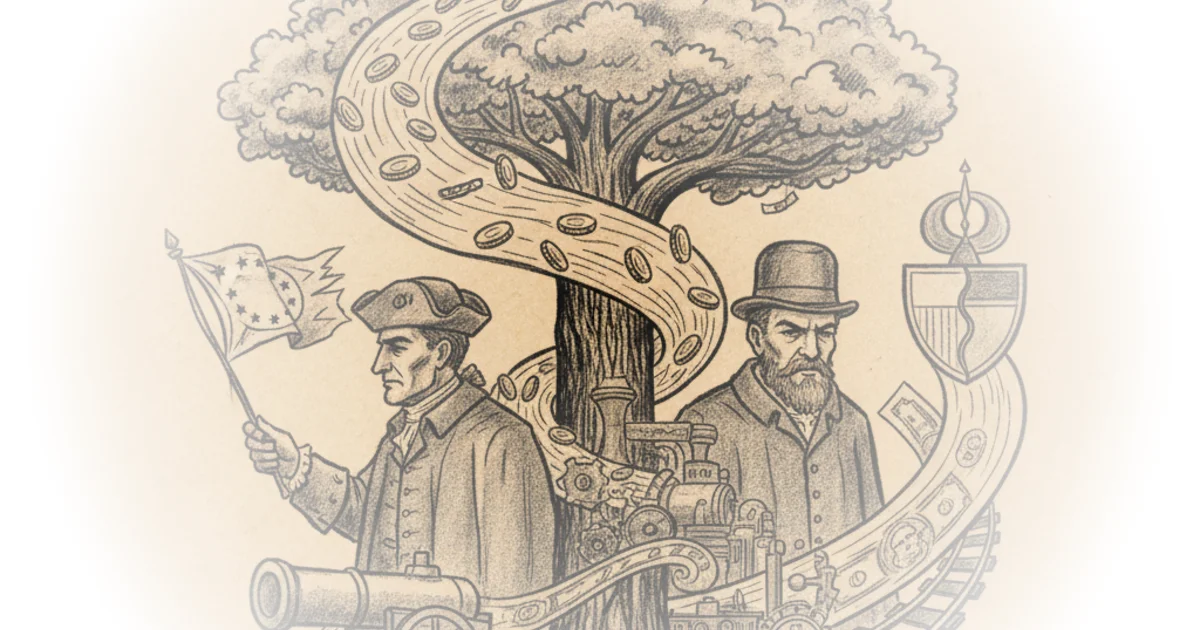
The author highlights Morris's radical improvisation in the face of a government with no power to tax. As Weiss notes, "My personal credit, which thank Heaven I have preserved through all the tempests of the War, has been substituted for that which the Country has lost. I am now striving to transfer that Credit to the Public." This quote captures the essence of the argument: the early American state was held together by the private solvency of its founders. Morris didn't just manage money; he became the currency.
Morris didn't just manage money; he became the currency.
Weiss details how Morris founded the Bank of North America, envisioning it as a "Pillar of American Credit" designed to "unite the several states more closely together in one general money connection." The argument here is that financial institutions were the glue of the union, binding powerful individuals to the national cause through "the strong principle of self-love and the immediate sense of private interest." This is a compelling, albeit cynical, view of nation-building that suggests shared economic interest is a more durable bond than shared ideology.
However, the piece glosses over the fact that Morris's later financial ruin—driven by massive land speculation in the 1790s—was not just a personal tragedy but a warning about the volatility of unchecked speculation. Critics might note that celebrating Morris's optimism ignores the systemic risks his land deals posed to the very stability he sought to build. Yet, Weiss maintains that his "boldness" remains a necessary counter-narrative to the modern fear of risk.
The Bull in a Crisis
The commentary then pivots to George F. Baker, the "dean of American bankers," whose career spanned the Gilded Age and the Great Depression. Weiss contrasts the modern, insured, and heavily regulated banking system with the "federally uninsured, lightly regulated" First National Bank of New York, which Baker led. She writes, "Pay every claim presented as long as the money lasts... When we stop paying it will be because there is not a single dollar in the till, and none obtainable." This quote underscores a philosophy of absolute transparency and confidence that Weiss argues is now extinct.
The author portrays Baker as a man who understood that a bank's value lay in its reputation, not just its reserves. "The bank and the nation always snapped back from panics and depressions... stronger than before," she argues, suggesting that the resilience of the market was tied to the courage of its leaders. This framing is powerful in a time of economic anxiety, offering a historical precedent for the idea that faith in the future can be a self-fulfilling prophecy.
Yet, the piece acknowledges Baker's fatal flaw: his refusal to reduce exposure during the 1929 crash. "I was a damn fool," Baker admitted after his net worth was halved. Weiss uses this moment to humanize the titan, showing that even the most "indomitable" optimists can misread the market. A counterargument worth considering is that Baker's "bull" mentality, while noble in spirit, may have contributed to the depth of the crash by preventing a necessary correction in asset values.
The famously lucky banker had salvaged a kind of victory even from that unforced error.
Weiss concludes by linking these two figures to a broader thesis about American exceptionalism. She notes that the "sky-high level of household net worth expressed as a percentage of gross domestic product" confirms that the current era is, for owners of capital, "the good old days." The argument is that the "fear of God"—a phrase attributed to banker George G. Williams regarding the secret to success—should be replaced by a renewed faith in the market's ability to self-correct and build civilization.
Bottom Line
Weiss's strongest move is reframing the history of American finance as a story of patriotic sacrifice rather than greed, using the specific, high-stakes examples of Morris and Baker to challenge modern regulatory orthodoxy. The argument's biggest vulnerability is its tendency to romanticize the lack of regulation, overlooking the human cost of the panics and crashes that these "bold" bankers navigated. Readers should watch for how this historical ideal of the "patriot financier" collides with the realities of a modern, globalized, and deeply interconnected financial system where individual courage is no longer enough to prevent systemic collapse.