Perun cuts through the noise of Russian nuclear posturing to reveal a startling truth: the "Skyfall" missile isn't a terrifying leap forward, but a dangerous resurrection of a discarded Cold War folly. By reframing the weapon not as a strategic breakthrough but as a symptom of "Superweapon Syndrome," the author challenges the assumption that exotic military technology automatically translates to battlefield dominance. This is a crucial distinction for busy observers who might otherwise mistake propaganda for progress.
The Anatomy of a "Flying Chernobyl"
Perun begins by dismantling the hype surrounding the Burvestnik, or "Skyfall," a nuclear-powered cruise missile that Vladimir Putin recently touted as having "unlimited range and unconditional advantages." The author notes that while the Kremlin claims this weapon has shocked the world into silence, the reality is far more mundane and perhaps more concerning. "Some commentators were quick to note that the nuclear-powered cruise missile was a concept both the Soviets and US had looked at and discarded as obsolete as far back as the mid-Cold War." This historical context is vital; it suggests that the technology isn't new, but rather a failed idea that Russia is trying to force into relevance.
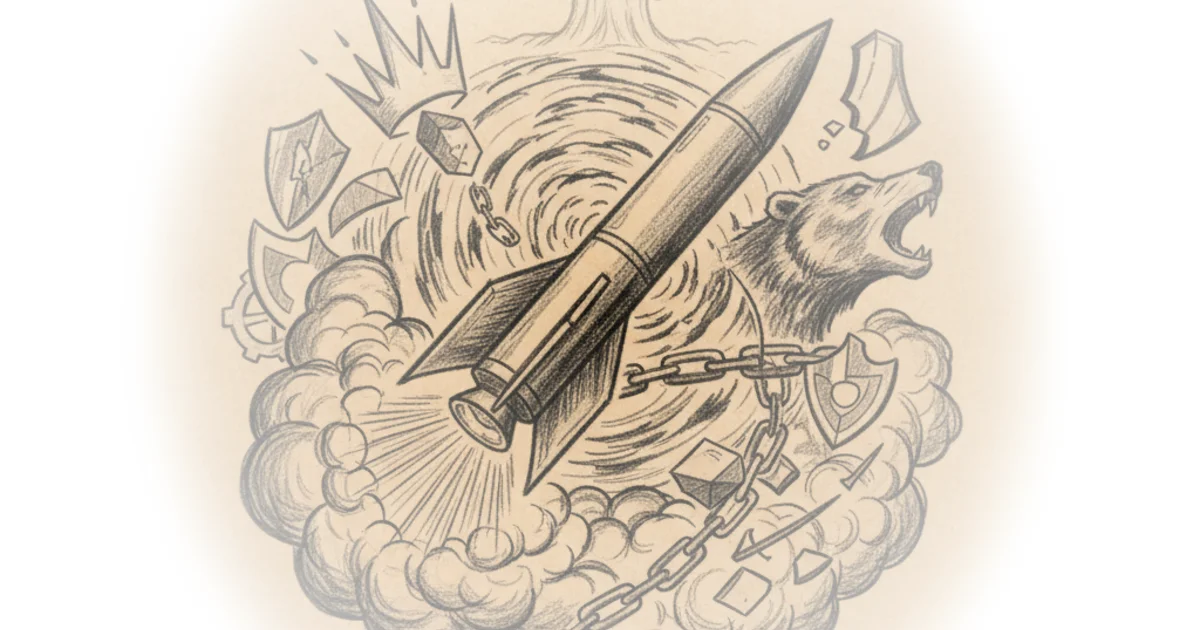
The core of Perun's argument rests on the sheer absurdity of the engineering challenge. The missile relies on a direct-cycle nuclear reactor to heat air for propulsion, a method that essentially turns the weapon into a "flying Chernobyl" that spews radioactive exhaust constantly. Perun writes, "Even though there isn't currently anything like Skyfall in service anywhere, that basic concept of using a nuclear reactor to propel something in the air is a very old one." The author traces this lineage back to the 1950s, when both the US and USSR experimented with nuclear aircraft before realizing the environmental and strategic costs were too high.
"The core concept was in many ways similar to Russia Skyfall, just with everything dialed up to 11... outputting a constant sonic boom and stream of radioactive products out the back, presumably going after not just your opponent's military bases and defense industrial targets, but also local home values."
This vivid description underscores the weapon's indiscriminate nature. Perun argues that the US canceled similar programs like Project Pluto in the 1960s precisely because the collateral damage was unacceptable. The fact that Russia is reviving this concept today, amidst a brutal war in Ukraine, raises serious questions about resource allocation. A counterargument might suggest that Russia simply has different strategic priorities or a lower tolerance for risk, but Perun's evidence points to a deeper issue of institutional obsession.
The Human Cost of "Superweapon Syndrome"
The commentary takes a darker turn when addressing the human toll of this development. Perun highlights a tragic incident in August 2019 where five Russian nuclear engineers died during a test of the missile's power unit. "The relevant test reportedly took place on an offshore platform in the Arctic at a Navy test range and there was reportedly a small radiation spike detected in a Russian city 40 km east of the test range." The author notes that while the exact cause is debated, the outcome is undeniable: a "reactor criticality accident" that killed and injured personnel while releasing radiation.
This tragedy serves as the emotional anchor for Perun's broader thesis on "Superweapon Syndrome." The author defines this as "the tendency of militaries, be they historical or fictional, to sometimes pour resources into novel or exotic weapons programs of dubious value, rather than the more boring and practical stuff that often helps win or deter wars." This is a powerful framing device. It shifts the narrative from "Russia is building scary new toys" to "Russia is wasting precious resources on a broken concept."
"A former US State Department official now at the Arms Control Association described the weapon as quote unquote end quote. With massive questions over why in the middle of a hard-fought war in Ukraine, Russia would be diverting resources towards this thing."
Perun's critique is sharp here. The author acknowledges that Russia is capable of building effective weapons, citing successes like the Iskander missile system. However, the Skyfall represents a departure from practicality. "The Soviet Union and now the Russian Federation is capable of designing and building very effective weapon systems, but from what we can tell, this just isn't one of them." This distinction is crucial for readers trying to separate Russian military competence from Russian strategic blunders.
Critics might argue that the deaths of the engineers were an isolated accident rather than a symptom of a flawed program, or that the missile's psychological impact on the West justifies the cost. Yet, Perun's analysis suggests that the technical hurdles are insurmountable without unacceptable risks. The author points out that the US abandoned the concept not because they couldn't build it, but because they realized it wasn't worth it.
"The core points at this stage are probably that from a raw engineering perspective, this concept is feasible and that both the Soviet Union and United States were looking into it well over half a century ago. They looked at it and even against the backdrop of the Cold Wars porn for crazy nuclear weapons decided this wasn't the way to go until many many decades later at least one decision maker in Moscow apparently decided that perhaps the whole flying Chernobyl concept deserved a second look."
The Strategic Implications
Perun concludes by zooming out to consider the broader implications of this phenomenon. The author suggests that the Skyfall is less about military utility and more about political signaling. Putin's 2018 "superweapon speech," which unveiled the missile alongside other exotic systems, was a clear attempt to project power in the face of US missile defense advancements. "You didn't listen to our country then. Listen to us now," Putin reportedly said, framing the new arsenal as a response to American actions.
However, Perun argues that this strategy is flawed. By focusing on "superweapons," Russia may be neglecting the conventional forces that are actually needed to fight the war in Ukraine. The author writes, "This is what you get when you combine two long-running areas of Russian military engineering experience, nuclear propulsion and missile systems." The result is a weapon that is technically impressive but strategically questionable.
"But before we jump into why sticking a nuclear reactor in an oversized cruiser missile and then flying it over your own country might not be the greatest idea ever, a quick word from a sponsor."
While the sponsor break is a standard feature of the original video format, Perun's transition back to the analysis is seamless. The author uses the break to reset the tone, reminding readers that the discussion is about serious strategic analysis, not just sensationalism. The focus returns to the "Superweapon Syndrome," a concept that explains why nations continue to invest in doomed projects despite clear evidence of their failure.
Bottom Line
Perun's analysis of the Skyfall missile is a masterclass in separating hype from reality, using historical precedent to expose the folly of "Superweapon Syndrome." The strongest part of the argument is the connection between the weapon's technical failures and the broader strategic missteps of the Russian military. The biggest vulnerability is the reliance on limited open-source intelligence to confirm the missile's current status, though the historical parallels are compelling enough to stand on their own. Readers should watch for how this "superweapon" narrative is used to justify further resource diversion in a war that demands practical solutions.