Then & Now challenges the comforting narrative that humanity is on a linear march toward peace, arguing instead that our capacity for destruction has simply evolved alongside our technology. This piece is notable for its refusal to dismiss the "dark side" of history as mere regression, suggesting instead that the very engines of our progress—reason, profit, and innovation—are the same forces that enable our most catastrophic failures.
The Illusion of Linear Progress
The author opens by dismantling the "Whiggish" view of history, a framework that sees time as a constant triumph toward a better future. Then & Now writes, "The idea that history improves over time has taken many forms... describing it as the tendency in many historians to write on the side of Protestants and Whigs to praise revolutions provided they have been successful." This framing is crucial because it exposes how our historical biases often serve to validate the present rather than understand the past. The author argues that while we have moved away from the visceral brutality of the Crusades or Roman crucifixions, we have merely traded them for more efficient, bureaucratic horrors.
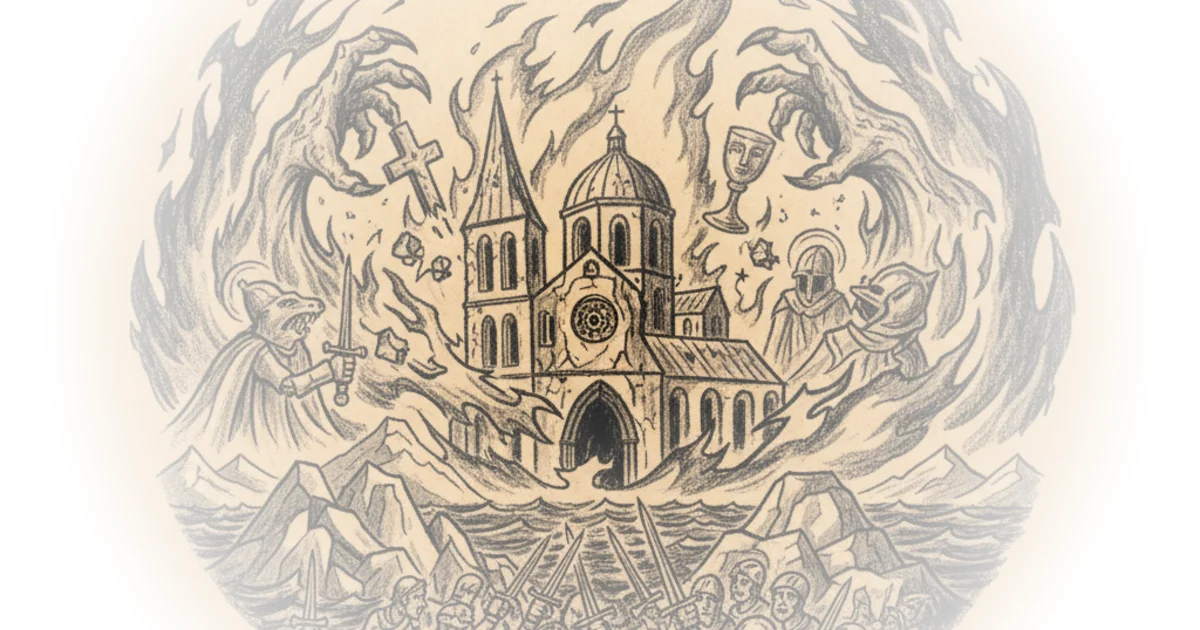
The piece highlights that modern atrocities often rely on the very tools we celebrate. Then & Now notes, "Science, technology and modern methods of bureaucracy were necessary for the holocausts to take place in the way that it did." This is a sobering correction to the idea that enlightenment automatically equals morality. Critics might argue that the sheer scale of modern life-saving medical and agricultural advances outweighs these dark chapters, yet the author's point stands: our capacity for harm has not diminished; it has been industrialized.
"These are Frankenstein moments when progress becomes Faustian, when Enlightenment reverts to mythology, when innovation trips itself up."
The Limits of Reason
A central pillar of the commentary is the critique of pure rationalism. The author invokes David Hume to suggest that logic is merely a tool, not a moral compass. Then & Now explains, "Reason could only ever be the slave of the Passions... thinking logically can tell us how to do something but it cannot tell us what to do in the first place." This distinction is vital for understanding why intelligent people can orchestrate terrible events. The author illustrates this by noting that mathematics and engineering can lead to both "light bulbs or guns" and "running water or poison."
The text further explores how the Enlightenment's obsession with "light" and "vision" as symbols of reason often blinded thinkers to the irrational drives of humanity. Then & Now writes, "If a hypochondriac wind clamors in the gut it all comes down to the direction it takes; if it goes downward it becomes a fart but if it goes upwards it is an apparition or a holy inspiration." This witty observation underscores the fragility of our self-perception as purely rational actors. We are driven by desires that logic cannot fully contain or direct.
The Systematization of Greed
Perhaps the most striking shift in the argument is the move from irrational violence to the calculated pursuit of profit. The author argues that the Enlightenment replaced older ethical guidelines with a new force: greed. Then & Now states, "Greed has always existed but profit systematized this was new. Human desire could become superhuman." This reframing suggests that the Industrial Revolution and colonialism were not just about expansion, but about the mathematical optimization of self-interest.
The piece traces how thinkers like Thomas Hobbes and Adam Smith legitimized the pursuit of power and profit as natural or even beneficial. Then & Now observes, "The love of power is natural it is insatiable." This systematization allowed for a scale of exploitation that was previously unimaginable, turning human beings into variables in a profit equation. The author notes that while the Bible warned against greed, the new economic philosophy argued that "private vices and the pursuit of self-interest led to public good." This tension remains unresolved in modern society, where efficiency often trumps empathy.
"The neutral release of energy can be used for both good and evil; discoveries can be used to both emancipate and dominate."
Bottom Line
Then & Now delivers a powerful corrective to the assumption that technological advancement guarantees moral superiority, proving that our capacity for evil has simply become more sophisticated. The argument's greatest strength lies in its synthesis of history and philosophy to show that reason and greed are double-edged swords, yet its vulnerability is a slight overemphasis on the inevitability of this "dark side" without offering a clear path to harnessing our rationality for restraint. Readers should watch for how this analysis applies to current debates on artificial intelligence, where the same "Frankenstein moments" of innovation outpacing wisdom are beginning to unfold.