In an era where artificial intelligence development feels increasingly like a high-stakes arms race, Packy McCormick offers a counter-intuitive thesis: the path to true breakthrough isn't more compute, but more weirdness. While the industry chases incremental gains on existing architectures, McCormick argues that the most profound shifts in history—from Newtonian physics to modern biology—came from pursuing ideas that initially seemed absurd or even occult. This is not a call for blind contrarianism, but a rigorous case for intellectual exploration as a survival strategy for both individuals and the tech ecosystem.
The Alchemist's Legacy
McCormick anchors his argument in a startling historical fact that reframes the narrative of scientific genius. He writes, "Jeova Sanctus Unus was an alchemist... His real name was Isaac Newton." By revealing that the father of classical physics spent thirty years obsessively studying alchemy, McCormick dismantles the modern myth of the purely rational scientist. He argues that Newton's willingness to entertain "weird ideas" about active principles and invisible forces was the very engine that drove his discoveries in gravity and calculus.
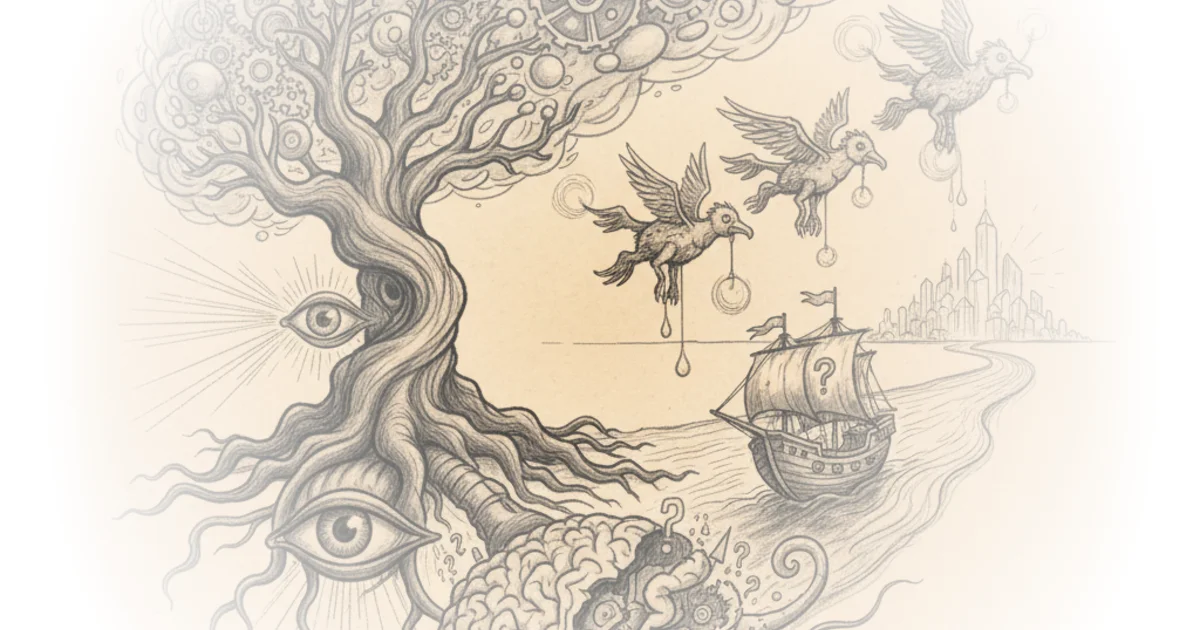
The author suggests that the modern dismissal of such fringe concepts is a strategic error. "The people who change the world are the ones who take weird ideas seriously," McCormick asserts. This framing is compelling because it shifts the metric of success from immediate validation to long-term potential. It challenges the reader to consider that the "weirdness" of an idea is often a signal of its novelty, not its invalidity. However, this romanticization of the outlier risks glossing over the fact that for every Newton, there are thousands of alchemists who wasted their lives on dead ends. The risk of failure is inherent, yet McCormick insists it is a necessary cost.
Taking weird ideas seriously means that when you encounter an idea – from others, or from insight – that others would dismiss or may never have thought of in the first place, you study it with the same rigor you'd apply to more standard ones.
Escaping the Local Maximum
The commentary then pivots to the current state of the technology sector, diagnosing a dangerous stagnation. McCormick observes that the AI industry is largely in an "exploit" phase, merely tweaking existing transformer architectures and adding more energy and graphics processing units. He invokes the work of theoretical biologist Stuart Kauffman to explain this phenomenon, describing the industry's current trajectory as a climb to a "local maximum." In this metaphor, companies are stuck on a small hill, where any attempt to move forward actually takes them backward, trapping them in a suboptimal state.
To escape this trap, McCormick argues that we need the raw material of "weird ideas" to facilitate a jump to a higher peak. He highlights the work of Extropic, a startup using thermodynamic sampling units to harness thermal noise rather than fighting it. "Instead of fighting the natural randomness in circuits, Extropic treats it as a feature," he notes. This example serves as a potent illustration of his thesis: by importing concepts from quantum computing and combining them with classical approaches, the company is attempting to open up the "Adjacent Possible"—a realm of innovation that was previously invisible to the mainstream.
Critics might note that relying on such high-risk, high-reward ventures is a fragile strategy for an industry that currently demands predictable returns. The financial pressure to deliver results often forces companies to stick to the safe, incremental path of exploitation, making the "weird" approach a luxury few can afford. Yet, McCormick contends that without this exploration, the entire field risks hitting a hard ceiling.
The Bioelectric Revolution
The argument extends beyond silicon into the realm of biology, where McCormick identifies a similar pattern of orthodoxy stifling progress. He points to the dominance of the "central dogma" of biology—the idea that DNA encodes all information—as a local maximum that researchers have been climbing for seventy years. Into this rigid framework steps Michael Levin, whose work on bioelectricity suggests that organisms function more like collective intelligences than genetic machines.
McCormick describes Levin's findings as initially dismissed as "vitalism," a debunked superstition, yet they have yielded startling results, such as growing heads on flatworms in the wrong places by manipulating ion channels. "If you want to understand something, sequence it," the author paraphrases the prevailing view, before contrasting it with Levin's approach: "What if organisms are less like machines executing genetic programs and more like collective intelligences solving problems?" This shift in perspective has already begun to expand the search space for medical breakthroughs, from regenerative medicine to understanding aging.
The weird idea makes other ideas thinkable. It expands the search space. Often, innovation comes from connecting distant domains.
McCormick reinforces this point by citing historical precedents where "weird" ideas eventually won the day, such as Barbara McClintock's discovery of "jumping genes" and Barry Marshall's proof that bacteria cause ulcers. In each case, the scientific establishment rejected the idea until the evidence became undeniable. The lesson is clear: the most transformative insights often arrive disguised as errors.
Bottom Line
Packy McCormick's strongest contribution is his reframing of "weirdness" not as a flaw, but as a necessary mechanism for escaping stagnation in complex systems. The piece's greatest vulnerability lies in its reliance on survivorship bias; while Newton and Levin succeeded, the essay offers little guidance on how to distinguish a world-changing weird idea from a fool's errand before the investment of decades. As the technology sector faces diminishing returns on current AI models, the call to embrace the adjacent possible is not just intellectually stimulating—it may be the only viable path forward.
The people who change the world are the ones who take weird ideas seriously.