In a cultural moment defined by the relentless churn of algorithmic speed and utilitarian fixes, PILCROW offers a startlingly different roadmap for 2026: a return to the slow, muddy, and often painful rhythm of time itself. Rather than predicting specific political outcomes or market shifts, the piece argues that the year's defining celestial event—a rare conjunction of Saturn and Neptune—demands a psychological shift away from efficiency and toward the "intolerable" clarity of unfiltered suffering and dreaming.
The Architecture of Time
PILCROW anchors the year's potential in the astrological concept of the "hinge point," specifically the convergence of Saturn, the lord of structure and limits, with Neptune, the planet of dissolution and imagination. The author notes that this alignment, occurring at the very first degree of Aries, hasn't happened since 1989, a year marked by the fall of the Berlin Wall. "Most astrologers talk about Saturn and Neptune as contraries, and about their upcoming meeting as a sign that longstanding structures—literal and figurative—will dissolving," PILCROW writes. This framing is effective because it moves beyond fatalism; it suggests that the crumbling of old systems is not a catastrophe but a necessary precondition for a new kind of reality to emerge.
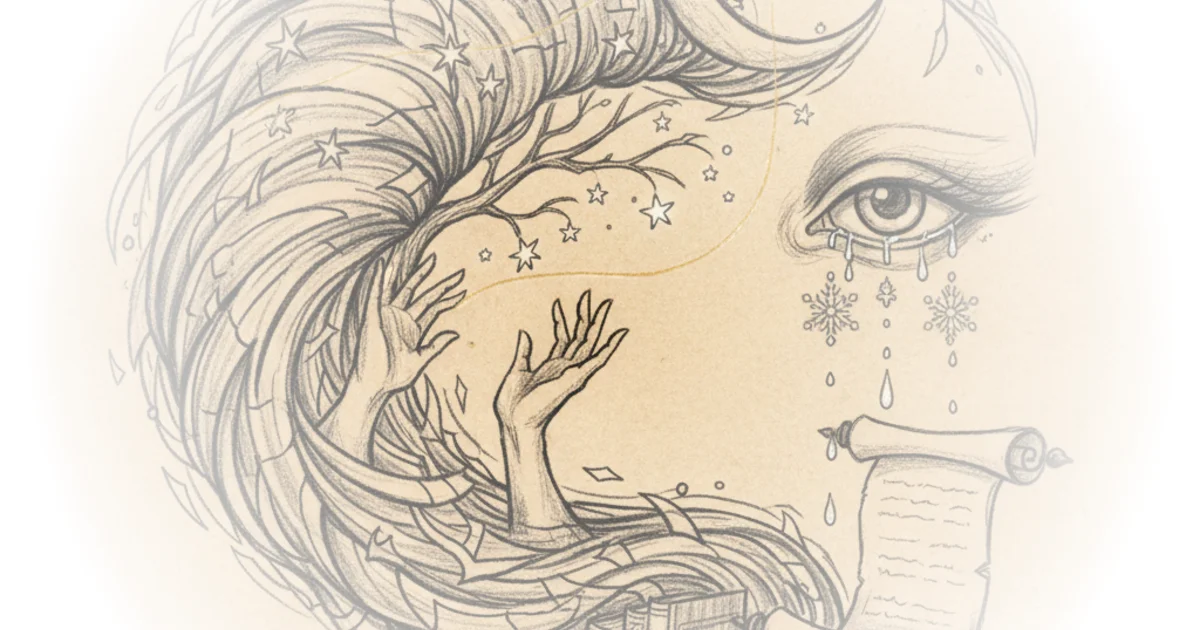
The piece leans heavily on the poetry of T.S. Eliot to describe this transition, evoking a "midwinter spring" where the boundaries between seasons blur. PILCROW suggests that the coming year will force a confrontation with the nature of time itself. "Human misery would be intolerable if it were not diluted in time," the author quotes Simone Weil, before adding the crucial counterpoint: "We have to prevent it from being diluted in order that it should be intolerable." This is the essay's most provocative claim: that the antidote to modern anxiety is not distraction or faster processing, but the willingness to sit with the raw, undiluted weight of existence.
Suffering is the relationship, Weil tells us, between past and future. Which is both nothing and everything.
Critics might note that this philosophical approach risks becoming an abstraction that offers little practical guidance for those facing immediate material crises. However, PILCROW grounds the theory in the mechanics of the sky, arguing that the planetary shift from "earth and water" to "fire and air" signals a move toward action, albeit a "weirder, thicker, more ambiguous route."
The Politics of the Inner Life
The commentary then pivots to the practical application of this cosmic weather, framing the year as a necessary retreat from the "fast utilitarian fixes" of the current era. PILCROW highlights the role of Mercury, the planet of language and communication, which will go retrograde three times in 2026. "Traditional astrology tells us that Mercury struggles in liquid: waterlogged, bogged down, sad," the author explains, interpreting this as a cosmic signal to slow down our speech and our thinking. "Slow and swimming lingo," PILCROW calls it, suggesting a cultural turn away from the fragmented, high-speed discourse that dominates public life.
This section is particularly striking in how it reframes "retrograde" not as a period of malfunction, but as a time for deep reflection. The author draws on the imagery of a "muddy river" from Eliot's Four Quartets to describe this state: "seasons and rages, destroyer, reminder of what men choose to forget." The argument implies that the collective memory we are trying to suppress is the very thing that needs to be retrieved. "The water watches and waits," PILCROW writes, positioning the unconscious mind as a guardian of truth that the conscious, busy mind often ignores.
For the reader navigating a world of constant digital noise, this call to "tread water while reading and re-reading our primary texts" offers a compelling alternative to the pressure of constant productivity. The author suggests that the "trippiest thing ever" is simply to "take reality undiluted—and to suffer."
A Year of Specificity
Rather than offering generic horoscopes, PILCROW provides a series of "hour markers" for each sign, treating them less as predictions and more as prompts for introspection. For Aries, the author warns of an "alchemical darkness" that must be endured to find gold, while for Taurus, the year is described as a time of "earthy sainthood" where one must face "the most occluded parts of your soul." The specificity of these descriptions—referencing Jean Baudrillard for Leo, Georges Bataille for Virgo, and Emily Dickinson for Sagittarius—elevates the piece from a standard almanac to a literary meditation.
The advice for Aquarius is particularly relevant to the current zeitgeist, noting that eclipses will push what was at the "edges" to the "centerstage." "What was centered may get pushed to the margins," PILCROW observes, a sentiment that resonates with the shifting power dynamics seen in global institutions. Similarly, the guidance for Pisces to reconnect with the body through movement and to treat financial spreadsheets as spiritual rituals offers a grounded counter-narrative to the disembodied nature of modern work.
No one should laugh at astrology, for he who no longer seeks to seduce the stars is the sadder for it.
A counterargument worth considering is that this focus on the internal and the celestial might inadvertently encourage a withdrawal from civic engagement. If the primary task is to "let things happen" and study the stars, does one risk becoming passive in the face of tangible injustice? PILCROW does not fully address this tension, though the emphasis on "work in service of the other" for Scorpio suggests that the internal work is meant to fuel external action, not replace it.
Bottom Line
PILCROW's meditation succeeds by refusing to offer the comfort of certainty, instead inviting the reader to embrace the "unimaginable zero summer" of a year where old structures dissolve. The piece's greatest strength is its refusal to separate the cosmic from the psychological, arguing that the "hard edges of reality" and the "oceanic dissolve" are not opposites but partners in the human experience. Its vulnerability lies in its high bar for engagement; it demands a level of introspection and patience that feels almost radical in an age of instant gratification, but for the reader willing to slow down, it provides a profound framework for navigating the maelstrom.