Benn Jordan doesn't just build a studio; he exposes the hidden physics of modern production, arguing that true audio fidelity is less about expensive gear and more about brutal, unglamorous infrastructure. In a landscape of polished, aspirational content, Jordan offers a raw, technical autopsy of a DIY project that nearly bankrupted him, proving that the barrier to entry for professional sound isn't money—it's the ability to navigate electrical noise, bureaucratic red tape, and the laws of thermodynamics.
The Architecture of Silence
Jordan begins by dismantling the romantic notion of the solitary genius in a basement, revealing that his previous setup was a "cramped dark sonically dead" trap that consumed 18 hours of his day. He frames the move to a farm not as a lifestyle upgrade, but as a necessary escape from a workflow where "the majority of the time in the production of a video was spent setting things up or tearing things down." This pivot highlights a critical insight for any creator: the environment often dictates the output more than the talent does.
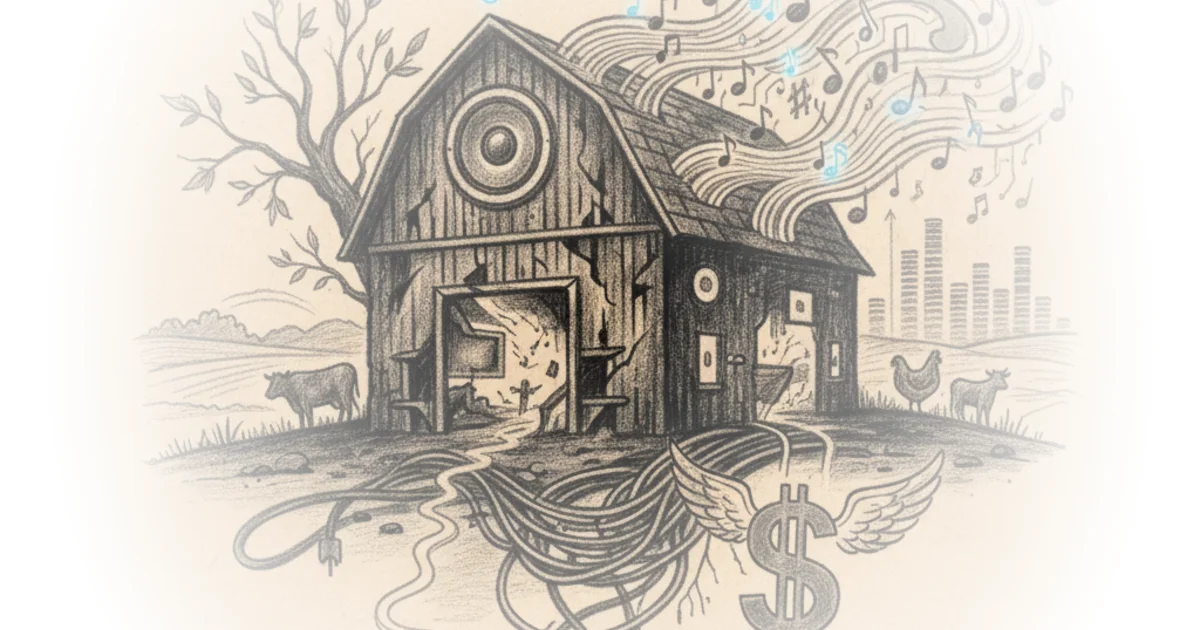
The project's scale was immediate and terrifying. Jordan notes that the time from listing to contract was "less than 24 hours," a speed that masked the "vast amount of work and responsibility" he was signing up for. He wisely opted for a single full-service contractor to avoid the industry's common pitfall of liability fragmentation. As Jordan explains, "blaming another company is a routine way to not be accountable," so he chose a firm where "the Hot Potato of liability stayed in one place." This decision underscores a broader truth about complex projects: accountability is a feature of the contract, not just the work.
"You cannot design a studio to be immune to ground noise or interference because everything in your Studio has a failure point and also because physics."
The Invisible Enemy: Power and Noise
The most technical and valuable portion of Jordan's narrative focuses on the invisible war against electrical noise. He rejects the internet's obsession with "ground loops," correctly identifying that the hum is often a symptom of complex interference rather than a simple loop. His solution was radical: a complete separation of circuits. He ran power from the main house to a subpanel, splitting it into HVAC, lighting, and audio circuits, with the audio line passing through a "PIDAL Transformer" for isolation.
Jordan is refreshingly honest about the risks involved, noting that cheap filters can be dangerous: "something like an isolation Transformer the bigger and heavier the better... or you could replace it with a ground to another circuit or a different Rod outside." He even recounts a near-fatal moment when an electrician energized a live wire while he was working underneath it, a stark reminder that in DIY construction, safety is often an afterthought until it's too late. This section is vital because it shifts the conversation from "what gear to buy" to "how to build a foundation that doesn't kill your equipment or your health."
Critics might argue that such extreme isolation is overkill for most home studios, but Jordan's point stands: in an era of digital recording, the analog noise floor is the enemy. His approach treats the studio not as a room, but as a shielded vessel.
The HVAC Paradox and Energy Reality
Jordan then tackles the climate control dilemma, a topic often ignored in audio circles. He champions "Mini Splits"—ductless systems that heat, cool, and dehumidify individually—arguing they are superior to central air for studios. He posits a cynical but plausible theory for their lack of adoption in the US: "if you owned a heating and cooling business why in the world would you prioritize training your employees on installing more cost and labor efficient devices when you could make far more money running duct work."
"The cost of your recording studio defines the quality of your recording studio... I am absolutely on the opposite side of that."
However, the reality of his build was humbling. His initial energy bill hit $879 for 4,038 kilowatt-hours, a figure that forced him to realize he was "a complete dumbass" for leaving windows open while running AC. He installed sensors on 16 circuits to find the leak, eventually cutting usage by 50%. This anecdote serves as a perfect counterpoint to the "more is better" mentality; efficiency is often the result of rigorous data, not just better equipment. He concludes that the ideal setup is a hybrid: a central unit for general comfort and a mini-split for the precise, silent climate control needed during recording.
The Infrastructure Nightmare
Perhaps the most relatable struggle for remote workers is the internet connection. Jordan's experience with AT&T highlights the absurdity of modern telecommunications infrastructure. Despite having 10-gigabit fiber available, the provider "refused to install it in the studio unless I uninstalled it from the house," forcing him to run his own line. The attempt to fish a cable through a cracked underground conduit resulted in a "fractured cuboid" bone in his foot.
His workaround—line-of-sight wireless antennas—was a triumph of engineering, delivering 1 gigabit per second until a lightning strike fried his equipment. This sequence of events illustrates the fragility of relying on third-party infrastructure. Jordan's solution was to eventually trench and terminate fiber himself, a costly but necessary step for reliability. The lesson here is clear: if you depend on a connection for your livelihood, you cannot afford to be a passive consumer of the service.
The Philosophy of Sound
Finally, Jordan addresses the hierarchy of audio gear. He rejects the idea that a $30,000 Dolby Atmos system is a prerequisite for quality. "If you are engineering solid mixes in a shed with freeware plugins on $30 computer speakers you are a God to me," he writes. This is a powerful stance in an industry obsessed with price tags. He spent six months testing monitors, prioritizing technical questions over brand prestige, and ultimately chose a path of independence over the discounts offered by manufacturers.
"I do not want to be dependent on those types of services or budgets unless I could pay for them myself."
This refusal to be swayed by industry pressure is the piece's emotional core. Jordan's journey proves that the "dream studio" isn't defined by the gear inside it, but by the integrity of the build and the clarity of the creator's intent.
Bottom Line
Benn Jordan's account is a masterclass in the intersection of audio engineering, construction management, and stubborn self-reliance. Its greatest strength is the refusal to romanticize the process, instead exposing the electrical shocks, broken bones, and bureaucratic nightmares that underpin professional results. The piece's vulnerability lies in its extreme difficulty; while the principles of isolation and efficiency are universal, the sheer capital and physical endurance required to replicate this project are out of reach for most. Ultimately, the takeaway is not to buy a farm, but to respect the invisible infrastructure that makes creativity possible.