In a field often dominated by mathematical formalism, Slavoj Žižek delivers a startling provocation: quantum physics desperately needs philosophy, but only if it rejects the spiritual mysticism currently hijacking the conversation. This piece, drawn from a 2025 conference on Lee Smolin's work, argues that the true revolutionary potential of quantum mechanics lies not in proving consciousness creates reality, but in revealing a universe fundamentally inconsistent and devoid of a divine safety net. For the busy reader, this is a rare opportunity to see how the most abstract science intersects with the most urgent questions of human agency and material reality.
The Trap of Spiritualism
Žižek begins by dismantling the popular tendency among physicists to retreat into Eastern mysticism when faced with quantum paradoxes. He notes that while the "Copenhagen orthodoxy" once demanded scientists simply calculate without thinking, the modern era has swung too far in the opposite direction. "Many quantum scientists are now aware that they should be raising proper philosophical questions," he observes, only to immediately critique how they answer them. Instead of rigorous inquiry, he sees a flood of "esoteric spiritualism or direct subjective idealism."
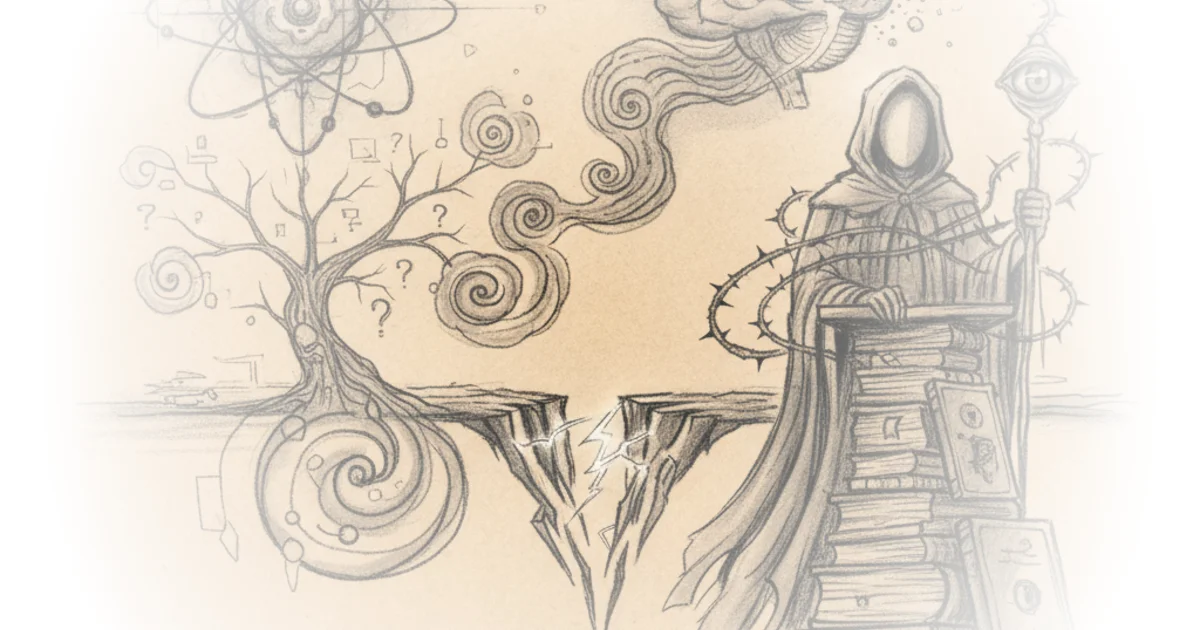
He cites Roger Penrose, who suggested that "Somehow, our consciousness is the reason the universe is here," and links this to figures like Zeilinger connecting quantum mechanics to Tibetan Buddhism. Žižek finds this move intellectually lazy. "For them, the quantum collapse is an act of free conscious decision," he writes, dismissing this as a way to avoid the harder ontological work. The argument here is sharp: attributing the collapse of the wave function to human consciousness is a convenient fiction that ignores the fact that measuring devices, devoid of any mind, trigger the same collapse. This framing is effective because it strips away the romantic veneer of "quantum woo" and forces a confrontation with the cold, mechanical reality of the data.
Critics might argue that Žižek is too dismissive of the phenomenological experience of the observer, potentially overlooking how the act of measurement is inextricably linked to the observer's frame of reference. However, his insistence that the "Real" of quantum waves exists independently of our perception remains a crucial corrective to idealist overreach.
So you, quantum scientists, need philosophy, but you should not trust philosophers who appropriate your work for obscurantist purposes.
The Atheist Lesson of Quantum Mechanics
The commentary then pivots to a theological and materialist re-evaluation of the universe's structure. Žižek contrasts the current quantum reality with Einstein's deep-seated belief in a harmonious, divinely ordered cosmos. He recalls Einstein's famous assertion: "Raffiniert ist der Herrgott, aber boshaft ist er nicht" (God is subtle, but he is not intentionally deceiving us). For Einstein, science was sustained by a faith that the universe was "marvellously arranged in a harmony that pervades all that exists."
Žižek argues that quantum mechanics has shattered this foundation. "I think it is this very belief which has been dealt a mortal blow by quantum mechanics," he states. Instead of a harmonious whole, we are left with an "inconsistent, plural world not grounded in any big foundation." He offers a provocative theological twist: if God is the ultimate observer who collapses wave functions, quantum experiments suggest "He is not observing the small." This leads to the "atheist lesson of quantum physics": "God himself can be cheated." Virtual particles can briefly violate energy conservation laws precisely because the ultimate agency is not watching every microscopic fluctuation. This is a powerful reframing of the "God doesn't cheat" maxim, turning a theological comfort into a statement of cosmic indifference.
The historical parallel to Jan Matejko's 1873 painting Astronomer Copernicus, or Conversations with God is apt here; just as Copernicus displaced humanity from the center of the cosmos, quantum mechanics displaces the divine from the center of the physical laws. Yet, Žižek pushes further, suggesting that the universe is not just displaced but fundamentally broken.
The Ontology of Failure
Perhaps the most distinctive part of Žižek's argument is his application of Hegelian dialectics to the wave-particle duality. He challenges the idea that our inability to define an electron's true nature is a limitation of human knowledge. "The question 'But what is really an electron in itself?' is thus meaningless; the electron is this very duality—there is nothing beyond," he writes. This shifts the problem from an epistemic obstacle (what we don't know) to an ontic feature (what reality actually is).
He draws a parallel to social theory, noting that the split between individual and society is not a puzzle to be solved but the very essence of society itself. "The essential feature of today's society IS the irreconcilable antagonism between Totality and the individual," he argues. This logic extends to the human subject, who exists in a "loop of symbolic representation." Žižek uses the "Hugh Grant paradox" from Four Weddings and a Funeral to illustrate this: the hero's stuttering, failed attempt to express love is precisely what proves the love's authenticity. "If he were to declare his love in a perfect and smooth way, we would get a robot-like recitation," he notes. The failure is not a bug; it is the feature that constitutes the subject.
This is a bold move, equating the fundamental weirdness of quantum physics with the structural failures of human language and identity. It suggests that the "gap" between perspectives is not a void to be filled, but the only place where reality exists. As Žižek puts it, "The status of the Real is purely parallactic and, as such, non-substantial: it has no substantial density in itself; it is just a gap between two points of perspective."
The Political Implications of an Open Future
Finally, Žižek addresses the political vision of Lee Smolin, who argues that the primacy of time implies an "open future" and a democratic society. Smolin advocates for principles where rational argument decides questions, but where diverse viewpoints are encouraged when evidence is insufficient. Žižek questions whether this "radicalized pragmatism" truly aligns with the ontology of quantum mechanics. "Does QM not imply a universe in which there is no global progress, in which every progress is localized and may appear a catastrophe from a different standpoint?" he asks.
He warns against the trap of viewing history as a smooth, gradual progress toward a better society. "The lesson of the twentieth century that the dream of a more just society can turn into hell on earth," he reminds us. The connection between the "openness" of time in physics and the "openness" of democracy is, for Žižek, potentially dangerous if it ignores the chaotic, non-linear nature of reality. He suggests that the human condition arises not from a grand design, but from a "totally contingent anomaly," a "pathological neuronal short-circuit" that has no inherent meaning. This contingency is the only true freedom we have.
Bottom Line
Žižek's strongest contribution is his rigorous defense of a materialism that embraces inconsistency rather than trying to smooth it over with spiritual or deterministic narratives. His argument that the "gap" in our understanding is actually the structure of reality itself is a compelling, if unsettling, perspective. However, the piece's biggest vulnerability lies in its tendency to conflate the mathematical oddities of quantum mechanics with the messy realities of social and political life, risking a leap from physics to philosophy that may be too wide for some readers to follow. The reader should watch for how this "ontology of failure" might reshape debates on AI and human agency, where the line between malfunction and innovation is increasingly blurred.