Cory Doctorow dismantles the comforting myth that free markets naturally police the greed of the ultra-wealthy, arguing instead that today's "deranged billionaires" are not market failures but the intended product of a system designed to protect them. He exposes how economic orthodoxy has been twisted into a series of logical traps that justify monopoly power as "efficiency" and frame the insulation of the rich from competition as a virtue. This is not just a critique of wealth; it is a forensic examination of how the language of economics is weaponized to turn the very mechanisms meant to serve the public into tools of feudal control.
The Great Contradiction
Doctorow begins by revisiting the foundational promise of capitalism: that selfishness, when channeled through competition, produces public benefit. He notes that both Adam Smith and Karl Marx agreed on this mechanism, albeit for different ends. Smith argued that we rely on the baker's "regard to their own interest" rather than his "benevolence" to get our dinner. Doctorow points out that this theory only holds if the baker fears losing customers to a rival.
"Anyone who believes in markets must also tacitly believe that successful market participants don't believe in markets. They should understand that capitalists hate capitalism, that every pirate yearns to be an admiral."
This observation cuts to the heart of the current crisis. The moment a company dominates a sector, its incentive shifts from innovation to insulation. Doctorow illustrates this with a revealing internal email from an Apple executive, who admitted the company was wasting money by making iPhones "too good" and suggested a strategy of "deliberate shittiness" to protect margins. This isn't a glitch; it's the logical endpoint of a system where the goal is to stop competing.
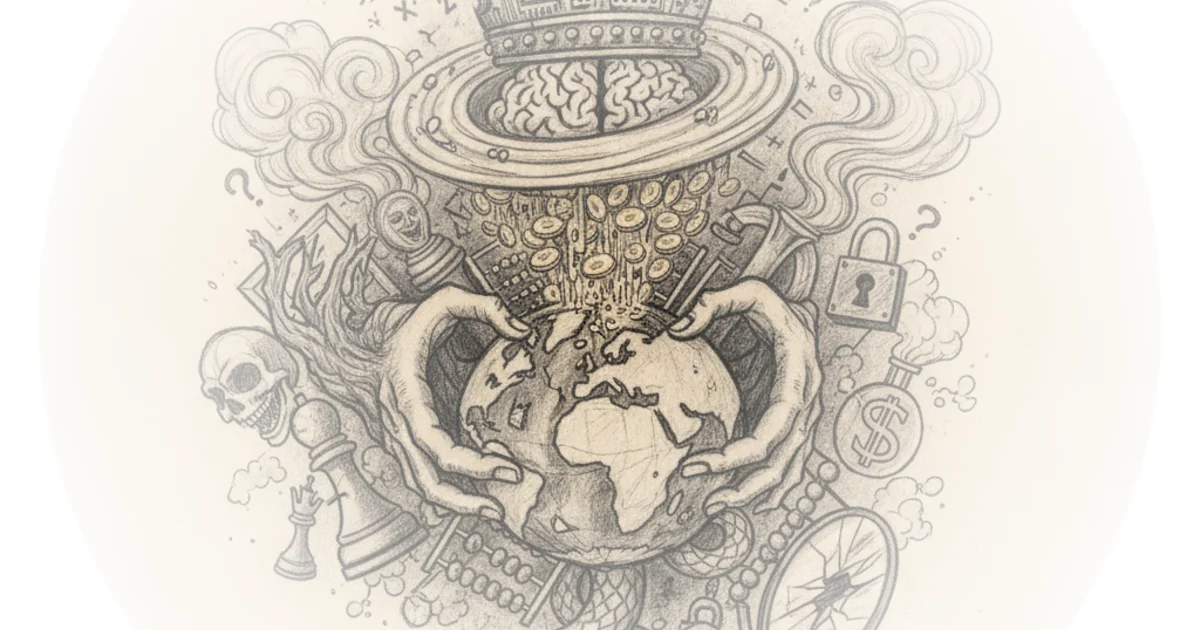
Critics might argue that high profits simply reflect superior efficiency or risk-taking, but Doctorow counters that these giants have spent decades building "moats and walls" specifically to prevent the competition that would force them to be efficient.
"If you get the incentives right, then even the greediest baker will resist the temptation to fill his loaves with sawdust and gravel. The greedier he is, the more he'll strive to make his bread cheap and delicious... Once you've conquered the market, every capitalist seeks to become a feudal lord."
The Logic of the Moat
The commentary then shifts to how economic theory has been co-opted to defend these monopolies. Doctorow dissects the "consumer welfare" standard, a doctrine that claims any monopoly that persists must be efficient because, in a true market, an inefficient one would have been competed out of existence. He calls this a "perfect apologetic" that allows think-tanks to accept funding from monopolists without contradiction.
"By definition, any monopolist with extra cash on hand to fund your PR blitz on its behalf must be efficient, otherwise it would have gone broke. QED."
This circular logic is reinforced by the concept of "revealed preferences," which Doctorow describes as a "neurological injury" that prevents economists from seeing power dynamics. He uses a stark example: observing someone selling a kidney to pay rent and concluding they have a "revealed preference" for having only one kidney. This framing strips agency from the vulnerable and treats coercion as choice.
The author also tackles the idea of "meritocracy," comparing it to the Puritan belief in divine providence where wealth is proof of virtue. He argues that this mindset has devolved into a eugenic belief in "royal blood," where the children of billionaires are assumed to be better "capital allocators" simply because they inherited the throne.
"Just as a Puritan believes that wealth is evidence of virtue, a hewer to economic orthodoxy believes the meritocratic system graces the best among us... You can tell they're the right people to do be doing this because the market chose them."
This section connects deeply to the history of the Thiel Fellowship, where the goal was explicitly to identify "nonconformists" who should be "let off the hook" from the rules that bind everyone else. Doctorow notes that Peter Thiel has long argued that "capitalism and competition are opposites," and that true entrepreneurs should seek monopolies to escape the "exhausting life of constant competition."
"These champions of 'free markets' have spent decades defending policies like noncompetes, which makes it a crime for a fast-food worker to quit their job at Wendy's and take a job at the McDonald's across the street in order to get a $0.25/hour raise."
From Pirates to Kings
The final thrust of the piece is the transformation of these "intellectual billionaires" into modern monarchs who openly disdain the democratic process. Doctorow highlights how figures like Elon Musk and Peter Thiel no longer hide their desire to be exempt from the rules. He cites Musk's suggestion that "universal suffrage leads to universal suffering" and that only "makers" should vote, a sentiment that treats the electorate as a burden rather than a foundation of governance.
"These billionaires that capitalism's (alleged) defenders are caping for when they deplore 'billionaire derangement syndrome'... were busily transforming themselves into kings, unshackled from rules, morals or consequences."
Doctorow argues that the term "billionaire derangement syndrome" is a misnomer; the behavior is entirely rational for those who have successfully captured the market. The real derangement lies in the public's continued belief that the system works as advertised. He references the concept of enshittification, noting that once a platform captures its users, it inevitably degrades the quality of service to extract more value, a process that is now accelerated by the lack of competitive pressure.
"The (smart) defenders of markets do understand this, but they face a dilemma. By definition, the benefactors with the most money and power to contribute to their think-tanks... are the rentiers — the billionaires who've shored up their fortunes with Warren Buffet's beloved 'moats and walls.'"
"It is difficult to get a man to understand something, when his salary depends on his not understanding it."
Bottom Line
Doctorow's most potent argument is that the defense of "free markets" has become a shield for the very entities that have destroyed market competition. The piece's greatest strength is its ability to trace the intellectual lineage from Adam Smith to modern monopolists, revealing the hypocrisy at the core of current economic policy. However, the argument risks underestimating the sheer inertia of the political system that protects these interests, suggesting that exposing the logic is enough to dismantle it. The reader must now watch to see if the growing recognition of this "feudal" shift can translate into the antitrust enforcement necessary to break the moats.