Ryan Grim and Jeremy Scahill deliver a harrowing inventory of global instability, but their most piercing insight lies not in the sheer volume of violence, but in the stark contradiction between official American rhetoric and the ground reality of human suffering. While the administration touts diplomatic breakthroughs and security victories, the authors meticulously document how policy decisions are actively deepening humanitarian catastrophes, from the freezing death of an infant in Gaza to the militarization of aid distribution. This is not just a news recap; it is an indictment of a system where bureaucratic euphemisms mask the erosion of international law and the loss of innocent life.
The Human Cost of Winter and War
The coverage opens with a brutal accounting of the last twenty-four hours, refusing to let the numbers blur into abstraction. Grim and Scahill highlight the death of a nine-month-old girl in Khan Younis, a victim not of a direct airstrike, but of the environmental collapse exacerbated by conflict. The mother's testimony is devastating: "It was raining, fiercely cold, and I had very little to keep her warm... Then, suddenly, I found my little baby motionless, dead." This quote anchors the piece, forcing the reader to confront the tangible result of aid restrictions. The authors argue that the winter storm is not merely a weather event but a weaponized condition, where the inability to access shelter materials becomes a death sentence.
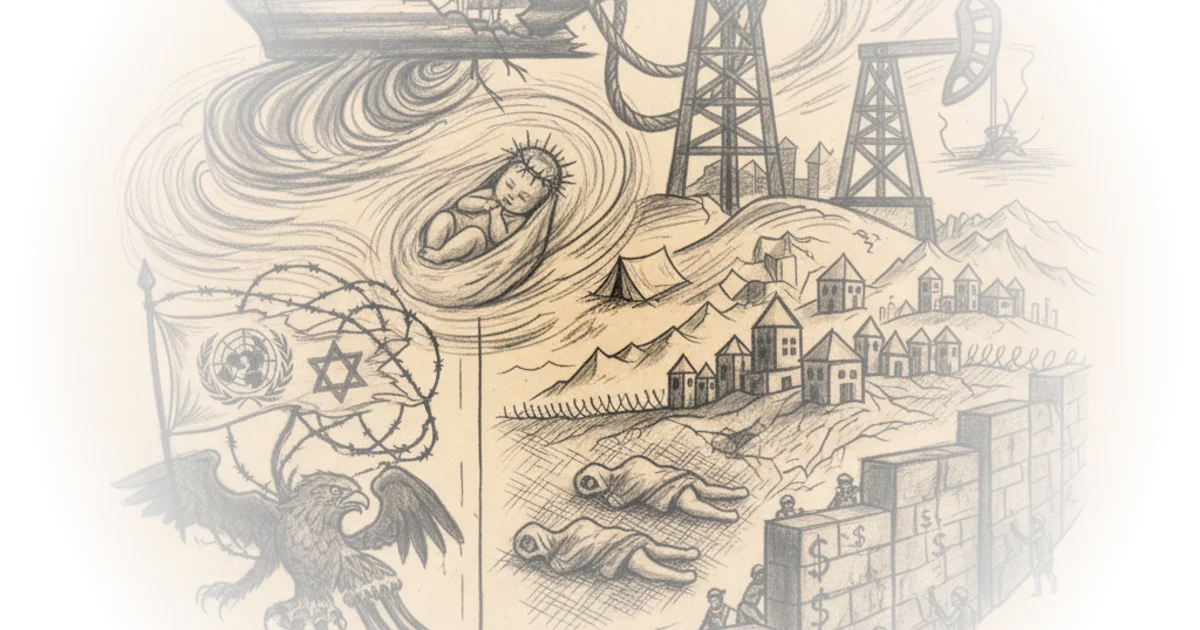
The authors juxtapose this tragedy with the official narrative from the White House. US Ambassador Mike Waltz claimed that over 600 trucks were entering Gaza daily, a figure the authors dismantle by citing the Israeli military's own data, which shows an average of only 459 trucks. Grim and Scahill write, "Gaza's Government Media Office said no more than 234 trucks per day have entered Gaza on average since the ceasefire," labeling the US claim a "blatant attempt to exonerate the occupation from the crime of the blockade and starving the civilian population." This framing is crucial; it exposes the gap between diplomatic spin and the logistical reality on the ground. The Norwegian Refugee Council's report that nearly 4,000 pallets of shelter materials have been rejected further underscores that the barrier is not a lack of goods, but a policy of denial.
The design of aid distribution sites has turned food delivery into a "militarized death trap," where deaths and injuries were inevitable.
The piece also scrutinizes the mechanics of violence, citing a new visual investigation by Airwars that reconstructs how US- and Israel-backed aid sites functioned. Grim and Scahill note that these sites were engineered to create "deaths and injuries inevitable," a chilling admission that the infrastructure of aid was compromised by the logic of war. While critics might argue that security concerns necessitate strict controls, the authors present evidence that these controls were disproportionate and lethal, resulting in over 1,000 deaths during a five-month period. The refusal of Hamas leader Khaled Meshaal to accept full disarmament, which he likens to "removing the soul" of the movement, adds a layer of political complexity, but the authors ensure the primary focus remains on the civilian toll of this stalemate.
The Expansion of Conflict and the Erosion of Oversight
Shifting focus to the West Bank and international theaters, the commentary reveals a pattern of expansion and impunity. Grim and Scahill report that Israel approved 764 new housing units in illegal settlements, a move Finance Minister Bezalel Smotrich celebrated as part of a long-term strategy. The authors point out that this approval comes despite the settlements being illegal under international law, signaling a deliberate entrenchment of occupation. This is not incidental; it is policy. The authors connect this to broader regional instability, noting that Israeli soldiers fired at a UN convoy in Lebanese territory, a direct violation of Security Council Resolution 1701. The UN's response was sharp, noting that the Israeli military had advance notice of the patrol, making the aggression a calculated act rather than a misunderstanding.
The article also turns its gaze to the United States' own militarization of domestic and foreign policy. The authors highlight a report revealing that the Pentagon diverted at least $2 billion from core missions to support immigration crackdowns, degrading military readiness in the process. Grim and Scahill write, "Lawmakers warn that the shift is degrading military readiness and using troops on missions for which they 'have neither signed up, nor been trained.'" This argument challenges the narrative of a streamlined, efficient security apparatus, suggesting instead a chaotic reallocation of resources driven by political agendas. The seizure of a Venezuelan oil tanker by the US is framed not as a law enforcement victory, but as "international piracy" according to Caracas, with the authors noting the Venezuelan government's assertion that the true motive is control over "natural wealth, our oil, our energy."
Furthermore, the piece exposes the erosion of democratic oversight. When Congress held a hearing on the West Bank, referred to by its biblical name "Judea and Samaria," not a single Palestinian was invited to testify. Grim and Scahill describe a panel featuring only representatives from pro-settler organizations and think tanks, a clear signal of whose voices are being amplified and whose are being silenced. The potential designation of UNRWA, the UN agency serving millions of refugees, as a "foreign terrorist organisation" is presented as a move that would "further cripple Gaza's already vulnerable aid infrastructure." This deliberation, reportedly held within the State Department, suggests a willingness to dismantle the very mechanisms of humanitarian relief to satisfy political demands.
Critics might argue that the administration's hardline stance is necessary to counter state sponsors of terrorism like Iran and Hezbollah. However, the authors counter this by showing how such measures often backfire, isolating the US diplomatically and worsening the conditions for civilians who are already suffering. The arrest of Bolivia's former president and the surge in violence in Sudan are presented as part of a global tapestry of instability where US intervention often exacerbates rather than resolves conflict.
Bottom Line
The strongest element of Grim and Scahill's coverage is its refusal to let official narratives stand unchallenged, using specific data points and human testimonies to dismantle the administration's claims of progress. Their biggest vulnerability lies in the sheer density of the tragedy, which risks overwhelming the reader with a sense of hopelessness, though the authors mitigate this by clearly identifying the policy choices driving the crisis. The reader must watch for the potential designation of UNRWA as a terrorist organization, a move that could irrevocably sever the lifeline for millions of Palestinians and mark a new low in the erosion of international humanitarian norms.