In a cultural moment obsessed with the technical horsepower of artificial intelligence, L. M. Sacasas offers a startlingly quiet counter-narrative: the problem with AI isn't that it's bad at mimicking humans, but that it is too perfect to be human. This piece bypasses the usual debates about copyright or job displacement to ask a more visceral question—why does content generated by massive algorithms leave us feeling cold, while a simple, accidental discovery in a park can warm us to our core? For the busy reader navigating an increasingly synthetic digital landscape, this is a necessary pause to examine the emotional cost of our technological trajectory.
The Illusion of Virtuosity
Sacasas begins by recounting a personal experiment in consumption. He describes stumbling upon a music video created entirely by generative AI tools, noting that while the technical execution was impressive, the experience was ultimately hollow. "First, I reflected on the fact that this digital artifact represented an immense technical achievement," Sacasas writes, acknowledging the sophistication of the technology. Yet, he immediately pivots to the emotional reality: "In truth, I was bored by the video before it was over." This admission is crucial; it challenges the prevailing narrative that technical capability equates to cultural value. The argument lands because it validates a common, unspoken feeling among users who find themselves scrolling through endless streams of "perfect" but soulless content.
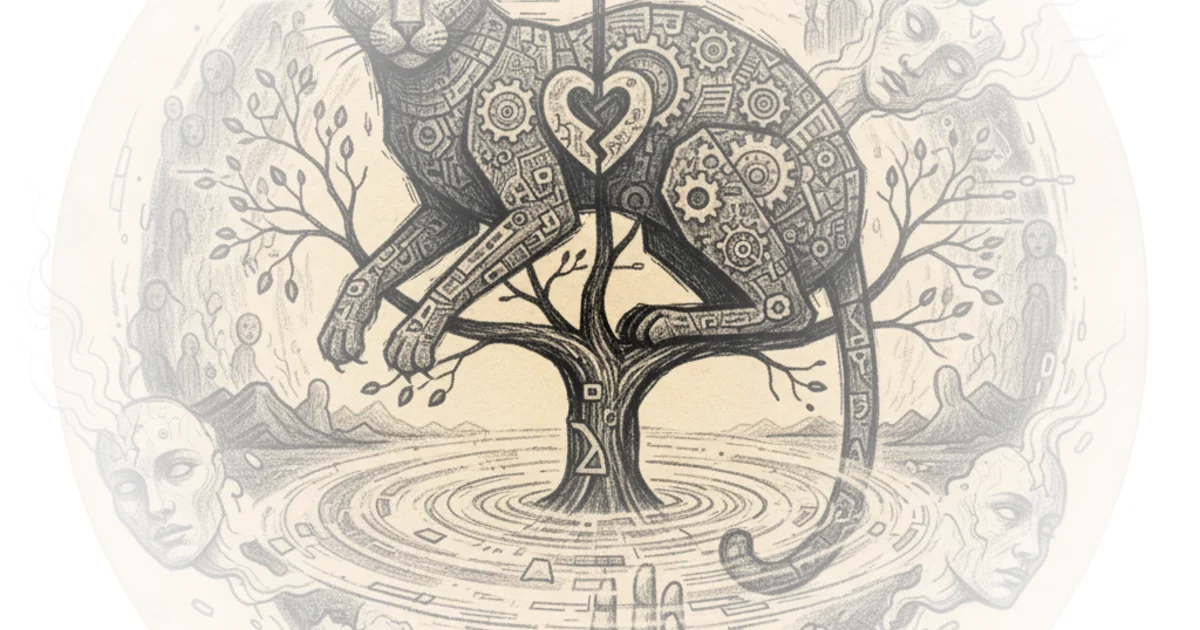
The author suggests that our fixation on whether machines can "excel as the best of human artists" is a category error. "But a simulacra of human virtuosity is not what we need," Sacasas argues. "We need each other. We need signs of life about us." This reframing shifts the debate from capability to connection. Critics might note that this view risks romanticizing human imperfection or ignoring the genuine utility AI offers in accessibility and efficiency. However, Sacasas is not arguing for the removal of the technology, but rather for a clearer understanding of what it cannot provide: the sense of companionship that comes from knowing another consciousness is behind the work.
We need signs of life about us. We need to know that we are not alone.
The Aura of Intention
The piece's most compelling turn occurs when Sacasas contrasts the high-tech video with a low-tech discovery: a painted cat on an old oak tree. He describes the moment his children spotted the artwork, which had likely been there for years, waiting to be seen. "The surprise was important, but there was more. The surprise suggested intention, and intention suggested a person," he observes. Here, Sacasas introduces the concept of "aura," not as a mystical property of the object, but as a relational experience. "The aura of a work of art is what we sense when our humanity, our personal nature perceives another speaking to us through their creative endeavor," he explains.
This distinction is the heart of the article. The AI video was a product of prediction and probability, a "symbolic complex" that conforms to what we expect. The painted cat, however, was an act of "gratuity." "It was a gift. It asked nothing for itself or its creator," Sacasas writes. The argument is that the value of the cat lies in its lack of commercial or algorithmic intent. It was created simply to exist in the world and connect with a passerby. This framing is effective because it moves the discussion away from the quality of the image to the quality of the relationship between the creator and the viewer. The painted cat invites the viewer to be generous, to notice, and to feel less alone in a crowded world.
The Pollution of the Social Ecosystem
Sacasas takes the argument a step further, suggesting that the proliferation of AI-generated content is not just a neutral expansion of media, but an active degradation of our shared environment. "In a time of acute loneliness, the proliferation of AI-generated content seems not unlike an act of pollution, compromising the integrity of the social ecosystem," he posits. This is a bold claim. It suggests that flooding the zone with synthetic content dilutes the signal of human connection, making it harder to find genuine moments of surprise and delight. The author draws on Walker Percy's ideas about the "loss of the creature," arguing that just as tourists often fail to see the Grand Canyon because they are looking for a postcard image, we fail to see the world because we are looking for the predictable output of an algorithm.
The piece concludes by contrasting the extractive nature of digital content with the shared nature of the painted cat. "No one needs to calculate how much energy was consumed by the creation of this drawing on the tree," Sacasas notes. "It is not a resource to be extracted." The painted cat remains a mystery, a shared secret between the unknown artist and the viewer, whereas the AI video is a product to be consumed and discarded. "I can no longer recall where I found that AI music video, but I will probably never forget where the cat in the tree found me," he writes. This final image is powerful, grounding the abstract debate in a tangible, emotional memory.
It was a gift. It asked nothing for itself or its creator. Its essence was its gratuity.
Bottom Line
Sacasas's strongest contribution is the shift from evaluating AI on its technical merits to evaluating it on its capacity to foster human connection; the argument that "gratuity" is the missing ingredient in our digital diet is both poignant and persuasive. However, the piece's biggest vulnerability lies in its potential to overlook the accessibility benefits of AI tools for those who cannot paint or compose, potentially framing all non-human creation as inherently alienating. Readers should watch for how this tension between synthetic abundance and human scarcity plays out in the coming years, as the line between the two continues to blur.