This isn't just another Hollywood merger story; it's a revelation of how foreign state capital and domestic political influence are converging to reshape American media. Judd Legum exposes a buried truth: the $24 billion equity backing Paramount's hostile bid for Warner Bros. Discovery doesn't come from American banks, but from the sovereign wealth funds of Saudi Arabia, Abu Dhabi, and Qatar. For busy readers tracking the intersection of money and power, this piece delivers a critical warning about who actually owns the stories we consume.
The Hidden Architects of the Deal
Legum's investigation cuts through the glossy press releases to reveal the true financial engine behind the acquisition. While Paramount's official statement credits "Ellison Family and RedBird Capital," Legum points out that this narrative is incomplete. "What is not mentioned in the press release is that while the equity financing is 'backstopped' by American individuals and entities, the majority of the equity financing — $24 billion — comes from the sovereign wealth funds of Saudi Arabia, Abu Dhabi, and Qatar." This fact, Legum notes, is "buried on page 42 of a separate SEC filing," a classic move to obscure the scale of foreign government involvement.
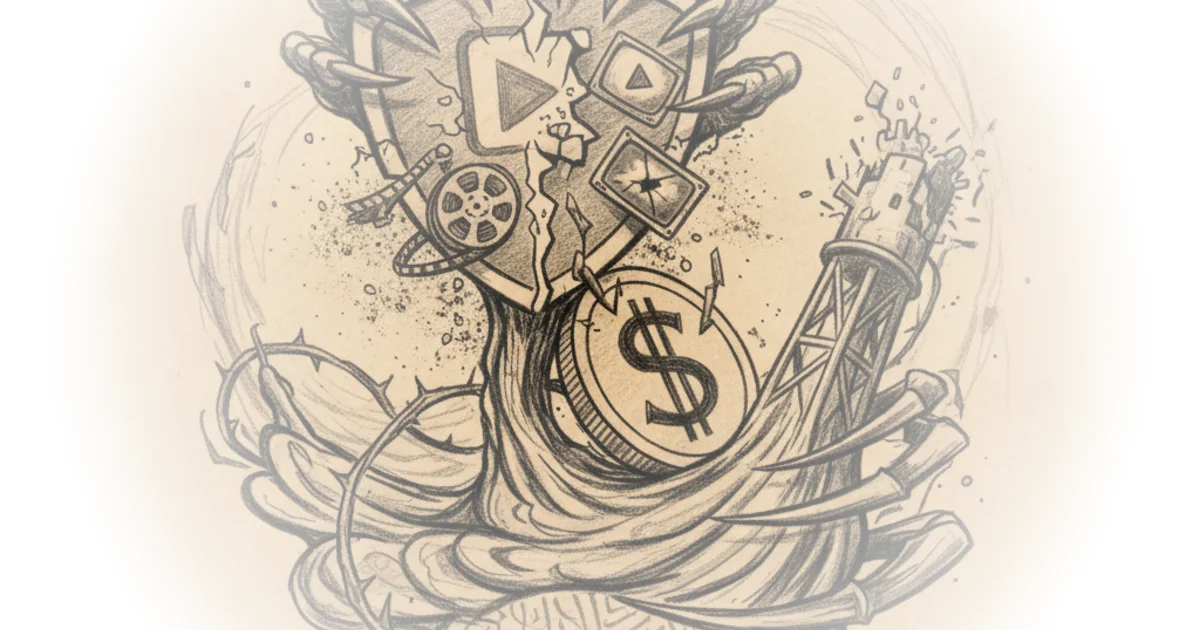
The sheer magnitude of this investment cannot be overstated. Legum provides necessary context: "$24 billion is a massive investment by foreign governments on Paramount's behalf. To put it in perspective, the current value of Paramount is just $15 billion." This disparity suggests that the American company is effectively a vehicle for foreign capital. The argument here is compelling because it shifts the focus from corporate strategy to national sovereignty. If foreign governments hold the purse strings, do they hold the pen?
$24 billion is a massive investment by foreign governments on Paramount's behalf. To put it in perspective, the current value of Paramount is just $15 billion.
The involvement of Jared Kushner adds a layer of domestic political complexity that Legum handles with surgical precision. He notes that Kushner's firm, Affinity Partners, is "run by President Trump's son-in-law" and that "nearly all of Affinity Partners' assets come from the same sovereign wealth funds bankrolling the proposed Paramount takeover." Legum argues that this creates an inherent conflict of interest: "Kushner's involvement in the deal highlights the ongoing legal and ethical problems with his dual role. On the one hand, Kushner is operating as a high-ranking official representing the Trump administration in the most sensitive foreign policy matters. On the other hand, he is being paid by and partnering with Middle Eastern governments as they seek to expand their political, economic, and cultural interests."
Critics might argue that private equity deals are common and that separating governance rights legally mitigates these risks. However, Legum's framing suggests that financial leverage often translates to influence regardless of legal technicalities. The question isn't just about board seats; it's about who holds the leverage when the music stops.
The Ideological Transaction
The piece takes a sharp turn into the realm of media censorship and political alignment. Legum details how Paramount has actively courted the administration by reshaping its news division to align with right-wing demands. The evidence is stark: the hiring of Kenneth R. Weinstein, a "Trump loyalist" with no news experience, to serve as an ombudsman. Legum writes, "Weinstein had no experience with producing or overseeing news coverage and previously was the president of the Hudson Institute, a right-wing think tank." This move was explicitly designed to secure regulatory approval for previous mergers, a pattern Legum suggests is repeating.
The trend continues with the appointment of Bari Weiss. Legum describes her as an "anti-woke crusader" who "had no experience in broadcast news" but whose publication, The Free Press, "repeatedly distorted the truth in order to conform to a right-wing ideological agenda." The administration's response to this reshaping is telling. When asked about the potential influence of Kushner's involvement, the President's response was dismissive: "I don't know," Trump responded. "I've never spoken with him about it." Yet, Legum notes that the President had already signaled his stance on the competing Netflix deal, warning that it "could be a problem" due to market share, while simultaneously emphasizing that he would "personally 'be involved' in the decision."
Paramount is willing to conform to Trump's ideological agenda.
This section of Legum's analysis is particularly potent because it connects the dots between financial backing and editorial direction. The argument implies that the hostile takeover isn't just about market consolidation; it's about ensuring that the resulting media giant is ideologically compliant with the executive branch. The hiring of Larry Ellison's ally and the alignment of Paramount's leadership with the President's circle suggest a quid pro quo that transcends standard business negotiations.
The Regulatory Loophole and National Security
Perhaps the most technically dense but crucial part of Legum's commentary is the analysis of the Committee on Foreign Investment in the United States (CFIUS). Paramount claims the deal bypasses CFIUS jurisdiction because foreign investors have agreed to forgo governance rights. Legum dismantles this claim immediately. "Paramount is tacitly acknowledging that Kushner is using Affinity Partners as a vehicle for foreign influence," he writes, noting that lumping a U.S. firm in with foreign sovereign funds is an admission of their intertwined nature.
Legum's critique of the legal maneuvering is sharp: "A company cannot extinguish concerns about foreign ownership simply by nominally giving up governance rights. There are many other ways that entities providing $24 billion in equity investment can influence the operations of a company." This is a vital distinction for readers to understand. The legal structure may look clean on paper, but the economic reality is that foreign governments hold the keys. Legum concludes that CFIUS has a duty to investigate the "influence the sovereign wealth funds have and whether that influence raises national security concerns."
The piece also contrasts this with the Netflix deal, which faced scrutiny from lawmakers across the spectrum. Legum cites Senator Mike Lee's concern about "a lot of antitrust red flags" and Senator Elizabeth Warren's description of the deal as an "anti-monopoly nightmare." While the Netflix deal raised consumer and labor concerns—potentially eliminating jobs and raising prices—Legum argues that the Paramount deal raises a different, more existential threat: foreign ownership of American cultural infrastructure.
A company cannot extinguish concerns about foreign ownership simply by nominally giving up governance rights.
A counterargument worth considering is that foreign investment brings capital that domestic markets cannot provide, potentially saving jobs and studios. However, Legum's evidence suggests that the cost of this capital is the independence of the newsroom and the alignment of content with foreign and domestic political agendas. The trade-off, as presented, seems heavily skewed toward political control rather than economic efficiency.
Bottom Line
Judd Legum's reporting delivers a damning indictment of a media landscape where foreign state capital and domestic political loyalty are merging to bypass standard regulatory checks. The strongest part of the argument is the exposure of the $24 billion foreign equity stake buried in SEC filings, which fundamentally changes the nature of the takeover from a corporate battle to a national security issue. The piece's biggest vulnerability lies in the assumption that CFIUS will act independently despite the political pressure described, but the evidence of ideological alignment makes that skepticism well-founded. Readers should watch closely to see if the administration's regulatory approval process can withstand the weight of these conflicting interests.