In an era where Hollywood often defaults to superficial cultural pastiche, a new analysis from Animation Obsessive reveals how Mulan achieved a rare authenticity through the obsessive, research-heavy work of a single character designer. This piece doesn't just praise the film's aesthetics; it argues that the movie's visual success was a direct result of Chen-Yi Chang's refusal to compromise historical accuracy for Western stereotypes, a stance that required him to educate an entire studio on the nuances of ancient Chinese art. For the busy professional seeking to understand how high-stakes creative projects succeed, this breakdown of the tension between industrial animation and cultural integrity offers a masterclass in leadership and vision.
The Architect of Authenticity
The piece centers on Chen-Yi Chang, a designer who arrived at Disney with a background in experimental animation and a deep disdain for the stereotypical depictions of Asia common in the 1990s. Animation Obsessive reports that Chang was the "linchpin" of the project, with producer Pam Coats calling him a "walking library" and "our salvation on this movie." This attribution is crucial; it shifts the credit from the monolithic "Disney machine" to the specific human effort required to bridge cultural gaps. The article highlights that Chang's influence was not merely decorative but foundational, noting that production designer Hans Bacher admitted, "I could not have designed Mulan without him."
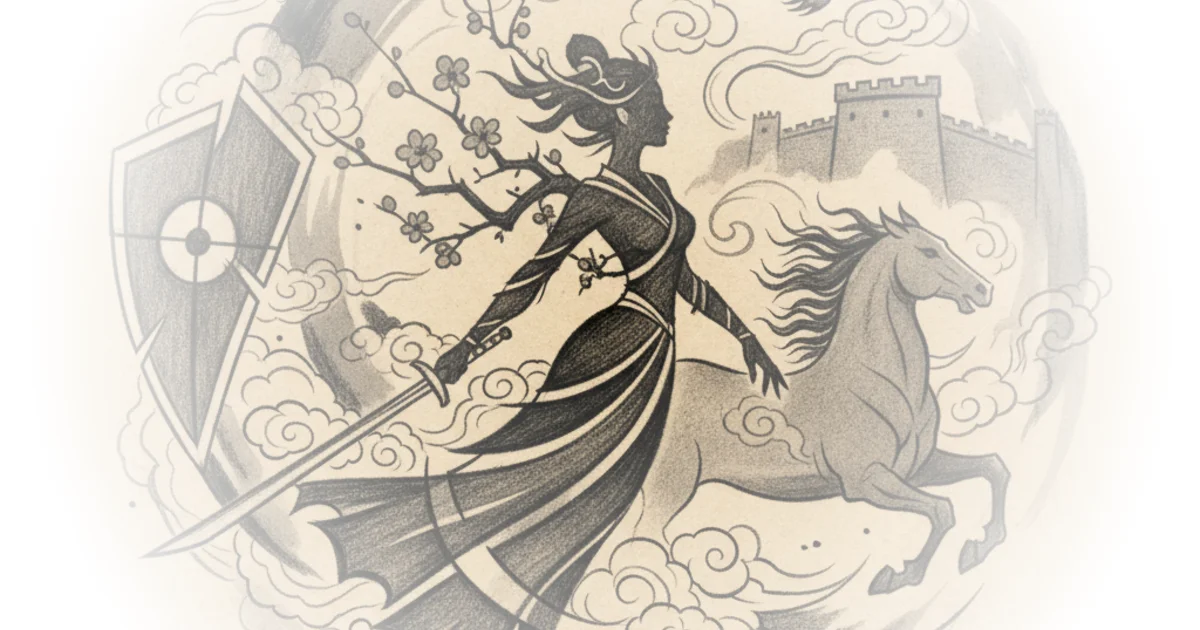
Chang's approach was methodical. He didn't just sketch; he immersed himself in history, studying materials from a thousand years prior to the film's setting. The piece argues that his strategy was to "steal" from ancient art, transforming intricate murals into functional cartoon designs. This is where the coverage shines, detailing how Chang solved the problem of animating complex Tang dynasty armor by referencing an 8th-century mural from the Kumtura Caves. As Chang is quoted saying, "Oh, this is how ancient artists see it... Wow, that's a really good way of doing it." This moment of discovery underscores a vital lesson for any industry: the most innovative solutions often come from looking backward, not forward. It echoes the experimental spirit of the Zagreb School of Animation, which Chang admired in his youth for its ability to convey complex ideas through simplified, expressive forms.
"If I hadn't done it well ... I'd have felt that I'd let down the Chinese people. The pressure was enormous."
The stakes Chang felt were personal and immense. He recognized that he was navigating a minefield of expectations: Western audiences expected pigtails and long mustaches, while Chinese audiences were often conditioned by inaccurate Ming dynasty portrayals. The article notes his fear that presenting the "real look" of the Han and Tang dynasties would shock both groups. Yet, he pressed on, blending the "primitive" directness of Han art with the "curvy motifs" of Tang sculptures. This decision to prioritize historical truth over immediate audience comfort is a bold creative risk that paid off, resulting in a visual language that felt both fresh and grounded.
Systematizing Elegance
One of the most compelling arguments in the piece is how Chang translated his historical research into a repeatable system for a large team. Animation Obsessive explains that Chang didn't just draw characters; he created a "schematic formula" that forced artists to think in terms of basic shapes and the "S-curve," a motif derived from the flowing elegance of ancient Chinese painting. Director Tony Bancroft is quoted in the piece, stating that the film's "unique and consistent" design came from the "combination of these two strong artistic visions." This collaboration between Chang and Bacher is presented not as a compromise, but as a synthesis where Chang's cultural expertise met Bacher's production design rigor.
The coverage details how Chang fought against the tendency to over-generalize Asian features, a common pitfall in Western animation. Instead of relying on a single graphic element, he pushed for variety, ensuring that even background characters had distinct personalities. He argued that using "just one single type of graphic element to overgeneralize" is what turns caricature into stereotype. By breaking characters down into circles, squares, and triangles, he created a visual vocabulary that was both stylized and individual. This approach mirrors the principles of the California Institute of the Arts (CalArts), where Chang later studied, emphasizing the importance of character-driven design over rigid realism.
Critics might note that despite Chang's efforts, the film still faced criticism from some quarters for its aesthetic choices, with some viewers mistaking the Tang dynasty makeup for Japanese influence. However, the piece effectively counters this by explaining the historical causality: Japanese culture adopted many of these fashions from Tang China, not the other way around. Chang's insistence on accuracy was an educational act, challenging the audience's preconceived notions rather than pandering to them.
The Cost of Individual Vision
The article concludes with a sobering reflection on the nature of credit in the animation industry. Despite Chang's pivotal role, the piece notes that "the studio's name tends to absorb attention; the individual artists who make the films rarely become famous." This is a systemic issue that the coverage addresses with clarity, highlighting how Chang's work was often overshadowed by the Disney brand. Yet, the testimony of his colleagues remains powerful. Animator Aaron Blaise called him "just amazing," and Chang himself described the work as his "best work so far."
The piece also touches on Chang's journey, from a child in Taiwan inspired by a Reader's Digest article to an experimental animator in the 1980s, and finally to the heart of Hollywood. His story is one of persistence, driven by a desire to see his culture represented with dignity. As the article puts it, Chang was fighting a "fight to really, genuinely put old China into a Disney feature film." This framing elevates the discussion from mere art criticism to a narrative about cultural representation and the power of individual agency within a massive corporate structure.
Bottom Line
Animation Obsessive delivers a definitive account of how Mulan transcended its era through the rigorous, culturally informed work of Chen-Yi Chang. The piece's greatest strength is its ability to trace the direct line from historical research to on-screen elegance, proving that authenticity is a deliberate design choice, not an accident. Its only vulnerability is the inevitable sadness of seeing such a vital contributor remain somewhat in the shadows of the brand he helped define, a reminder that the true cost of corporate success is often the erasure of the individual artist. For anyone interested in the intersection of culture, design, and leadership, this is essential reading.