Rohin Francis captures a cultural moment that defies easy categorization: the public's gleeful, meme-fueled reaction to the assassination of a healthcare CEO, not as a tragedy, but as a symptom of a broken system. While most analysis focuses on the suspect or the immediate security failure, Francis argues that the outrage is a rational response to a healthcare model that treats human life as a line item on a spreadsheet. This is a crucial distinction for busy observers trying to understand why a murder provoked celebration rather than universal condemnation.
The Anatomy of a Meme Pandemic
Francis, a British doctor and medical professional, approaches the event from the outside looking in, noting that the reaction was "blown away by the memes" that united a polarized electorate. He observes that the public response was not merely dark humor but a collective coping mechanism for a system that feels fundamentally hostile to its users. "When you leave people feeling powerless what do they have left except their anger and laughter as a coping mechanism," Francis writes. This reframing is vital; it suggests the viral content wasn't just internet noise, but a signal of deep-seated structural despair.
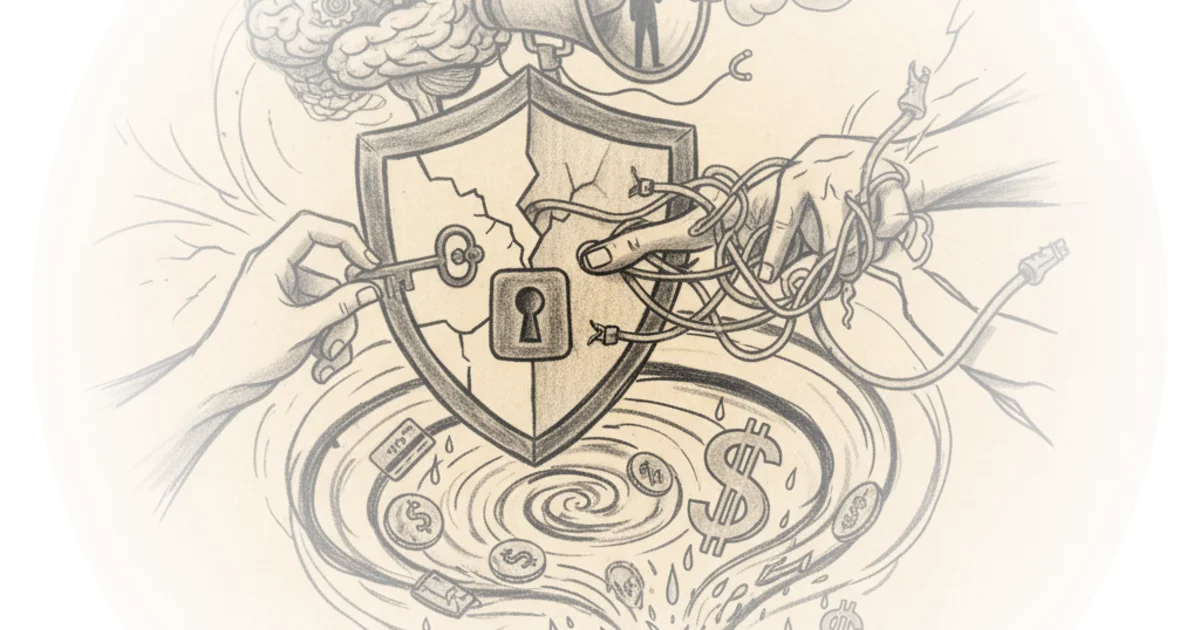
The author does not shy away from the moral complexity, acknowledging that "killing some is wrong" and that ending a life prematurely is inherently unjust. However, he immediately pivots to the specific context of the victim, Brian Thompson, describing him as the head of a company that Francis bluntly labels "an evil company." The argument here is that the public's lack of sympathy stems from the perception that the victim was not a singular villain, but the face of a predatory machine. Francis notes that the company had a "rejection rate for claims double that of the norm" and utilized AI systems known to deny care, creating a "faceless emotionless cold interaction" for millions of Americans.
"Is an act of violence only something perpetrated with a gun or with fists or is an act of violence equally the Restriction of life-saving treatment for somebody or the delaying as their illness progresses?"
This question forms the philosophical core of Francis's commentary. He challenges the binary view of violence, suggesting that bureaucratic decisions made by algorithms can be as lethal as physical force. He illustrates this with the recent controversy where an insurer threatened to stop funding operations that ran over a specific time limit. "They said they won't fund it and what's a patient going to do they're going to wake up in the middle of their operation and say actually I'm going to I'm going to I can't afford the rest of this I'm going to head off," Francis paraphrases the absurdity of the situation. This highlights the insanity of a system where human biology cannot be neatly timestamped to fit a profit margin.
Critics might argue that equating corporate policy with physical violence dilutes the moral gravity of murder and risks justifying vigilantism. While Francis explicitly states that murder is never justified, his point is that the system itself is a form of violence that goes unpunished, creating a moral equivalence in the public eye that traditional ethics struggles to address.
The Global Blind Spot
Francis uses his position as an outsider to critique the American tendency to view the US healthcare model as the only alternative to the UK's National Health Service. He argues that both nations suffer from a "capitalist framework" that blinds them to better models elsewhere. "Americans don't you know they don't even want to attempt to to ra TR in the unregulated UN sort of uh restricted capitalism that is inherent to the model," he notes, pointing out that countries like Germany, France, and Japan offer effective systems without the same level of corporate extraction.
The author draws a sharp parallel between the current healthcare outrage and the 2008 financial crisis, where the public felt a similar sense of injustice when bankers were bailed out while ordinary people suffered. "This is just you know guess the the bubbling over," Francis suggests, linking the assassination to a broader pattern of wealth transfer and perceived impunity for the elite. He notes that the pandemic saw an "enormous transfer of wealth from the bottom 98% to the top 2%," leaving a residue of anger that has now found a target.
"Is systematic abuse of power inevitable when human lives are reduced to to numbers on a screen when these insurance companies you know particularly using AI... they're just numbers on a screen?"
This observation cuts to the heart of the administrative violence Francis describes. When care is denied by an algorithm, the human element is erased, making it easier for the system to commit atrocities against the vulnerable. Francis compares this to historical atrocities where victims were dehumanized into statistics, arguing that the modern insurance industry has perfected this dehumanization through data analytics.
The Bottom Line
Francis's strongest contribution is his refusal to treat the assassination as an isolated act of madness, instead framing it as the inevitable explosion of a system that has long treated patients as liabilities. His argument is vulnerable to the charge that it risks romanticizing violence, yet his evidence of the industry's predatory practices—such as denying care for overrunning surgeries—provides a stark context that explains the public's visceral reaction. The takeaway is clear: until the healthcare system stops treating human life as a variable to be optimized for profit, the anger will only grow louder.
"Is it an inevitable consequence of producing a system like this?"
The most critical lesson from this coverage is that the public's empathy has been exhausted by a system that offers none in return. The next chapter will not be written by the police, but by whether the administration and the industry can address the structural violence that Francis so clearly identifies.