The Atlantic Alliance Has a New Problem — And It's Money
Europe is confronting a reality it spent decades pretending wasn't possible: a scenario where its most critical financial relationship becomes a weapon aimed at the continent itself.
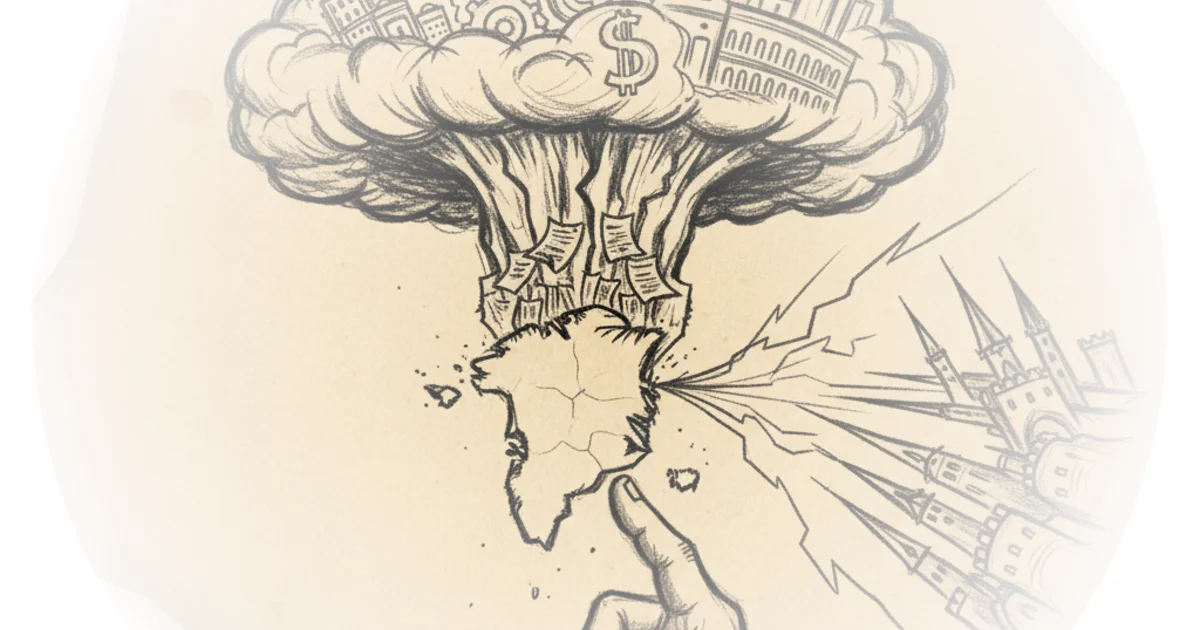
That shift just became concrete in Davos. When President Trump demanded Greenland — explicitly, with 80 minutes of brinksmanship framing — he didn't merely disrupt diplomacy. He forced European capitals to confront an uncomfortable truth: the alliance they treated as sacred is now being managed as a transaction. Territory isn't negotiated anymore; it's acquired like real estate.
The result was immediate and global. Eight NATO allies faced maximalist threats within days. A trillion-dollar market selloff rippled across markets on Tuesday. By Wednesday, a framework deal emerged at Davos. The temperature lowered. But the question persisted: when will this claim return?
What Europe discovered is that trust — once the foundation of transatlantic cooperation — has fundamentally broken. For decades, the alliance operated as an article of faith. Today, security increasingly looks like a product being sold by sponges who absorb pressure and return value only when convenient.
This breach feels particularly jarring because on paper, conflict between such integrated partners makes no sense whatsoever. It brings to mind Norman Angell's central argument from his 1909 book The Great Illusion. He correctly identified that globalization had created an era where economic interdependence made war amongst great powers fundamentally irrational. His famous illustration pointed out the absurdity: Lloyds of London insured the German merchant marine, meaning British naval forces would effectively be sinking ships that British insurers would have to pay for.
Angell's logic was indisputable. Every state leader agreed with his conclusions. Yet history demonstrated five years later just because a conflict is economically self-defeating doesn't mean it won't happen.
We're facing a similar paradox today. The lesson remains: economic logic is no longer a reliable guard rail when trust is replaced by coercion.
Europe's Terrifying Progression
In twelve months, the nervous energy in Europe transformed into something profound. As The Economist observed, the continent moved through a terrifying progression — from wondering if it can defend alongside America to questioning if it can defend without America to finally asking what it must do to defend itself from America.
The Greenland crisis was the catalyst. The stability of the entire Western Alliance risked ownership of an island where the US already enjoys unparalleled military access and where American companies are already exploring mineral potential. This suggests we've moved beyond policy disagreements into coercion.
Beyond Greenland, the broader geopolitical landscape has shifted toward profound anxiety. It became unthinkable to imagine Canada — traditionally America's most steadfast partner — wargaming defensive strategies against its southern neighbor. Yet the current climate forced such contingencies into war rooms across allied capitals.
For Europe, accepting this new reality means acknowledging that strategic autonomy is no longer a distant ideal but an urgent necessity for survival.
Building this autonomy will be massive — taking years, if not decades. Both Europe and the United States must plug critical gaps in their military capabilities. The transition from efficiencies of global integration toward otterarchy — self-sufficiency driven by mutual fear — will impose heavy costs. Fiscal strain on national budgets will be immense. Every consumer will feel higher prices; every business will face a fragmented, more expensive landscape for trade.
While the Davos climbdown lowered immediate temperature, it didn't erase the need to refine war room plans drafted when economic warfare and annexation first hit the wires.
Europe's Financial Arsenal
Europe's defensive arsenal against American economic coercion is built on a realization: if trust is no longer the currency of alliance, hard financial leverage must take its place. This isn't aggression — it's a reluctant strategic recalculation. It's how the European Union asserts status as a peer-level economy rather than expendable vassals.
Relying on shared history is no longer viable risk management. If America treats the alliance as transactional shakedowns, Europe has found that ensuring those transactions carry prohibitively high costs serves everyone's interests.
The financial nuclear option dominated headlines — though it wasn't a policy proposal from any European head of state. The idea of weaponizing Europe's 2.84 trillion dollars in treasury holdings originated in research departments at one of the institutions managing them. George Saravellas, global head of FX research at Deutsche Bank, sparked debate with a memo titled Europe owns Greenland, it also owns a lot of treasuries, arguing that America's reliance on foreign creditors to pay its bills represents its ultimate geopolitical weakness.
Rebecca Patterson at the Council on Foreign Relations echoed this sentiment, suggesting even if total selloff is unrealistic, Europe could send devastating signals by scaling back exposure through government-affiliated investors like public pension funds.
This argument gained enough traction that Treasury Secretary Scott Bebsant felt compelled to address it at Davos, dismissing talk as media hysteria and a false narrative defying logic.
For all the hysterical chatter, some investors weren't just listening — they were acting. In the frantic week of the Greenland crisis, a Danish pension fund announced divestment of its entire 100 million dollar portfolio in US government bonds, citing poor health of US public finances and administration unpredictability. More significantly, Swedish pension giant Electa confirmed it trimmed holdings by roughly 7 to 9 billion dollars, explicitly citing reduced predictability in American policy as a growing risk factor.
The question isn't whether the idea is on the table — it's whether it's actually viable. Let's examine whether Europe could coordinate such a strike or if financial realities of the twenty-first century make this a suicide pact.
The Trade Bazooka
Beyond bond markets, Europe has been readying its anti-coercion instrument — a trade bazooka designed specifically to counter economic blackmail. It's a stark reflection that this tool was originally conceived defending against authoritarian pressure from China and Russia. It was first proposed after Beijing attempted to blackmail Lithuania by cutting off trade over ties with Taiwan.
Seeing it discussed as primary defense against the United States — traditionally a European ally — represents a surprising, historic shift in the transatlantic relationship.
What makes the ACI so potent is its ability to bypass usual veto power that often paralyzes European foreign policy. Unlike most security decisions requiring unanimous consent, the ACI operates through qualified majority voting: 55% of member states representing 65% of total population must agree. A single dissenting capital can no longer block a unified response.
This tool turns European trade policy into centralized one-for-all, all-for-one defense. It allows Brussels to move past simple tit-for-tat tariffs and unleash far broader countermeasures.
For instance, the EU could legally bar American tech firms from bidding on massive public procurement contracts for hospitals, schools, and digital infrastructure markets where American vendors currently enjoy substantial share. They could restrict or close access to the EU's 450 million consumer market for American financial services, hitting Wall Street banks and venture capital funds where it hurts.
In perhaps the most radical move available, the ACI allows Europe to revoke intellectual property rights of companies from the coercing country. This would effectively jailbreak American software and hardware, allowing European firms to legally ignore US patents and commercial protections within the single market.
The Industrial Leverage Points
While the trade bazooka targets digital and financial software of the modern economy, Europe has also identified industrial hardware bottlenecks where America remains critically dependent on Europe.
The centerpiece is Dutch firm ASML, holding global monopoly on EUV lithography machines needed to manufacture the world's most advanced computer chips. Analysts increasingly describe ASML as Europe's version of rare earths — a unique technological gatekeeper giving Brussels massive say in the global AI race.
If Europe restricted export or even servicing of these machines, it would strike directly against Silicon Valley's innovation engine that the White House views as its primary strategic asset.
As with many solutions, the ASML choke point is more of a mutual leash. While machines are designed and built in the Netherlands, they're filled with American-made components like high-powered Simmer lasers from San Diego. Under the foreign direct product rule, Washington could veto export of any product containing significant US technology. So if Brussels tries using ASML as weapon, America can essentially brick production lines by cutting off American parts and software updates keeping machines alive.
Leverage isn't only in high-end silicon. It's also in basic industrial feedstocks keeping American manufacturing humming. The EU has already treated aluminum and steel scrap as critical secondary raw material, moving to restrict export. This would hit US steel makers relying on recycled materials to keep energy costs down.
By cutting off specialized chemicals and industrial products, Europe signals it can clog arteries of American industry just as effectively as any digital lockout.
The Retaliatory Tariffs
Finally, there's the most conventional part of the arsenal: 93 billion euros (or 108 billion dollars) in retaliatory tariffs originally drafted after Liberation Day shock last year. These aren't randomly applied to drive up costs on European consumers — they're carefully calibrated to maximize political pain in America while minimizing price tags for European voters.
By targeting soybeans, Europe sends direct messages to agricultural heartland supporting Republican leaders like House Speaker Mike Johnson. The list also features classic targets: iconic American products like Harley-Davidson motorcycles, Levi's jeans, and American whiskey. These were chosen precisely because they're easily replaced by European, Japanese, or South American alternatives.
The goal makes trade war feel expensive to average American voters while ensuring European side of ledger remains balanced.
The Economic Reality Check
As effective as this arsenal appears at first glance, it's built largely on macroeconomic myths. In high-stakes theater of Davos, threat of treasury dump or tariff wall makes great headlines. But as dust settles, economic reality is far more sobering.
Argument that massive selloff of US debt by European bond holders would spike interest rates and bankrupt the highly indebted US trying to reduce deficit spending doesn't hold up under scrutiny.
For starters, dumping bonds on such scale is inherently self-defeating. Flooding the market drives down price of assets you're trying to exit — essentially setting fire to your own portfolio to spite your neighbor. Furthermore, once you've dumped bonds, you're left holding US dollars. You now need another currency to store trillions in savings. There aren't many economies with open capital accounts liquid enough to absorb such volumes.
Large alternatives like China or India have strict capital controls in place. Even pivoting to trillions would create cascading problems across global financial systems.
Critics might note that much of Europe's leverage depends on American cooperation — if America simply refused to engage, the continent's economic countermeasures become hollow threats. The industrial dependencies cut both ways; ASML's machines contain American components precisely so Washington can counter any export restriction with devastating effect.
Bottom Line
Europe's strategic recalculation is real and urgent. The financial nuclear option isn't science fiction — it's already being discussed at Davos and implemented by pension funds divesting from US bonds. Europe's trade bazooka exists, operationalized through qualified majority voting that bypasses traditional veto blocks.
The biggest vulnerability: much of this leverage depends on America choosing to play by rules it helped establish. If Washington simply refuses to cooperate — or uses its own industrial dependencies to neutralize European counter-measures — the continent's hard-won arsenal becomes posturing rather than deterrence.
What emerges is clear: Europe has moved from wondering whether to defend alongside America toward asking what defending against America actually looks like. The answer isn't certain, but it's no longer unthinkable.