In an era where fantasy is often dismissed as mere escapism, Tom van der Linden argues that J.R.R. Tolkien's The Lord of the Rings offers a profound moral framework that transcends time, transforming a fictional war into a lesson on the sanctity of human choice. This piece distinguishes itself by moving beyond surface-level religious allegory to explore how the story recontextualizes ancient pagan virtues—specifically the fear of death and the glory of battle—into a modern Christian ethic of mercy and moral victory. For the busy reader seeking substance, this analysis reveals why the story's enduring power lies not in its magic, but in its insistence that true heroism is a spiritual choice, not a physical conquest.
The Mythological Foundation
Van der Linden begins by dismantling the common misconception that the story is a simple allegory. He notes that while Tolkien was a devout Catholic who infused the work with Christian imagery, the author "famously disliked allegories stating he rather prefers history be it real or fictional." Instead, van der Linden highlights Tolkien's belief that mythology serves a unique function: "in his words they open the door on other time and if we pass through though only for a moment we stand outside our own time outside time itself." This framing is crucial because it shifts the reader's perspective from looking for hidden codes to experiencing a universal truth. The argument lands effectively because it explains why the story feels "more real" than our own world to so many readers, as van der Linden quotes a critic who found the book to be a "homecoming" that "broke our hearts."
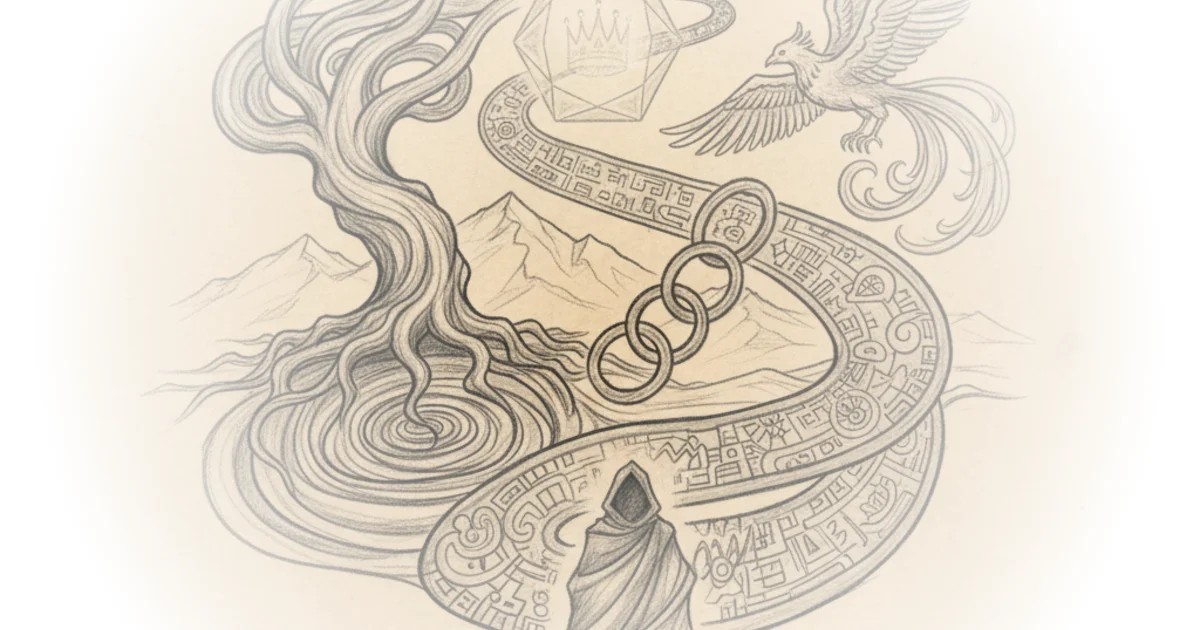
The author also credits Peter Jackson's cinematic vision for preserving this mythological essence. Van der Linden writes, "I want us to to imagine that we've been lucky enough to be able to go on location and shoot our movie where the real events happened." This approach treated the fantasy not as whimsy, but as "actual history," a choice that grounded the spiritual themes in a tangible reality. By using the specific qualities of cinema to expand on the text, the adaptation helped modern audiences access the "deeper meanings that are not bound by any time or place."
Reclaiming Pagan Virtues
The commentary then pivots to the character arcs of King Théoden and Éowyn in Rohan, illustrating how Tolkien appropriates and sanctifies pagan virtues. Van der Linden observes that the people of Rohan initially embody a "bleakness that was at the heart of many Pagan mythologies, a vision of a doomed World soon to be destroyed." Théoden's journey is one of overcoming the fear of death, while Éowyn's struggle is against the fear of shame. The author points out the irony in their positions: "while her uncle is so afraid of death that he has become shameful she is so afraid of shame that she seeks death."
This analysis is particularly sharp in how it reframes Éowyn's famous battle. Van der Linden argues that her victory is not in the killing of the Witch-king, but in her subsequent realization that honor exists outside of war. After her victory, she declares, "I will be a shield Maiden no longer nor VI with the great Riders nor take joy only in the songs of slaying I will be a Healer and love all things that grow and are not Barren." This transition from a desire for martial glory to a life of compassion is presented as the ultimate "moral victory." Critics might note that this interpretation risks romanticizing the retreat from conflict, yet van der Linden's evidence suggests that Tolkien viewed the refusal to use power for domination as the highest form of courage. The story posits that "the best qualities of the Pagan World shouldn't be merely adopted they should be appropriated and recontextualized into Christianity."
The Ethics of Defeat
Perhaps the most compelling section of the commentary addresses the central ethical dilemma: what values are we willing to suffer defeat for? Van der Linden contrasts the steward Denethor, who is willing to use evil means to secure a physical victory, with his son Faramir, who draws a line in the sand. "I would not use the ring not administeredith were falling in ruin an eye alone could save her," Faramir states, defining a point where defeat is preferable to corruption. This argument reframes the entire war not as a struggle for territory, but as a test of moral integrity.
The author extends this logic to Galadriel, who faces certain defeat regardless of her choice. Van der Linden writes, "she is perhaps more than any other character tempted to take it yet still she resists and makes the ultimate sacrifice to achieve a moral victory." The core of the argument is that the One Ring represents the antithesis of morality because it removes the capacity for choice. "The purpose of the ring is to dominate other Minds to enslave them and to place its own will upon them thereby taking away the freedom of others to make their own choices." Without freedom, there can be no heroism, only obedience. This distinction is vital: "ultimate power is singular it does not desire friends or Allies it does not work towards a greater good it's an end in itself."
The very Freedom that makes heroism and moral victories possible is exactly what the ring takes away.
Van der Linden further explains that the Ring's power relies on secrecy and isolation, cutting the user off from community. As the author notes, "there's no room for two eyes no room for another in the one ring." This insight into the isolating nature of absolute power offers a timeless critique of authoritarianism, suggesting that any system demanding total submission inevitably destroys the very humanity it claims to protect. The argument holds up well against historical examples of totalitarian regimes where the demand for unity resulted in the erasure of individual conscience.
Bottom Line
Tom van der Linden's analysis succeeds by shifting the focus from the epic battles of Middle-earth to the quiet, internal victories of its characters, proving that the story's true power lies in its defense of free will against the seduction of absolute power. The piece's strongest asset is its ability to connect ancient mythological fears with modern ethical dilemmas, showing that the choice to reject power is the only path to true honor. However, the argument's reliance on a specific theological framework may limit its resonance for secular readers who do not share the author's view of "sanctification," even if the moral core remains universally applicable.