Heather Cox Richardson delivers a searing indictment of an administration that appears to be weaponizing a national tragedy to accelerate a personal vanity project while the nation's security apparatus crumbles. The piece's most startling claim is not the violence itself, but the administration's immediate pivot to use a botched assassination attempt as a legal cudgel to force through a $400 million White House ballroom, ignoring centuries of legal precedent and historical preservation laws.
The Ballroom as a Political Shield
Richardson argues that the administration is exploiting the chaos of the White House Correspondents' Dinner incident to bypass the rule of law. When Secret Service agents apprehended an intruder with a shotgun and knives, the response was not a sober review of security protocols, but a frantic political maneuver. "Yesterday the administration tried to blame Democrats and the media for the incident at the White House Correspondents' Dinner on Saturday night," Richardson writes, noting how Press Secretary Karoline Leavitt immediately framed the event as a symptom of a "left-wing cult of hatred." This framing is a classic deflection, shifting focus from institutional failures to political enemies.
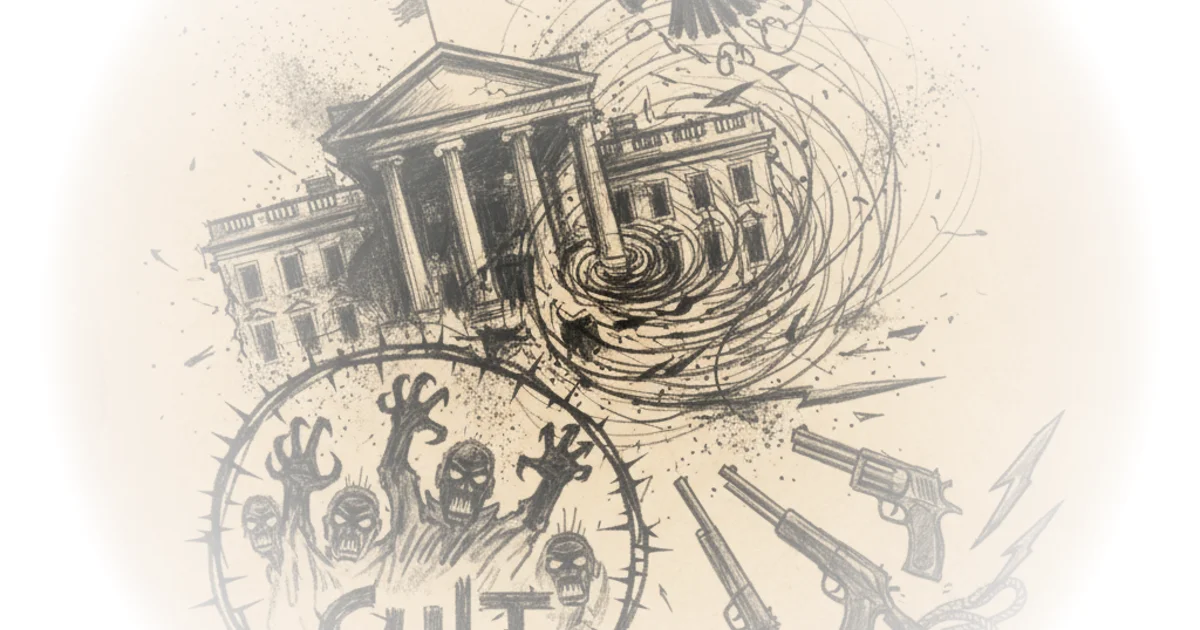
The administration's strategy quickly moved from rhetoric to legal aggression. Richardson highlights the Department of Justice's demand that the National Trust for Historic Preservation drop its lawsuit against the ballroom construction, claiming the lawsuit "puts the lives of the President, his family, and his staff at grave risk." This is a stark overreach. The National Trust rightly rejected the demand, pointing out that while the event was "awful," it did not change the fact that the executive branch must follow the law and get congressional approval for such a massive addition. Richardson points out the absurdity of the Acting Attorney General's motion, which spent seven pages arguing that the National Trust's name is "FAKE" because it sounds like a government agency. "Chris Geidner of LawDork called the motion 'deranged,'" Richardson notes, underscoring how the legal system is being treated as a playground for personal grievances rather than a pillar of democracy.
This drive for the ballroom mirrors the administration's earlier insistence on false narratives, such as the crowd size at the first inauguration. Richardson observes, "Forcing supporters to accept a lie as reality is a key tool of authoritarians, making it harder for them to reject the next lie, and so on." The ballroom is not just a building; it is a test of loyalty and a mechanism to normalize the rewriting of reality. Critics might argue that security concerns are legitimate and that the White House needs modernization, but the administration's refusal to seek congressional approval and its use of a crisis to bypass judicial injunctions suggest the motive is political dominance, not public safety.
Forcing supporters to accept a lie as reality is a key tool of authoritarians, making it harder for them to reject the next lie, and so on.
A Stalemate in the Gulf and a Hollowed-Out Military
While the administration fights for a ballroom, Richardson exposes a far more dangerous reality: a disastrous war in Iran that has settled into a "humiliating stalemate." The human cost is being obscured by official spin. Reports indicate that damage to American military bases, radar systems, and infrastructure in the Gulf region is far worse than admitted, with repair costs potentially reaching $5 billion. "One of the injured soldiers told CBS News that Defense Secretary Pete Hegseth's statement that a drone 'squeaked through' was false," Richardson writes. The soldier's testimony—that the unit was "unprepared to provide any defense for itself" and that the position was "not a fortified position"—shatters the administration's narrative of competence.
The economic fallout is equally severe. Gas prices have surged to $4.18 a gallon, the highest in four years. Richardson cites economist Paul Krugman, who illustrated the situation with a picture of an egg in a vise, warning that once stored oil runs out, prices will spike enough to destroy demand. The administration's foreign policy is not just failing; it is actively harming the American economy. Senator Lindsey Graham and other loyalists are pushing a bill to fund the ballroom, yet they seem unable to address the crumbling defense of U.S. troops abroad.
The erosion of military leadership is palpable. Richardson notes that Vice President J.D. Vance is distancing himself from the debacle, questioning whether Hegseth is providing accurate information. "Republican senators are losing confidence in Hegseth as he hollows out the ranks of senior military officers," she writes. This internal rot is exacerbated by the administration's focus on symbolism over substance. The Pentagon's request to rename the Department of Defense to the "Department of War"—a move costing taxpayers $52 million—accentuates a "warrior ethos" that ignores the defensive alliances the U.S. has relied on since World War II. This is not a strategy; it is a performance of aggression that leaves the nation vulnerable.
The Weaponization of the Justice System
Perhaps the most alarming trend Richardson identifies is the systematic dismantling of the Department of Justice's independence. The administration is using the legal system to punish perceived enemies, turning the rule of law into a tool of retribution. A federal grand jury in North Carolina indicted former FBI Director James Comey for a social media post of seashells arranged to spell "86 47," interpreting it as a threat against the President. Richardson points out the absurdity: "That is, Comey's posting a picture of seashells on a beach arranged in the pattern of 86 47... was a threat against Trump's life." This charge, alongside the firing of Comey's daughter Maurene, reveals a pattern of targeting individuals who have crossed the administration.
The judge in Maurene Comey's case called her an "exemplary Assistant United States Attorney," noting she received the "highest accolades" for her work on high-profile corruption cases. Yet, the administration tried to move her case to a Merit Systems Protection Board that has come under the sway of the Department of Justice itself. Richardson argues that Acting Attorney General Todd Blanche is "currying favor with Trump by going after Comey again," turning the DOJ into a personal enforcer. The FCC's review of ABC's licenses following a joke by Jimmy Kimmel further illustrates this trend. "Trump loyalist Brendan Carr... frequently attacks media organizations," Richardson writes, showing how regulatory bodies are being weaponized to silence dissent.
The administration's desperation is evident in its attempt to project power through symbols. The White House posted a photo of Trump and King Charles with the caption "TWO KINGS," a move Richardson describes as a desperate bid to demonstrate dominance. Meanwhile, the State Department is finalizing plans to put Trump's face on passports and national park passes. These are not policy decisions; they are acts of political theater designed to distract from the administration's failures in Iran, the economy, and the rule of law.
The Human Cost of Authoritarianism
Richardson's piece culminates in a powerful reflection on the human cost of this authoritarian drift. The indictment of James Comey and the firing of his daughter are not just political maneuvers; they are attacks on the integrity of the federal workforce. Maurene Comey's case, where a judge blocked the DOJ's attempt to move it to a biased board, highlights the resilience of the judiciary, but also the fragility of the system. "It's really important that all of us remember this is not who we are as a country," Comey said in a video, echoing Richardson's central theme. "This is not how the Department of Justice is supposed to be."
The administration's focus on the ballroom and the renaming of the Defense Department distracts from the real crises: the lives of soldiers in Kuwait who were left unprotected, the families of those killed in Iran, and the American families struggling with rising gas prices. Richardson writes, "The claim that Democrats are calling for violence, when in fact it has been Trump calling for executing those he believes are his enemies, follows that pattern exactly." This inversion of reality is the hallmark of the administration's strategy, one that prioritizes personal vendettas over national security and democratic norms.
This is not how the Department of Justice is supposed to be. And the good news is we get closer every day to restoring those values. Keep the faith.
Bottom Line
Richardson's analysis is a masterclass in connecting disparate events—the ballroom, the Iran war, the Comey indictment—into a cohesive narrative of authoritarian overreach. Her strongest argument is that the administration is using a crisis to bypass legal and institutional checks, transforming the presidency into a vehicle for personal aggrandizement. The piece's biggest vulnerability is its reliance on the assumption that the public will recognize the absurdity of these moves, yet history shows that authoritarianism often thrives on distraction and division. Readers should watch for the outcome of the ballroom lawsuit and the congressional response to the Iran war, as these will be the true tests of whether the rule of law can withstand the administration's pressure.