Henry Oliver delivers a sharp, unexpected twist on 18th-century literary criticism: the greatest poet of his age was not a philosopher, but a satirist who excelled at tearing down pretension rather than building up grand systems. While most readers recall Alexander Pope for his famous aphorisms about the nature of existence, Oliver argues that these very lines reveal a philosophical bankruptcy that only Pope's biting wit could expose.
The Failure of Theodicy
Oliver begins by dismantling the reputation of An Essay on Man (1733), a work often cited as a masterpiece of Enlightenment optimism. He notes that while the poem attempts to "vindicate the ways of God to man," echoing Milton, it ultimately collapses under the weight of its own ambition. Oliver writes, "Never were penury of knowledge and vulgarity of sentiment so happily disguised," quoting Dr. Johnson to highlight the poem's intellectual hollowness. The core of Oliver's argument is that Pope's attempt to reconcile Christian theology with rationalism results in a text that pleases the ear but fails the mind.
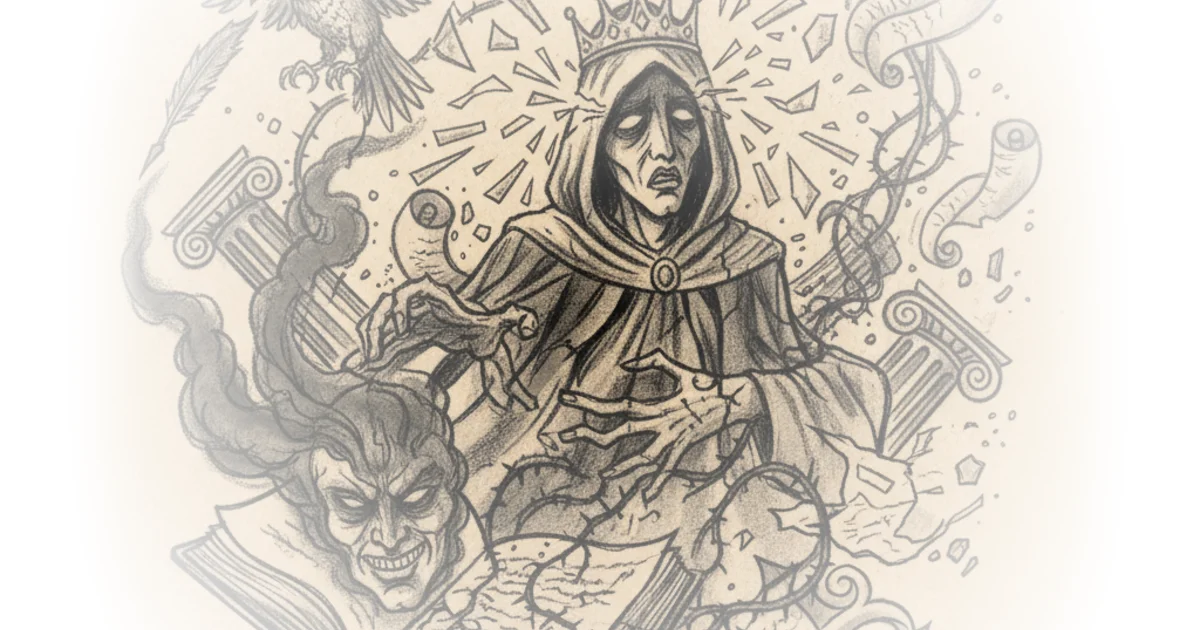
The author points out that the poem's most famous lines, such as "All partial evil, universal good," are essentially a defense of the Leibnizian idea that this is the "best possible of all worlds." Oliver observes that this thesis feels absurd to the modern reader, especially when confronted with real-world suffering. As he puts it, "Artful construction cannot make more convincing any attempt to solve the paradox of a God who is characterised as both omnipotent and omnibenevolent while presiding over a world full of evil." This framing is effective because it shifts the focus from Pope's poetic skill to the dangerous comfort of his philosophy.
"An Essay on Man is still (unconsciously) quoted in a way the others are not... [but] buckles under its own philosophical ambition."
Critics might argue that Oliver is being too harsh on a poem that was intended as a popularization of complex metaphysics for a general audience. However, the piece suggests that the poem's enduring popularity is a testament to its rhythm, not its truth. Oliver draws a parallel to the concept of the sublime discussed in companion deep dives on On the Sublime, noting that true sublimity involves a terrifying height that Pope's Essay attempts to reach but ultimately falls short of, landing instead in a safe, manageable mediocrity.
The Power of Contempt
Having established the failure of Pope's serious philosophy, Oliver pivots to his true strength: satire. He argues that Pope's An Essay on Criticism and his Scriblerian works are far superior because they do not try to solve unanswerable problems. Instead, they attack the pretensions of bad poets and shallow critics. Oliver writes, "In An Essay on Criticism, Pope's task is easier and the result more satisfying." The author highlights how Pope targets rivals like John Dennis, who claimed to understand the sublime but lacked the poetic ability to create it.
Oliver explains that Pope's satire Peri Bathous is essentially an inversion of the classical treatise Peri Hypsos (On the Sublime). While the sublime seeks to elevate the soul, Peri Bathous instructs readers on how to sink into the ridiculous. Oliver notes, "Pope coined the term 'bathos' to mean the disappointing and ridiculous effect of failed attempts at sublime art." This distinction is crucial; it suggests that Pope understood the limits of human understanding better than he did in his serious works. By mocking the "muddy Scriblerian masses" and their love for bad poetry, Pope exposes the fragility of artistic reputation.
The commentary also touches on Pope's imitation of Horace, where he critiques the blind deference to old poetry. Oliver writes, "While if our elders break all reason's laws, These fools demand not pardon, but applause." This line resonates deeply in any era where tradition is valued over merit. Oliver suggests that Pope's "contempt" was not just a personality flaw, but a necessary tool for clearing the air of bad art.
"The sublime is Icarus' sun; approaching it would scorch anyone's wings. But Pope, in tearing others down, employed such an exquisite poetic diction... there's no need to worry."
A counterargument worth considering is that Pope's vitriol might have blinded him to his own flaws, a point Oliver acknowledges by noting that Pope was "from his birth of a constitution tender and delicate" but possessed a "mildness of mind" that ended with childhood. Yet, Oliver maintains that this bitterness was the engine of his greatest work. The author concludes that while Pope's philosophical ambitions were flawed, his critical eye was unmatched.
Bottom Line
Oliver's piece succeeds in reframing Alexander Pope not as a failed philosopher, but as a master critic who understood that it is easier to deconstruct bad ideas than to construct good ones. The argument's greatest strength is its willingness to dismiss the most famous lines of An Essay on Man in favor of the sharper, more honest satire of his other works. The biggest vulnerability is a slight over-reliance on the idea that satire is inherently superior to philosophy, a stance that ignores the value of Pope's attempt to grapple with the problem of evil. Readers should watch for how this critique of "blind deference" applies to modern cultural criticism, where the fear of offending often stifles the very contempt necessary for genuine art.