Cory Doctorow delivers a piercing diagnosis for our current cultural moment: we are drowning in content that looks like art but lacks the one thing that makes art matter—an actual human intent behind it. He argues that as artificial intelligence floods our feeds with statistically probable words and pixels, we are losing the ability to distinguish between genuine communication and "eerie" simulations of feeling.
The Dilution of Intent
Doctorow anchors his analysis in a talk by musician and artist Brian Eno, refining the definition of art not as beauty, but as something specifically designed to provoke an emotional response from another person. He writes, "Art is everything you don't have to do," distinguishing the functional necessity of survival from the voluntary act of creation. This distinction becomes critical when we encounter outputs that mimic human expression without a human mind behind them.
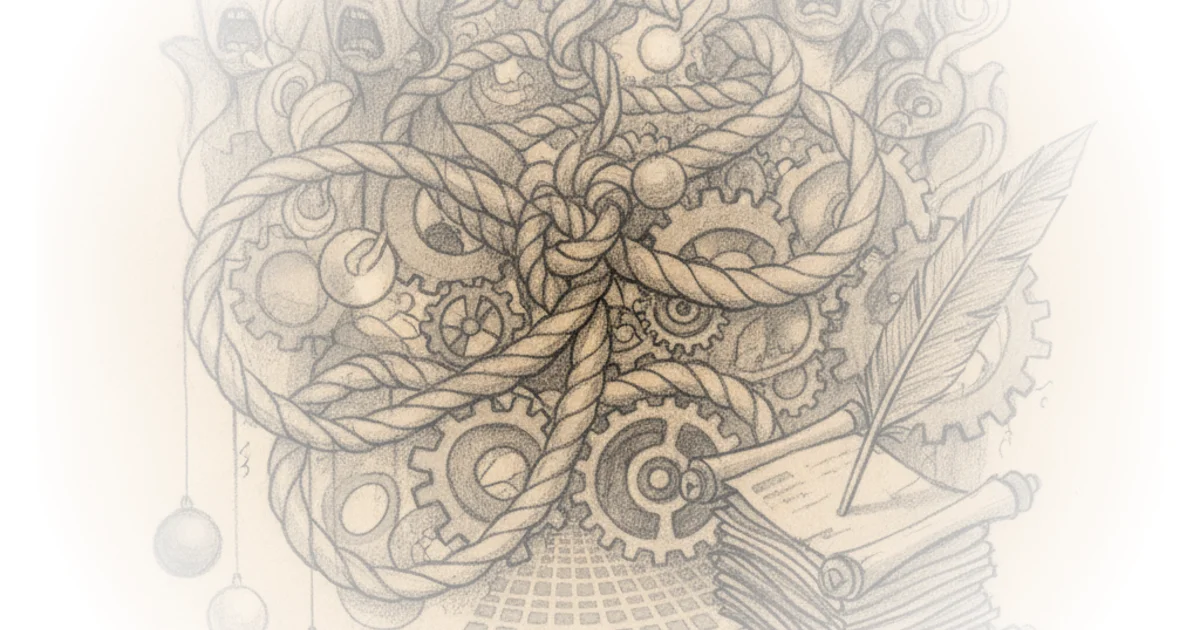
The core of Doctorow's argument rests on the concept of dilution. When an artist creates, every micro-decision is infused with subconscious purpose. In contrast, he notes, "when you prompt an AI to generate words or pixels... it isn't adding any of its intention to the finished work, it's diluting the intention you fed to it." He calculates that three sentences of user intent divided by a million generated pixels results in an image where the average intentionality is so low it becomes "practically homeopathic."
This framing is powerful because it moves beyond the tired debate of whether AI can be creative, focusing instead on the experience of the audience. We are prone to imputing intent to coherent strings of text or polished images, a psychological reflex Doctorow compares to our ancient tendency to see gods in sunsets. He observes that while we once asked, "What is God trying to say with this sunset?", we now know it is just physics. Similarly, he suggests, the rise of AI forces us to confront that many digital creations have no "intender" at all.
When you tell someone about what's going on in another person's mind... it doesn't fire up the theory-of-mind machine in the way that asking someone to infer the state of someone else's mind from implicit cues does.
Doctorow illustrates this with a sharp comparison of Disney theme park rides, using them as a metaphor for narrative fidelity versus emotional intensity. He contrasts Snow White's Enchanted Wish (1955), which bypasses plot to transmit pure feeling through atmosphere, against The Little Mermaid: Ariel's Undersea Adventure, which he dismissively calls a "book report ride." The latter faithfully retells the story but fails to evoke the emotional beats of the film.
This analogy holds up remarkably well for understanding why AI-generated stories often feel hollow despite being grammatically perfect. They are the ultimate "book report rides," prioritizing the explicit recounting of events over the implicit, dramatic evocation of emotion. As Doctorow puts it, "The problem is that while this has an increased likelihood of being high-fidelity way of transmitting a feeling, it also has an increased likelihood of being a low-intensity way of conveying that feeling."
Critics might argue that audiences do not always demand deep emotional resonance; sometimes they simply want information or distraction. However, Doctorow's point is specifically about the power of art to move us, suggesting that without the "theory of mind" connection between creator and viewer, the work remains a hollow shell.
The Eerie Silence of the Machine
The article takes a darker turn when discussing the psychological impact of this phenomenon. Doctorow cites Mark Fisher's description of works with a "seeming of an intent without an intender" as "eerie." He explains that while we can dispel eeriness by finding the source—like realizing a slamming door is just a draft—the prevention of this feeling in our media landscape is far harder.
He draws a historical parallel to E.L. Doctorow's (no relation) essay on the Babylonian creation story, noting how humans historically could not believe they had invented their own myths and concluded that God must have put them there. We are currently repeating this cycle with AI, hallucinating an artist where none exists. "We made up an imaginary artist who meant something by every choice in the work," Cory Doctorow writes, "and experienced an emotional affect that we ourselves had created out of (nearly) whole cloth."
This section connects deeply to the concept of the "stochastic parrot"—the idea that large language models are merely repeating patterns they have seen without understanding. Just as a parrot can mimic a phrase but doesn't know what it means, AI mimics the structure of art without the substance. The result is a cultural environment where we are surrounded by "impressive feats of software design" that ultimately "don't say anything to me."
'Excitement' is to art as 'falsifiability' is to science.
Doctorow concludes his main argument by returning to Brian Eno's framework, suggesting that while science advances through falsifiability, art advances through excitement. The rise of AI threatens to flood our world with content that passes every technical check for "good writing" or "beautiful image" but fails the only metric that matters: does it make us feel something?
Bottom Line
Doctorow's most compelling insight is that the danger of generative AI isn't just copyright theft or job displacement, but the erosion of the human connection that makes art valuable. His argument is strongest when he reframes "creativity" as a form of communication requiring two active minds; its biggest vulnerability lies in assuming all audiences seek this depth, though for those who do, the loss will be profound. As we navigate an era of algorithmic content, we must learn to spot the difference between a sunset and a simulation of one.