The prediction that artificial intelligence would finally outpace human intuition in forecasting the future didn't arrive with a scientific paper or a philosophical debate; it arrived with a profit margin. Scott Alexander's reporting from the recent annual prediction market conference captures a pivotal, almost silent shift: the moment when "bots-finally-beat-humans-at-predicting-the-future" stopped being a theoretical milestone and became a financial reality. This piece is essential listening because it moves beyond the hype of general AI capabilities to a specific, measurable domain where machines are already generating millions, challenging the very definition of human expertise in risk assessment.
The Scaffolding of Certainty
Alexander begins by dismantling the expectation that AI dominance would look like a dramatic "vibes" shift or a sudden breakthrough in academic journals. Instead, he observes, "All eyes were on the AI superforecasters." He details how these systems are not merely raw language models but are wrapped in a "scaffold"—a complex program that guides the AI through research, sub-agent creation, and iterative tool use. This structural addition is what allows them to outperform their base versions.
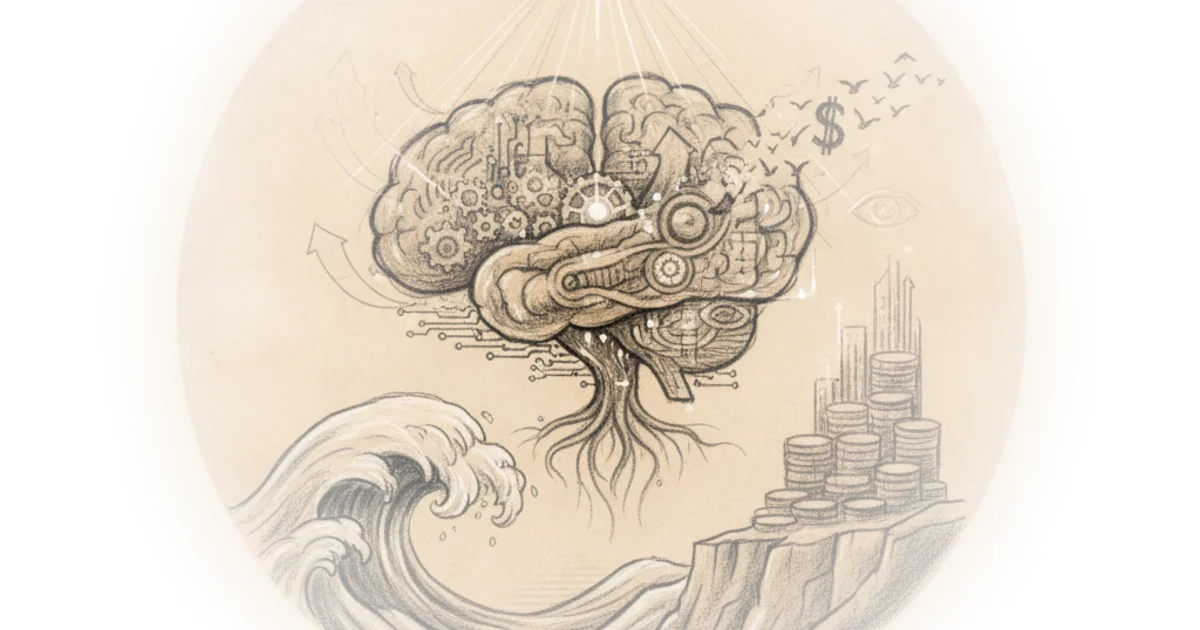
The author illustrates this with a concrete test case: forecasting whether a philanthropic initiative could halve respiratory infections by 2040. In just five minutes and for eight dollars, the AI deployed three sub-agents, analyzed sixteen websites, and cited two hundred twelve sources to arrive at a precise probability of 7%. Alexander notes that this speed and depth are transformative: "The forecast had taken five minutes and cost me $8 in credits." This efficiency is not just a convenience; it fundamentally alters the economics of high-level analysis. Where hiring human superforecasters requires weeks of negotiation and tens of thousands of dollars, AI makes this level of rigorous probabilistic thinking accessible as part of a standard news-reading process.
"AI forecasters are the same kind of advance as going from a world where writing required hiring a scribe and baking a clay tablet, to a world where writing only requires hitting the 'send tweet' button."
Critics might argue that speed does not equate to accuracy, and that the AI's confidence could be a hallucination of competence. However, Alexander counters this by showing convergence: when he asked another leading AI system (Preseen) the same question, it estimated 8.8%, while a top human forecaster guessed between 5% and 10%. The tight clustering of these independent assessments suggests the "scaffold" is working, not just guessing.
The John Henry Moment
The narrative arc of Alexander's piece draws a striking parallel to American folklore. He invokes the story of John Henry, the legendary steel-driver who challenged a steam drill to a race and won by a hair before dying from exhaustion, symbolizing the end of human supremacy in manual labor. In this context, top human forecasters like Ben Shindel and MarcosO are playing the role of John Henry.
In the recent "Metaculus Cup," a tournament pitting humans against AIs on fifty geopolitical and economic questions, humans took the top two spots, but an AI secured third place. Alexander writes, "Humans are still holding out, but for how long?" The data suggests we are in a statistical dead heat. While the graph of raw model performance shows AI lagging behind professional forecasters, Alexander points out that this comparison is flawed because it ignores the "scaffolding." He notes that well-scaffolded AIs today are already performing at a level equivalent to base models nine months in the future.
"If you extend the dotted green line on the graph... then add nine months for the extra scaffolding, it looks like the best AIs should be around 31, compared to top pro forecasters' 36."
This framing is crucial. It suggests that the gap isn't a canyon but a shrinking bridge. The Metaculus community itself forecasts a 95% chance that an AI will win the cup before 2030. Alexander's analysis here is particularly sharp because he acknowledges the role of luck in short-term competitions while emphasizing the long-term trend: "The margin of victory is less than the graph suggests, and we should expect human-AI parity in about six months."
The Financial Edge and Institutional Dynamics
One of the most provocative claims in the article concerns why these AI systems are generating massive returns on prediction markets like Kalshi while top hedge funds haven't fully pivoted to them yet. Alexander argues that the advantage lies not just in accuracy, but in scale and diligence. "AIs are faster and more diligent than humans," he writes, explaining that a human might take hours to find an inefficiency and execute a trade, whereas an AI can automate this across hundreds of markets weekly.
This leads to a fascinating observation about the nature of these markets: "There's only so much easy money on Kalshi, and his AI had already taken it all." The author suggests that while humans might still hold a slight edge in complex, non-finance domains, machines are already superior in well-contained, data-heavy financial environments. He points to the Market Pulse competition, where an AI bot beat all human competitors, including top-tier forecasters.
"If this is true, then why aren't all the top trading firms rushing to switch to AI? I don't know the details, but Jane Street is building their own data center, I wonder what they need all that compute for?"
This rhetorical question serves as a subtle critique of institutional inertia. While the executive branch and major financial institutions may be slow to adopt these tools due to regulatory caution or legacy systems, the private sector startups are already moving at breakneck speed. The implication is that the "scaffolding" technology is becoming a proprietary advantage that will soon be impossible for traditional human-led teams to match.
"The really crazy stories - like people threatening journalists into covering up information which would make them lose - are thankfully pretty rare; the real issue is that prediction markets are definitely trying to screw you over."
Alexander also touches on the psychological shift in how we trust these forecasts. He argues that society is more willing to accept a precise, potentially "fake-sounding" probability from an AI than from a human, partly because of science fiction tropes and partly because machines lack the political biases humans are accused of having. This standardization means that "the Preseen AI" can eventually carry the same weight as a figure like Nate Silver, but with infinite scalability.
Bottom Line
Alexander's most compelling argument is that we have crossed a threshold where AI superforecasting is no longer a novelty but a scalable economic force, effectively democratizing high-level probabilistic reasoning. The piece's greatest strength is its refusal to treat this as a distant future event, grounding the analysis in current profit margins and tournament results rather than speculation. However, the argument remains vulnerable to the "black box" problem: if we cannot fully audit the AI's reasoning chain, its financial dominance could mask systemic risks or feedback loops that human oversight previously caught. The reader should watch for how regulatory bodies respond as these automated systems begin to dominate not just prediction markets, but the actual allocation of capital and policy strategy.