Jonathan Rowson challenges the growing narrative that modernity is collapsing, arguing instead that declaring its death is often an exaggeration that obscures the messy, enduring reality of our current epoch. While many intellectuals are rushing to mourn the end of the modern world, Rowson suggests we are merely in a prolonged, uncomfortable transition where old structures persist alongside new crises. This distinction matters because it shifts the focus from a fatalistic surrender to a more nuanced engagement with how we live, work, and relate to the planet right now.
The Allure of the End
Rowson begins by acknowledging the seductive power of the "end of modernity" story, citing thinkers like Dougald Hine and Bayo Akomolafe who frame the current moment as a "generative capitulation." He notes that these voices, while brilliant, often lean into a "fairly strong anti-modern sentiment" that risks throwing the baby out with the bathwater. The author argues that this perspective can feel like a reflexive rejection of everything contemporary, ignoring the genuine dignity and joy found in normal life. "Sometimes we figure out who we are by noticing how we are different from the people we admire," Rowson writes, suggesting that the anti-modern stance is partly a performative identity marker rather than a purely analytical conclusion.
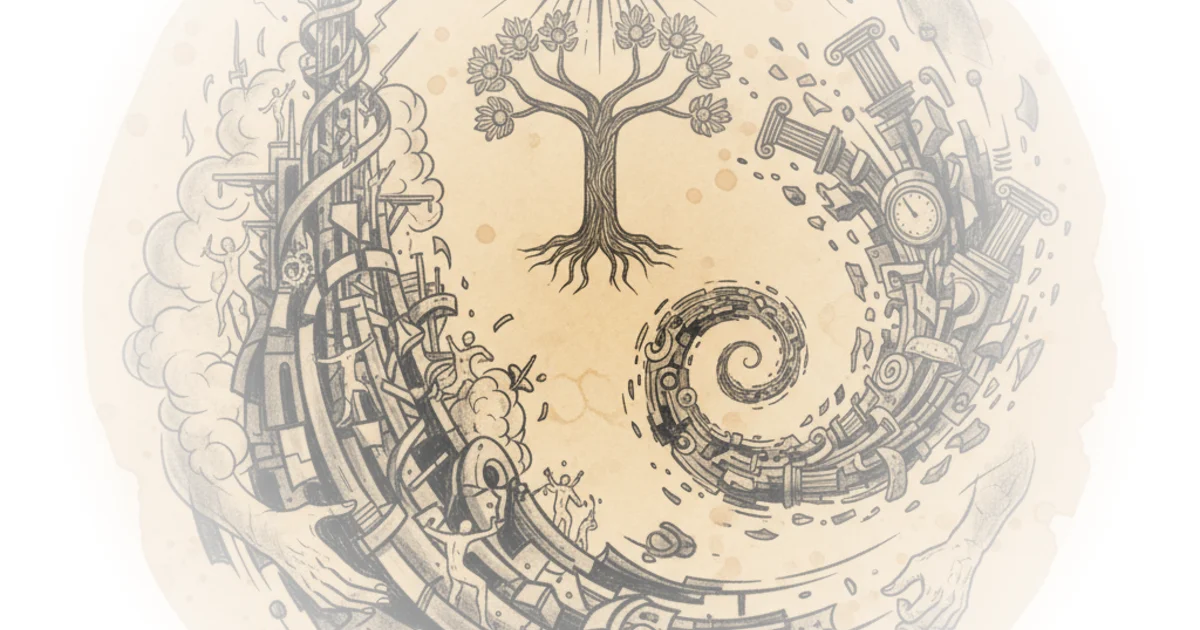
This framing is effective because it exposes the emotional undercurrents of the debate. However, critics might note that for those suffering under the weight of colonial legacies or ecological collapse, the "joy of normal life" is a luxury not everyone can afford. Rowson acknowledges this tension, admitting that for a child starving in Gaza or a family in Ukraine, modernity looks like a failure. Yet, he insists that the target of our critique should be more specific than the broad brush of "modernity" itself. "I am not sure there is a name for this outlook yet, but I think of it as a kind of generative capitulation," he observes, highlighting how the language of ending can become a self-fulfilling prophecy that paralyzes action.
The end of modernity may not manifest primarily as economic or ecological collapse, but as a global mental health crisis where the structures of modernity within us start to crumble.
The Architecture of the Modern
To understand why modernity is so hard to kill, Rowson turns to the French philosopher Bruno Latour. He explains that modernity is not just about science or technology, but a complex system of "threefold transcendence and a threefold immanence" that locks in power. Rowson paraphrases Latour's dense argument to show how modern society creates a "prison or hall of mirrors" where nature and society are artificially separated, yet constantly recombined to maintain control. "They have not made Nature; they make Society; they make Nature; they have not made Society," Rowson quotes, illustrating the contradictory logic that keeps the system stable.
This analysis is crucial because it moves the debate from surface-level complaints about technology to the deep structural logic of our civilization. Rowson argues that we are often constrained by our "idea of what is possible, as much as by what is possible," suggesting that the map of modernity is often more rigid than the territory it describes. He warns against the trap of believing the story has simply exhausted itself, noting that "modernity is a zombie epoch that will live on long after it has died." This metaphor is powerful, capturing the stubborn persistence of institutions and mindsets that no longer serve us but refuse to vanish.
Critics might argue that Rowson underestimates the speed of systemic collapse, pointing to the accelerating pace of climate change and geopolitical instability. While Rowson admits that "some significant degree of ecological collapse seems inevitable," he maintains that the transition will likely be uneven and drawn out over decades or centuries, rather than a sudden snap. He suggests that the real challenge is not predicting the end, but navigating the "betweening process" without losing our humanity.
Flirting with the Future
Ultimately, Rowson refuses to fully embrace the narrative of total collapse. He acknowledges the validity of those who see modernity as "co-extensive with structural violence through capitalism, nationalism, racism, colonialism, patriarchy," yet he resists the urge to wish it all away. "I don't feel I am 'without a world'. I still live and enjoy a modern life, and I am not sure the idea that modernity is ending is entirely intelligible," he admits. Instead of retreating into neo-romanticism or fatalism, he proposes a stance of "flirting with modernity"—engaging with its potential while actively working to free ourselves from its worst constraints.
This approach offers a pragmatic middle ground for those who feel torn between the promise of progress and the reality of its failures. Rowson suggests that the path forward involves "unlearning modernity" while recognizing that it will remain with us in "patches or sedimented form" for a long time. He concludes by invoking the lyrics of Lady Gaga and Bradley Cooper to frame the central question of our time: "Tell me something, girl, are you happy in this modern world? Or do you need more? Is there something that you're searching for?" The question remains open, inviting readers to decide for themselves whether to mourn the end or to find a new way to inhabit the present.
We are not ancient Egyptians in airplanes; we are creatures of a future-oriented epoch that lives for the novelty of what comes next.
Bottom Line
Rowson's strongest contribution is his refusal to let the "end of modernity" narrative become a convenient excuse for inaction, forcing readers to confront the complex, hybrid reality we actually inhabit. The argument's vulnerability lies in its potential to feel too abstract for those facing immediate, life-threatening crises where the distinction between "modernity" and "structural violence" feels like splitting hairs. The most important takeaway is that the transition away from current systems will be a long, messy process of "betweenness," requiring us to navigate the ruins without abandoning the possibility of a better future.