The Age Factor
Alexander the Great was only twenty-one years old when he inherited the largest army of his era. This raises a provocative question: how much of Alexander's conquest was really his genius versus simply being in the right place at the right time?
Carlin compares Alexander to other historical figures who reached the top job relatively young. Stalin took Soviet leadership in his mid-forties. Hitler was forty-three. Napoleon became Emperor at roughly thirty. Franklin Roosevelt assumed the presidency at fifty. Churchill was in his mid-sixties when leading Britain through World War II.
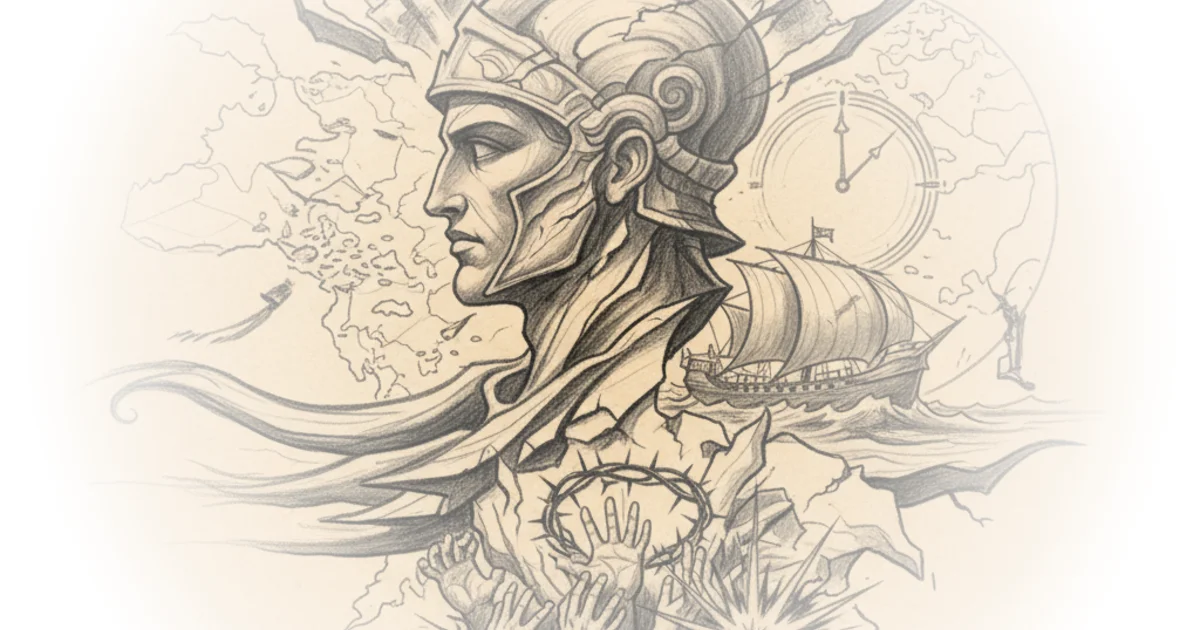
The contrast is stark. These leaders had decades of experience, stress, and hardship behind them before reaching supreme power. Alexander, by contrast, had virtually nothing on his resume besides inherited position and raw talent.
Critics might note that comparing twentieth-century dictators to ancient conquerors involves vastly different historical contexts. But Carlin uses this comparison to test a theory: if you put any competent leader in charge of Macedonia's army during this period, could they achieve similar results? The answer seems to be yes—at least up to a point.
The Staff Meeting
After Alexander's destructive campaign against Thebes—described as the functional equivalent of nuclear bombing—he returns home to Macedonia. This journey is poignant because it's the last time he will ever see his mother, Olympias, face to face. Their relationship was intense and complicated, and they would correspond throughout his remaining life but never meet again.
While in Macedonia, Alexander calls what amounts to a staff meeting to discuss the Persian expedition. He summons Parmenio, his father's legendary general who had been commanding an advance force in Persia since Philip's death. Parmenio was one of the greatest military minds in Macedonian history—Philip himself once sarcastically noted that in his entire life he'd only found one good general: Parmenio.
Also present is Antipater, another veteran commander in his mid-sixties. These men had helped Alexander secure power during the chaotic period after his father's assassination. Now they were advising a twenty-one-year-old with very little experience on how to continue his father's plans—plans they had been intimately involved with.
The Economic Reality
Carlin examines this period from a screenwriter's perspective, noting that audiences often want to skip these quieter moments between major battles. But the economic situation is crucial to understanding what happens next.
Alexander was at the point where he was borrowing money from friends. In a period before modern banking, maintaining an army required significant resources. The question becomes: how much of Alexander's story was actually about him versus the forces operating in that time period?
The generals advise Alexander to get married, establish an heir, and then launch the invasion of Persia. This advice reflects practical politics—securing succession through marriage alliances rather than eliminating rivals.
The Family Tree
While at home, Alexander also eliminates potential threats to his rule by murdering some of his father's former wife's relatives. This wasn't unusual; Philip had been skilled at pruning the family tree too. The goal was simple: don't leave people with enough royal blood for Macedonia's enemies to potentially install as a puppet king while the army was away fighting.
It's common sense in ancient politics—eliminate rivals before they become problems.
The Monster Question
Carlin introduces one of history's most haunting quotes: 'The old world is dying, the new world struggles to be born. Now is the time of monsters.' This phrase, allegedly written by Italian communist Antonio Gramsci during Mussolini's rule, has been debunked countless times. But it captures something true about eras when empires fall and new powers emerge.
One person's terrorist is another's freedom fighter. One people's monster is another nation's founding father. Alexander lived in such an era—the old world of Greek city-states was dying, a new Persian-centric world was struggling to be born, and it proved fertile ground for someone who could commit what might be called monstrous acts.
Carlin notes that many historical figures who did heavy things were younger than expected. World War II enlistees ranged from seventeen to twenty-one. Difficult times tend to level up human beings quickly.
The Verdict
Alexander's story raises a fundamental question: was he the driving force behind the conquests, or simply riding an army that could have won regardless of who led it? The Macedonian military machine at this point operated almost on autopilot—the officers and junior officer corps were exceptional. You could have put almost anyone in charge and likely still won.
What made Alexander different was his appetite—he never stopped pushing further, deeper into territories no one had controlled before. Had he lived longer, what kind of character would he have become? The speculation is fascinating.
The generals' advice to marry first, then attack, reflects the practical wisdom of experienced men advising a young ruler. Whether Alexander's conquests were truly unique or simply the product of an extraordinary army at the right time remains one of history's most compelling questions.", "counterpoints": "A counterargument worth considering: comparing ancient Macedonian politics to twentieth-century dictators like Stalin and Hitler involves fundamentally different historical contexts. The economic, social, and military dynamics of 335 BCE bear little resemblance to modern nation-states. Additionally, whether Alexander was truly a 'monster' or simply a product of his era depends heavily on one's definition of monstrous acts—and that definition itself is contested by historians.