A former federal judge, appointed by a Republican president and known for prosecuting corruption, has resigned in protest—not over a specific ruling, but because the very institution he served has been weaponized. This is not a standard political complaint; it is a structural indictment from within the Department of Justice, delivered by someone who spent decades upholding the rule of law. Robert Reich highlights this rare moment of institutional rupture, presenting a resignation statement that frames the current administration's actions not as political disagreement, but as a fundamental betrayal of the legal system's core purpose.
The Weight of a Lifetime Appointment
Reich opens by establishing the gravity of Judge Mark L. Wolf's decision. Wolf, a Reagan appointee who served under Attorney General Edward Levi, spent his career building a reputation for impartiality. Reich notes that Wolf's resignation is particularly striking because he is giving up a lifetime appointment to speak out. "I no longer can bear to be restrained by what judges can say publicly or do outside the courtroom," Wolf writes. This is a profound admission from a jurist who has spent decades in silence, bound by ethical codes. The move signals that the constraints of judicial neutrality have become a shield for the administration's misconduct rather than a guardrail for the judiciary.
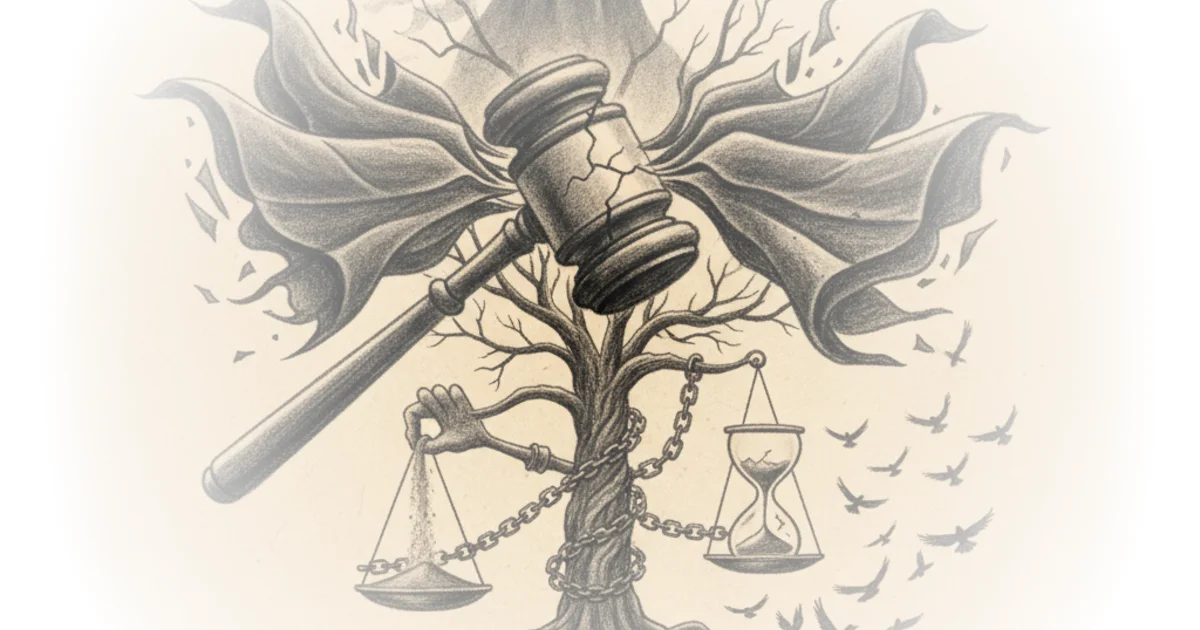
Reich draws a sharp parallel to the post-Watergate era, when Edward Levi was brought in to restore the Justice Department's integrity. Levi famously declared that "nothing can more weaken the quality of life or more imperil the realization of the goals we all hold dear than our failure to make clear by word and deed that our law is not an instrument of partisan purpose." Wolf served directly under Levi, making his current departure a direct repudiation of the very principles he was taught to uphold. The comparison is not merely rhetorical; it anchors the current crisis in a historical struggle for the soul of the department.
"What Nixon did episodically and covertly, knowing it was illegal or improper, Trump now does routinely and overtly."
This distinction is the core of Reich's framing. The argument suggests that the administration has moved beyond the shadowy abuses of the past into a new era of open, systemic corruption. Wolf's resignation is presented as the inevitable result of watching this transformation from the bench. Critics might argue that comparing current actions to Watergate is hyperbolic, but Reich counters by detailing specific, documented instances where the administration has dismantled oversight mechanisms. The evidence presented—firing inspectors general, eviscerating the public integrity section, and ignoring DOJ guidelines on indictments—suggests a deliberate strategy rather than isolated incidents.
The Erosion of Institutional Checks
Reich meticulously details how the administration has targeted the very offices designed to police corruption. The article notes that the Department of Justice's public-integrity section has been reduced from 30 lawyers to only five, and its authority to investigate election fraud has been revoked. Wolf observes that "prosecutorial decisions during this administration are a prime example" of this breakdown. The administration is accused of ignoring the principle that prosecutors should not seek indictments without sufficient evidence, instead targeting political adversaries while shielding allies.
The piece highlights specific cases that illustrate this pattern. The administration reportedly pressured the Attorney General to seek indictments against political opponents despite a lack of legal basis, while shutting down investigations into allies like Tom Homan, who was recorded accepting cash for future favors. "The FBI had created the fictitious company as part of an undercover investigation," Reich writes, noting that the investigation was abruptly halted after Homan became a government official. This selective enforcement is presented as a direct assault on the concept of equal justice.
The argument extends to the administration's treatment of the judiciary itself. Wolf points out that the Supreme Court has repeatedly removed restraints on executive orders via its "shadow docket," leaving lower courts powerless. Furthermore, the administration has responded to judicial pushback by calling for impeachments and fueling threats against judges. "There were nearly 200 [threats] from March to late May 2025 alone," Reich notes, including credible death threats and harassment campaigns. This creates a chilling environment where the judiciary is not just ignored but actively endangered.
"Silence, for me, is now intolerable."
This line from Wolf's statement serves as the emotional anchor of the piece. It transforms the resignation from a bureaucratic act into a moral imperative. Reich uses this to argue that the traditional mechanisms of institutional pushback are no longer sufficient. When the rule of law is systematically dismantled, the only remaining option for those sworn to protect it is to leave the bench and speak out. The argument is that the cost of silence has become higher than the cost of resignation.
A Global Warning
Reich concludes by placing Wolf's resignation in a global context. Wolf, who has spoken in many countries about the American judiciary, notes that the current situation mirrors the rise of "kleptocrats" in nations like Russia, China, and Turkey. These leaders control the police, prosecutors, and courts to jail opponents and suppress dissent. "They have impunity in their countries because they control the police, prosecutors, and courts," Wolf writes. The fear is that the United States is sliding toward this same model, where the law is no longer a constraint on power but a tool for it.
The piece suggests that the damage is already being felt by young lawyers and judges abroad who look to the American system as a beacon of democracy. If that beacon is extinguished, the consequences will be global. Reich frames this not just as a domestic political crisis, but as an existential threat to the international order. The resignation of a conservative, Reagan-appointed judge is the clearest signal yet that the breach in the dam has become too wide to ignore.
Bottom Line
The strongest part of this argument is the credibility of the source: a judge who has spent a lifetime prosecuting corruption and who resigned rather than be complicit in its normalization. The piece's vulnerability lies in its reliance on the administration's overt actions to prove a systemic collapse, which critics might argue is an overreach of a single judge's perspective. However, the sheer volume of specific, documented instances—from the dismantling of the public integrity section to the targeted harassment of judges—makes the case for a structural crisis difficult to dismiss. Readers should watch for whether other federal judges follow Wolf's lead, as a mass exodus would signal the final breakdown of the judiciary's independence.