Yascha Mounk argues that the crisis of liberal democracy is not a political failure, but an educational one: we have forgotten how to teach citizenship. In a landscape where higher education has devolved into a factory for job skills or a battleground for cultural wars, Mounk offers a startlingly traditional prescription: a mandatory, rigorous curriculum centered on the Western canon and the art of enduring life's fundamental tensions. This is not a nostalgic plea for the past, but a strategic intervention for the future of self-government.
The Activist vs. The Citizen
Mounk begins by diagnosing a fatal confusion in modern campus culture. He contends that universities have replaced the goal of creating citizens with the goal of creating activists. The distinction is not semantic; it is structural. "An activist is a soldier in a social or cultural war," Mounk writes, whereas "a citizen is a member of a political community, a group of individuals who recognize that they have responsibilities to one another." This framing is sharp and necessary. It forces the reader to confront the reality that the language of "social justice" often functions as a code for division, pitting "good guys" against "bad guys" rather than fostering the toleration required for a pluralistic society.
The author suggests that this shift has eroded the very foundation of the republic. He notes that citizenship demands we acknowledge that "even those you hate the most possess an equal share with you in the political collective." This is a difficult pill for a generation raised on binary moral narratives to swallow. Critics might argue that Mounk underestimates how systemic injustice can make the demand for "toleration" feel like a demand for complicity, but his point stands: a democracy cannot function if its participants view their opponents as enemies to be eliminated rather than fellow citizens to be engaged.
Activists say, go away; citizens say, we're all in this together, dammit.
The Grammar of a Free Society
Moving from the problem to the solution, Mounk proposes a radical restructuring of the undergraduate experience. He argues that the "what" of education must be a return to "general education"—a shared body of knowledge that every student, regardless of major, must master. He points to the 1945 Harvard report, General Education in a Free Society (the Redbook), as a historical anchor, noting that this was a pedagogical program designed for an era of mass political participation. The connection to that mid-century moment is vital; it reminds us that the modern research university was not always the default, and that a different model once existed to serve the needs of a free society.
Mounk is unapologetically specific about the content. He calls for full years of American literature, American history, Western literature, and Western philosophy, alongside global history. He challenges the assumption that students cannot handle this workload. "If we can demand that students study chemistry and physics... we can insist that they read," he asserts. This is a direct rebuke to the softening of standards that has plagued higher education for decades. The argument here is that a student cannot effectively evaluate the "nonsense" in their news feed without the "basic grammar" of their own culture and history.
He also makes a crucial intervention in the culture war, urging liberals to reclaim the humanities from both the populist right and the progressive left. He writes that liberals need to reclaim the great books "from the know-nothing populists who think that 'Western civilization' means 'I'm better than you' and the tenured avengers who use 'dead white male' as a term of abuse." This is perhaps the most politically astute part of the piece. It refuses to let the narrative of the canon be hijacked by either side, insisting instead on its utility for civic cohesion.
Stories as a Form of Knowledge
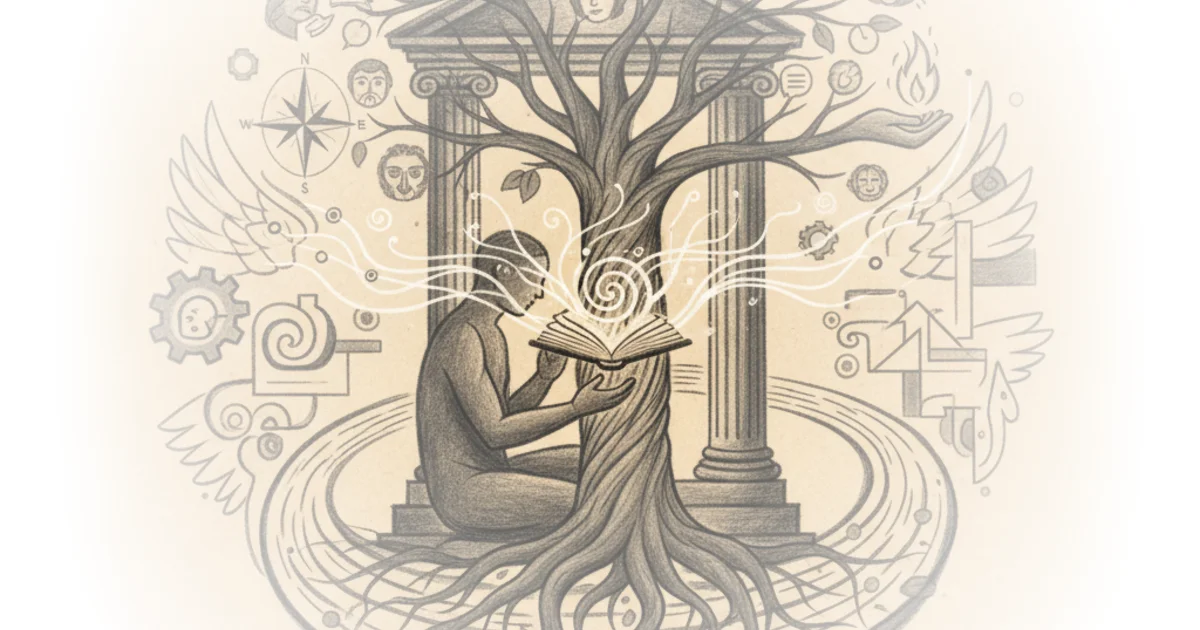
The most distinctive part of Mounk's argument is his defense of literature not as a source of moral lessons, but as a training ground for ambiguity. He argues that while political philosophy offers abstract principles, literature offers "vivid ways of posing questions." He draws on the insight that great stories, from the Old Testament to Shakespeare, do not offer extractable morals. Instead, they present "tensions" that cannot be solved, only endured. "The point of studying Antigone is not to decide whether Antigone is right or Creon is right," Mounk explains. "It is to see that they both are."
This is a profound shift in how we view the purpose of education. In a world obsessed with "problems and solutions," Mounk argues that the most important human experiences are "tragedies, in Hegel's sense of tragedy: a conflict between two rights, two values." By engaging with these conflicts through literature, students learn to navigate a world where there are no easy answers. This directly counters the "bad stories" of the modern media ecosystem—conspiracy theories, partisan narratives, and propaganda—that offer simplistic binaries and false certainties.
The world isn't heroes and villains, good guys and bad guys. It is people, who are always flawed and always have their claims.
Critics might note that Mounk's curriculum is incredibly demanding, potentially excluding students who lack the preparatory background or those who need college primarily for vocational mobility. However, his rebuttal is implicit: if the goal is the survival of liberal democracy, the cost of a narrower, more utilitarian education is far too high. He suggests that if engineering departments cannot mandate 20 courses in their majors, "good. They need to play better with others."
Bottom Line
Yascha Mounk's strongest contribution is reframing the crisis of democracy as a crisis of imagination, solvable only by restoring the shared cultural vocabulary that makes citizenship possible. The argument's vulnerability lies in its sheer ambition; implementing a 16-semester core curriculum in a system driven by market forces and student debt is a monumental political and logistical hurdle. Yet, as the executive branch and institutions struggle to maintain social cohesion, Mounk's call to stop treating students as consumers and start treating them as citizens remains the most compelling path forward.