N.S. Lyons argues that the recent electoral shift is not a victory to be celebrated, but a precarious opening for a total war against the American administrative state. This piece stands out for its explicit rejection of traditional conservatism, framing the current moment not as a return to stability, but as the only chance to dismantle what the author calls the "managerial oligarchy" before it becomes irreversible.
The Illusion of Victory
Lyons opens with a stark warning against complacency, asserting that despite a sweeping electoral win, the entrenched power of the bureaucracy remains untouched. "Not a single institutional power center of the left-managerial regime has yet been besieged, let alone taken and sacked," Lyons writes. The author contends that the opposition has spent decades embedding itself in the education system, the legal framework, and the security services, creating a self-reinforcing system that will fight back with an "immune response" if challenged. This framing is effective in its urgency, but it relies on a binary worldview where any institutional check on power is viewed as an existential threat rather than a democratic safeguard.
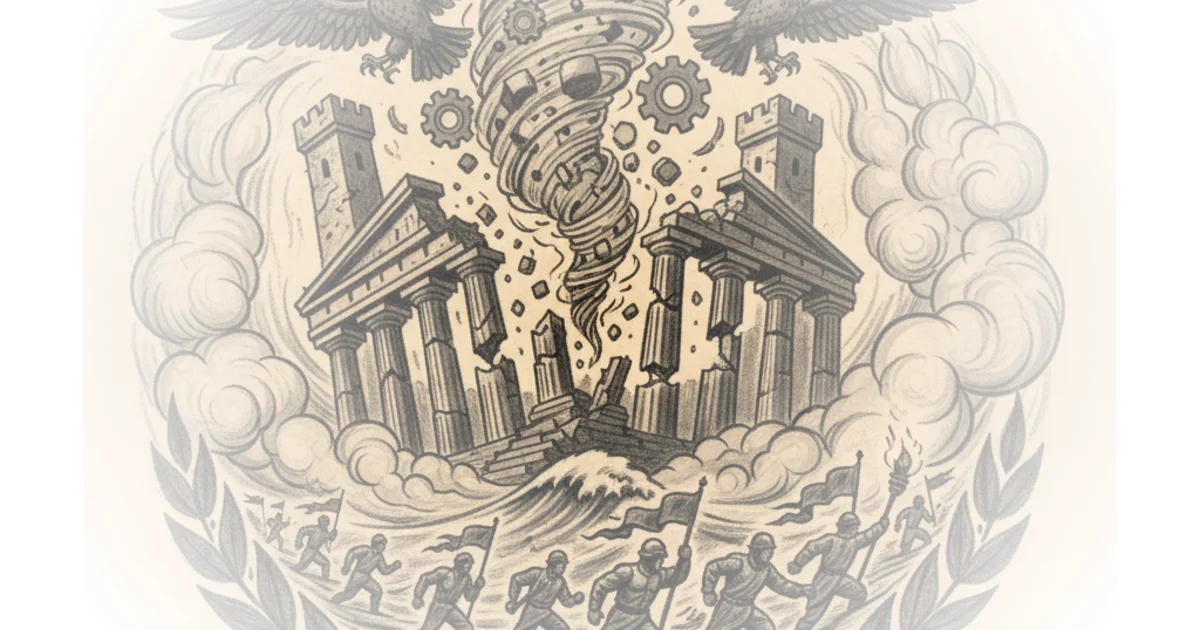
The core of Lyons's argument is that the previous conservative approach of merely "conserving" existing institutions is a fatal weakness. Instead, the movement must be "actively and unapologetically counter-revolutionary." Lyons insists that containment is insufficient; the goal must be to "roll back left-managerialism so decisively that all its latest gains and more are erased." This rhetoric of total erasure is striking, yet it overlooks the potential for institutional paralysis if the very mechanisms of governance are dismantled without a clear replacement plan.
"When a mortal enemy stumbles that is the time to close in to finish the threat permanently, not to back away or offer a hand to a foe that still clutches a dagger; mercy and reconciliation are lovely but only appropriate options after an unconditional surrender."
Lyons warns that the temptation to seek "unity" or "pragmatism" is a trap that will lead to the movement's demise. The author suggests that the stakes are so high that failure could result in "imprisonment and/or bankruptcy by lawfare" for the administration's figures. Critics might note that this language of mortal combat and existential threat risks justifying the suspension of normal democratic norms, treating political opponents as enemies to be destroyed rather than rivals to be defeated at the ballot box.
Striking the Joints
Moving from philosophy to strategy, Lyons argues that the counter-revolution must target the specific "joints and organs" of the bureaucratic state. The author draws a violent metaphor, distinguishing between strikes that merely "hurt" and those that "injure" or cripple the opponent. "The objective of employing violence becomes something very different: to end the threat from the attacker as quickly as possible," Lyons writes, applying this logic to political maneuvering. The proposed targets are specific and structural: the administrative state, public sector unions, universities, and the "non-profit-industrial complex."
The argument here is that symbolic gestures and "empty PR victories" are a waste of political capital. Instead, the focus must be on "destroying its ability to regain initiative and control." Lyons points to the detailed personnel plans of Project 2025 as a necessary step to prevent the "failure to drain even the smallest corner of the Swamp" seen in the past. This analysis of bureaucratic inertia is sharp, acknowledging that policy changes are easily reversed unless the personnel enforcing them are changed. However, the suggestion to "gouge eyes" and "shatter kneecaps" of the state, even as a metaphor, normalizes a level of aggression that could destabilize essential public services.
"If serious about fighting the managerial regime, the Trumpian counter-revolution must aim to land blows (metaphorically of course!) that truly injure this leviathan, not just hurt it a bit and piss it off even more."
The author identifies the flow of money as the regime's "lifeblood." Lyons highlights the strategy of Christopher Rufo to withhold funding from universities that do not align with specific ideological goals, arguing that this is the most effective way to "geld American universities." The logic is that bureaucracies exist to "parasitically consume" money and power, and cutting off the funding is the only way to stop the cycle. This financial approach is pragmatic, but it raises significant questions about the independence of higher education and the potential for political retaliation against institutions that disagree with the executive branch.
The Money Matters Most
Lyons concludes that the fight is ultimately about resources. The author describes bureaucracies as creatures that "mushroom up wherever there is an opportunity to absorb and siphon off... power and money." The argument is that rational debate over the merits of diversity or equity initiatives is futile; the only solution is to "derail the gravy train." By targeting the funding streams, the counter-revolution can force institutions to comply or collapse.
"Universities have developed massive domineering bureaucracies of administrators who impose woke ideology not because of the existence of woke ideas, but because a gigantic flood of federal student loan money... attracts money."
This perspective reduces complex cultural and educational debates to a simple matter of fiscal leverage. While it offers a clear path for action, it ignores the possibility that removing funding could harm students and staff who are not part of the "managerial" class Lyons targets. The strategy assumes that the "managerial regime" is a monolith that can be starved into submission, rather than a complex ecosystem with deep roots in civil society.
Bottom Line
Lyons provides a radical, high-stakes roadmap for dismantling the administrative state, arguing that only a total counter-revolution can prevent the permanent entrenchment of progressive ideology. The piece's greatest strength is its unflinching diagnosis of bureaucratic inertia, but its greatest vulnerability is its advocacy for a scorched-earth strategy that treats democratic institutions as enemy combatants rather than shared resources. The reader should watch to see if the administration adopts this aggressive posture or if the reality of governing forces a retreat from such extreme rhetoric.